 Marrakech Guidebook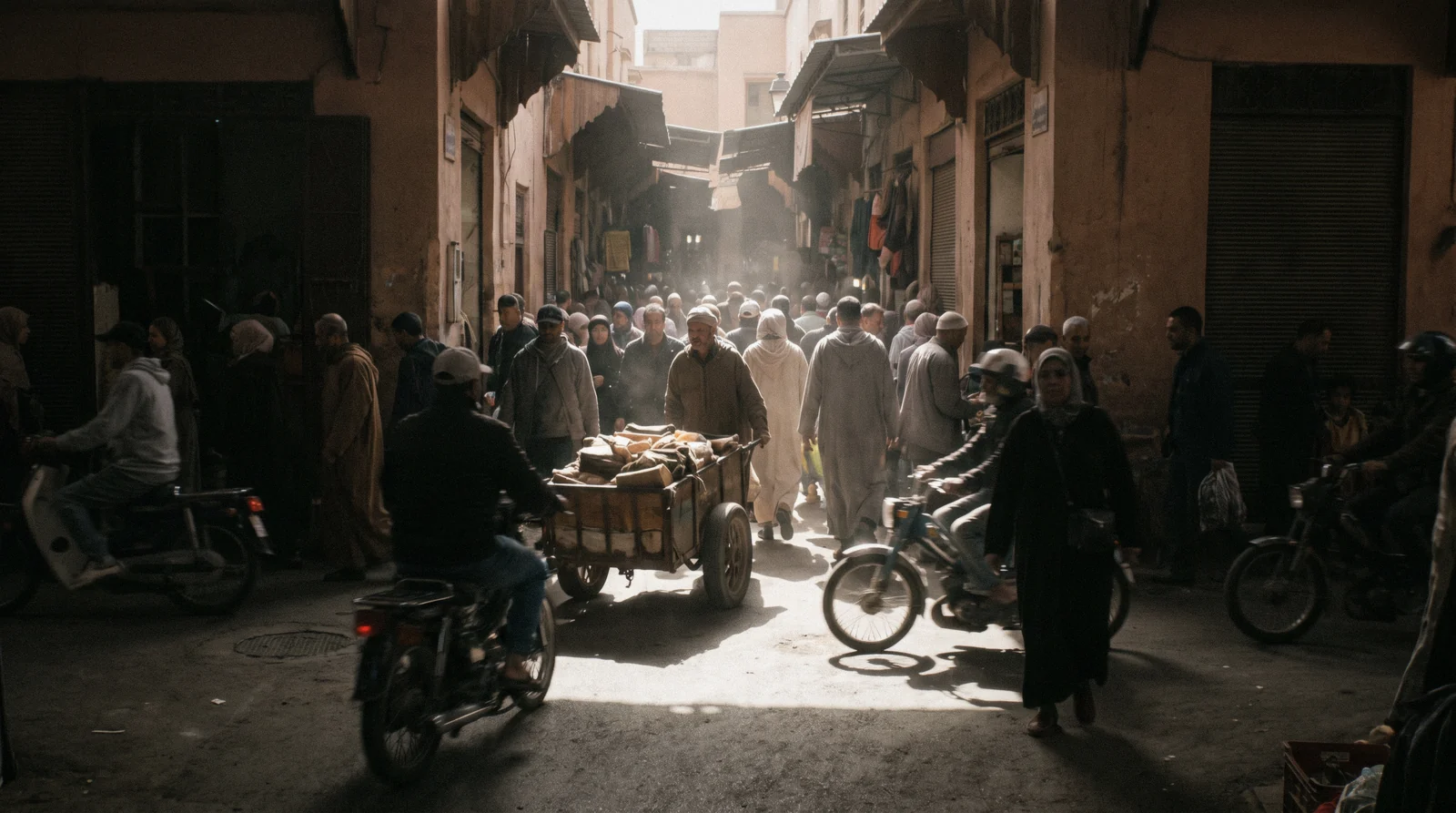
Is Marrakech Safe? What the Advisories Actually Say
Is Marrakech safe is the most searched question about the city and the worst served, because the pages answering it quote each other rather than the authorities. So this one quotes the authorities. Three foreign ministries publish current advice covering Morocco, none of them advises against travel to Marrakech, and exactly one of the three names the city at all. What they do publish is specific: bag snatching from motorbikes, people posing as official guides, credit-card fraud and goods substitution, and a fake travel-agency scam documented in Marrakech and nowhere else. This page prints their wording rather than a paraphrase of it, says plainly which of the famous medina scams no authority documents, and gives you the numbers to call. Everything was read in Q3 2026, and the city itself is set out in the guide to Marrakech as a whole.
Quick answer What the ministries say, what to watch, who to call
Three foreign ministries publish advice on Morocco and none of them advises against travel to Marrakech. The UK Foreign Office carries no city-specific warning at all; Canada asks for a high degree of caution nationally because of terrorism; France names Marrakech twice, for motorbike bag snatching and for a fake travel-agency scam. The petty-crime warnings all point at the same place: the historic medina quarters, on foot, in a crowd.
Key takeaways
- The one Marrakech-specific fraud any authority documents takes a card imprint to check your solvency and then moves money out of the account. The exact wording is worth reading before anyone photographs your card.
- Emergency numbers come in two official versions that disagree. Use 190 for police, 150 for ambulance and fire, 177 for the gendarmerie outside towns, and see why a French government page still lists 19 and 15.
- Nobody may work as a guide without a licence, and the badge is the check the advisories tell you to make. Booking a licensed guide for the souks removes the approach entirely, and the law says who gets punished.
- Henna, monkeys and the helpful stranger steering you to a tannery are documented by no authority anywhere. What that means is that you should treat the famous list as folklore with a grain of truth, not as sourced advice.
What Each Authority Publishes About Morocco
The four bodies an English-speaking or French-speaking visitor is likely to consult, with the level each sets, whether it mentions Marrakech and when it was last reviewed. Read from each ministry's own advisory page in Q3 2026.
| Authority | Its position | Marrakech named? | Reviewed |
|---|---|---|---|
| UK Foreign Office | No advise-against-travel wording for Morocco outside Western Sahara and the Algerian border | No, it speaks of medina quarters and major cities | 19 August 2026 |
| Global Affairs Canada | Exercise a high degree of caution in Morocco due to the threat of terrorism | No, though it notes good private medical facilities in the city | 1 September 2026 |
| France Diplomatie | Morocco remains a safe country under the control of the authorities, exposed to the terrorist threat | Yes, twice: bag snatching and a fake travel agency | 7 August 2026 |
| US State Department | Level 2, exercise increased caution, per its indexed page | No | 4 September 2026 |
The American page could not be read directly: travel.state.gov returned a 403 refusal to every attempt from this network, so the level and review date above come from its own indexed summary and no verbatim quotation of it appears anywhere on this page. The three European and Canadian rows were read in full.
The Warnings, in the Authorities' Own Words
Paraphrasing a travel advisory is how a caution turns into a scare. These are the operative sentences, quoted, with what each one means on a Marrakech street underneath.
The British wording is the most specific about where petty crime happens: it is common in tourist areas, "especially in historical districts (medina quarters) and on beaches". The same page warns of "drive-by motorcycle theft of visible jewellery and handbags", says it is "common for people posing as official tourist guides to harass tourists", and adds that "credit card fraud and scams are common", with a specific note to beware of "scammers substituting inferior goods for the ones you bought".
Those four sentences describe a real Marrakech day rather better than most guides do. The medina lanes are crowded, narrow and full of scooters; a bag on the outside shoulder is the thing that gets taken; the helpful stranger at a junction is a business proposition; and the rug or the spice you agreed to buy is not necessarily the one that gets wrapped.
- Wear the bag on the wall side of the lane and across the body, because the theft the advisories name is a passing motorbike rather than a pickpocket.
- Watch the goods being wrapped, and carry the parcel yourself from the moment it is closed.
- Treat an unsolicited offer to guide you as a paid service being started without a price, which is exactly what it is.
- Use the machine at a bank branch during opening hours, so a card the machine retains has somebody to retrieve it.
The alcohol warning nobody quotes correctly
The British advice for Morocco does not use the phrase drink spiking. What it publishes is a methanol warning: "There have been deaths and cases of serious illness caused by alcoholic drinks containing methanol in Morocco. Even small amounts of methanol can kill. It is not possible to identify methanol in alcoholic drinks by taste or smell."
That is a different risk from the one blogs describe, and it points at a different precaution. Drink at licensed premises, where the supply chain is a licensed one, rather than at whatever is being sold on a street. Drinking alcohol anywhere other than a licensed restaurant or bar is illegal in Morocco in any case, which the dress and conduct page sets out with the Ramadan restrictions alongside it.
Terrorism, in context
Canada's national position is a high degree of caution because of the threat of terrorism, with a separate instruction to avoid all travel within 20 km of the Algerian border, which is nowhere near Marrakech. France records that the last bomb attack in Morocco was in April 2011, on Jemaa el-Fna, and that 17 people died, while stating in the same section that Morocco remains a safe country under the control of its authorities.
Both things are true at once, and printing one without the other is how travel writing distorts. The attack is the reason for the security presence you will notice around the square and the monuments; the assessment is why no ministry advises against coming.
Quotations from the UK Foreign Office Morocco travel advice, Global Affairs Canada and France Diplomatie, each read in Q3 2026. The French text is quoted in translation and the original wording is in the research bundle.
The Only Two Warnings That Name Marrakech
Of every authority we read, one publishes text about this city rather than about Morocco. Both of its Marrakech paragraphs are worth having in full, because one of them describes a fraud that does not appear on any English-language safety page.
The first is the bag snatching. France Diplomatie reports that snatch thefts are regularly reported and that heightened vigilance is required in large cities such as Casablanca or Marrakech, where thieves on motorbikes ride along the pavements to take handbags and mobile phones. The detail that matters is the pavement: the risk is not a dark alley at two in the morning, it is a wide boulevard in the afternoon with a phone in your outside hand.
That is a Gueliz and Avenue Mohammed V description as much as a medina one.
Why that one is worth memorising
Every element of it is designed to sound legitimate. The approach arrives as an apology, the discount is a plausible size, the card is not being charged but merely checked, and the paperwork looks like paperwork. A visitor who has been primed to expect henna and monkeys does not recognise it as a scam at all.
The rule that defeats it is simple and absolute: nobody needs an imprint of your card to prove you can pay for something you are not buying today. Not a hotel that already has your booking, not an agency offering a future trip, not a shop arranging delivery. If a card leaves your hand for anything other than a transaction you are completing now, the answer is no. What Marrakech costs covers the money side, including why the medina runs on cash in the first place.
Both paragraphs are translated from France Diplomatie's Morocco security advice, security section updated 7 August 2026 and read in Q3 2026. No other authority we reached publishes Marrakech-specific crime text.
Emergency Numbers, and Why Two Official Sets Disagree
Three governments publish emergency numbers for Morocco and they do not fully match. These are load-bearing digits, so here is which set to use and why, rather than a single list presented as though there were no conflict.
Use the first column. The British and Canadian advisories agree on it independently and were both reviewed more recently than the French contacts page, which still lists the older two-digit forms. The tourist police line for Marrakech comes from the French ministry, which publishes it as a freephone number available around the clock.
| What you need | Number to use | Also published as | Who publishes it |
|---|---|---|---|
| Police, inside a town | 190 | 19, on a French government page | UK Foreign Office and Global Affairs Canada |
| Ambulance | 150 | 15, on the same French page | UK Foreign Office and Global Affairs Canada |
| Fire | 150 | Same number as the ambulance | UK Foreign Office and Global Affairs Canada |
| Gendarmerie, outside towns | 177 | No alternative published | UK Foreign Office and France Diplomatie |
| Marrakech tourist police | 05 24 38 46 01 | 05 24 88 86 80 | France Diplomatie, listed as a 24-hour line |
| Marrakech central police station | +212 5 24 43 19 87 | No alternative published | France Diplomatie contacts page |
What the tourist police is and is not
It is a real unit and an unusually badly documented one. No Moroccan authority publishes its address, its remit or its hours in writing; the two numbers above are published by a foreign ministry, not by the Moroccan police, and the commonly repeated claim that its office sits opposite Jemaa el-Fna could not be verified against any official source.
So treat the numbers as good and the geography as hearsay. For anything requiring a report, an incident on the square or a theft, the central police station is the citable address, and your consulate is the other number worth having saved before you travel. Save both to your phone rather than expecting to find them on a page while it is happening.
Numbers from the UK Foreign Office getting help page, Global Affairs Canada and France Diplomatie's Morocco contacts page, all read in Q3 2026. The legacy 19 and 15 forms appear on the French page only.
Unofficial Guides: What the Law Says, and Who It Punishes
The approach in the lane outside Ben Youssef is the most common friction of a Marrakech visit and the one most often described with a law that does not exist. Here is the statute that does.
There is no 1956 law on unofficial guides. That citation appears on a great many travel pages and in no official source. The operative statute is loi 05-12 regulating the profession of tourist guide, published in the Bulletin Officiel in 2012, amended four times since and most recently in 2021, with an implementing decree of 2015.
Its article 32 explicitly repeals the previous statute of 1997. Its structure is short and useful to know.
| Provision | What it requires | What it means for you |
|---|---|---|
| Article 5 | Nobody may practise as a tourist guide without an approval issued by the administration | The man offering to show you the tanneries is almost certainly outside the law |
| Article 10 | A guide at work must carry a professional card and a badge and produce them on demand | This is the badge the British advisory tells you to check |
| Article 12 | Guides' tariffs are indicative only, set by the national federation | There is no official rate to quote at anyone |
| Article 21 with Penal Code article 381 | Usurping the title is punished by three months to two years and a fine of 120 to 5,000 dirhams | The penalty falls on the unlicensed guide, not on the tourist |
| Article 22 | A licensed guide who lends or rents out his card faces six months to a year and a heavier fine | The badge you are shown should belong to the person showing it |
The part visitors actually worry about
Nobody is going to fine you for walking beside an unlicensed guide. The statute regulates the profession, and its penalties are aimed at people practising it without approval, at licensed guides who misuse their cards and at companies operating without the required approval. There is no provision anywhere in it that reaches the visitor.
What you risk is smaller and more likely: a route that ends in a shop that pays a commission, a price that was never agreed, and an argument at the end of it. The two clean answers are to decline clearly and keep walking, or to hire a licensed guide in advance so the question does not arise. A guided souk walk lists at $17.90 for 3 hours, a licensed medina walk taking in Bahia and the Saadian Tombs at $17.58 for 4 hours, and both put a card-carrying professional between you and the lane.
How to check a badge without being rude
Ask to see the card, look at the photograph and the category on it, and note that the two statutory categories are cities and tourist circuits, and natural areas. A guide for the Atlas mountains and a guide for the medina are licensed separately. Anybody genuinely licensed expects to be asked, because the law obliges them to produce the card on demand from a sworn official, and a visitor asking politely is a much easier version of that.
If the answer is a laminated photocopy, a lanyard with no photograph, or an explanation of why the card is at home, you have your answer without an argument.
Loi 05-12 articles 1, 5, 6, 10, 12 and 20 to 24, from the facsimile of Bulletin Officiel 6088; Penal Code article 381 from the consolidated code published by the Tresorerie Generale du Royaume. The Justice Ministry's own text server refused connection in Q3 2026, so both are cited from those copies.
The Famous Medina Scams Nobody Official Documents
Every list of Marrakech scams contains the same five items. We went looking for an authority behind any of them and found none, which is worth saying out loud rather than dressing a blog list as sourced advice.
No official body, not the British or Canadian ministries, not the French one that does name the city, not the Moroccan tourist office and not the Ministry of Tourism, publishes anything specific about henna approaches, snake charmers, monkey photographs or being steered towards a tannery. The only official framing that covers them is generic: people posing as official guides who harass tourists, and petty crime and scams in medinas and markets.
That does not mean the approaches are invented. It means the accounts are traveller accounts, and they should be read as such. The common thread in all of them is the same commercial structure, and understanding the structure is more useful than memorising the list.
- A service starts before a price is agreed. Henna on a wrist, a monkey on a shoulder, a photograph taken with your own phone: the payment conversation begins after the thing has happened.
- A closed route is presented as helpful information. The square is closed, the souk is shut today, the tannery is this way: each moves you somewhere you did not choose.
- An apology creates an obligation. The fake-agency fraud the French ministry documents opens exactly this way, with compensation for a service that disappointed.
- Nothing is written down. The one scam with a government source behind it involves paperwork, which is precisely why it works better than the others.
What to do instead of memorising a list
Agree a price out loud before anything starts, including a photograph. Say no once, clearly, and keep moving rather than explaining, because an explanation is a conversation and a conversation is the product. Do not follow anyone away from where you meant to go, however plausible the reason, and remember that the square and the souks are working commercial spaces where everyone present is there to trade.
And keep proportion. This is a city where the documented risks are a passing motorbike, a substituted parcel and a card imprint, all of which have straightforward answers. The number of visitors who go home having lost nothing but an argument is very large.
Women Travelling, and the Medina After Dark
Two of the three most searched sub-questions about Marrakech safety, answered from what the ministries publish rather than from a forum thread, with the practical reading attached.
The British advisory is direct: women may receive unwanted attention in Morocco, especially when travelling alone, and it recommends considering loose-fitting clothing covering the arms, legs and chest. Canada records that women travellers may experience harassment and advises staying on main roads in medinas and not displaying signs of wealth. Neither describes the attention as dangerous; both describe it as persistent, which matches what visitors report.
The practical reading is that the friction is verbal and commercial rather than physical, and that it thins out fast in Gueliz and around the Hivernage hotels. What the clothing advice does and does not do is set out in full on what to wear, including the fact that the Moroccan tourist authority itself publishes no dress code at all.
The square and the lanes at night
Jemaa el-Fna is at its busiest and best lit after dark, and the food stalls run late; the streets that need thought are the lanes off it once the shops have closed, because a medina derb with no shopfront open is a dark corridor with no witnesses rather than a dangerous street. Walk the lit spine rather than the shortcut, and note the route home in daylight, since the same lane looks entirely different once the shutters are down.
A booked evening removes the navigation problem altogether. The night food walk through the medina stalls runs 2.5 hours and includes hotel pickup and drop-off, which is the practical answer for a first night rather than a safety warning about the square itself.
Two legal points visitors are entitled to know
France Diplomatie publishes them plainly, and a page that discussed safety while omitting them would be less than useful. Same-sex sexual relations are an offence in Morocco, punishable by up to 3 years, and the British advisory adds that showing affection in public can lead to prosecution. Sexual relations outside marriage between a man and a woman are also an offence, carrying up to 1 year.
Enforcement against foreign visitors is not something any authority documents in either direction, and this page will not speculate about it. What is publishable is the law as written and the ministries' own advice to be discreet in public, which is the same advice they give about religious sites.
Unwanted-attention and public-affection wording from the UK Foreign Office; harassment and medina main-road advice from Global Affairs Canada; the penal provisions as quoted by France Diplomatie from Penal Code articles 489 and 490. Read in Q3 2026.
Bookings That Remove the Friction
Not one of these is a safety product, and none is sold as one. What they do is replace the two situations that generate most Marrakech complaints, an unlicensed guide in a lane and an unagreed fare at a kerb, with a price fixed before you travel. The souk walk lists at $17.90 for 3 hours and the licensed medina walk at $17.58 for 4 hours; the night food tour is $49.98 for 2.5 hours with hotel pickup, the private guide $66.35, the shopping walk $27.64, the airport transfer $8.29 for a run of about 20 minutes and the tuk-tuk circuit $16.00. Listed prices read in Q3 2026.
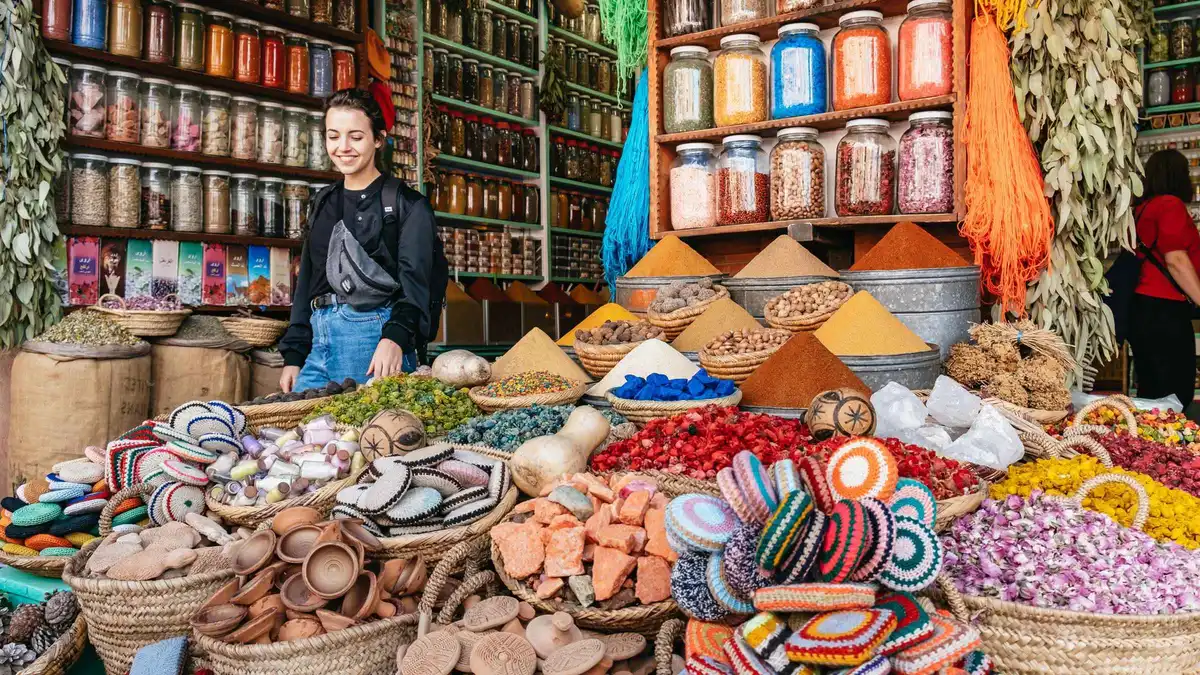 from $17.90
Marrakech: Colorful Medina Souks Guided Walking Tour
listed at $17.90
Three-hour guided walk through the dyers', metalworkers' and spice souks with a local guide. Sold as a shared small group or a private walk, pickup optional.
Check Availability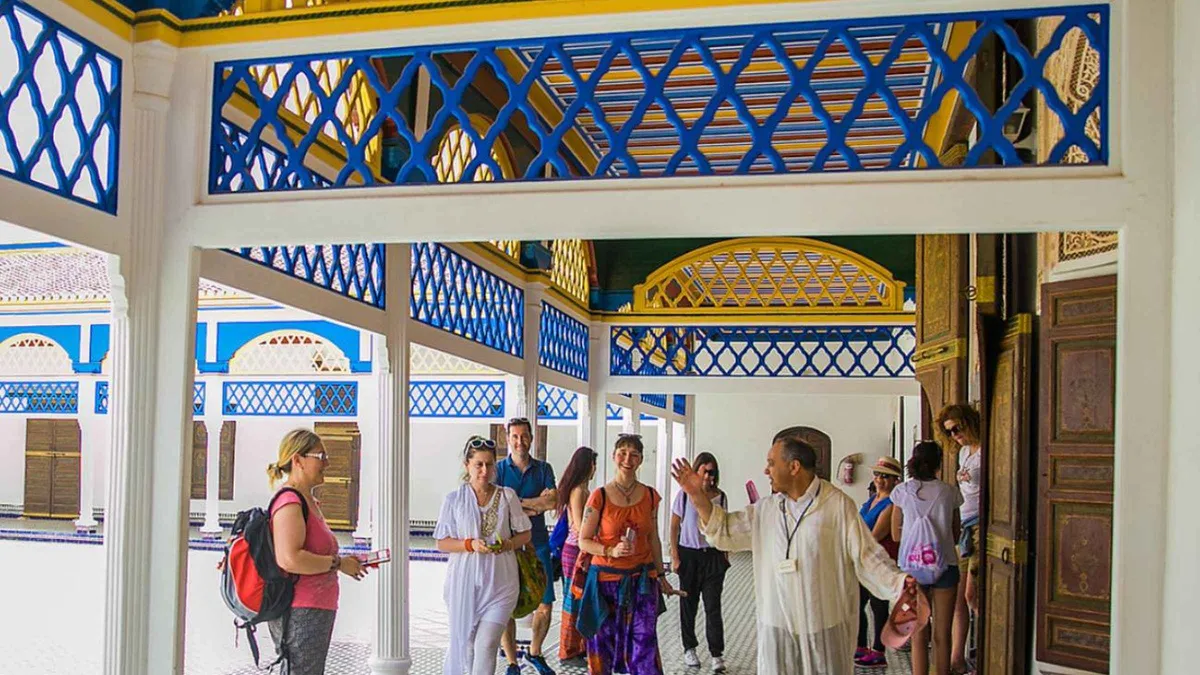 from $17.58
Marrakech: Bahia Palace, Saadian Tombs, Souk and Medina Tour
listed at $17.58
Four-hour licensed-guide walk covering Bahia Palace, the Saadian Tombs, the souks and the medina, with a WhatsApp reminder the day before. Monument tickets are paid in cash on site: 100 MAD per adult per monument, 30 MAD ages 7-13.
Check Availability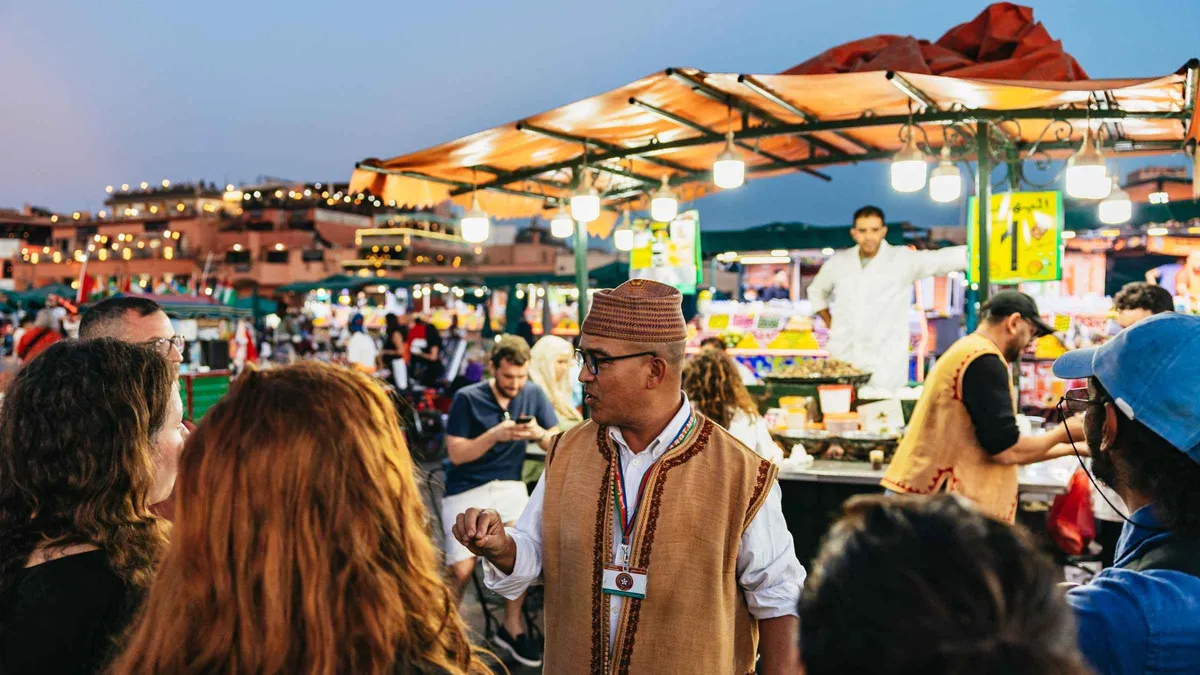 from $49.98
Marrakech: Street Food Tour by Night
listed at $49.98
Two-and-a-half-hour night walk through medina food stalls with tastings and drinks, hotel pickup and drop-off included. Sold as a shared group or a private tour.
Check Availability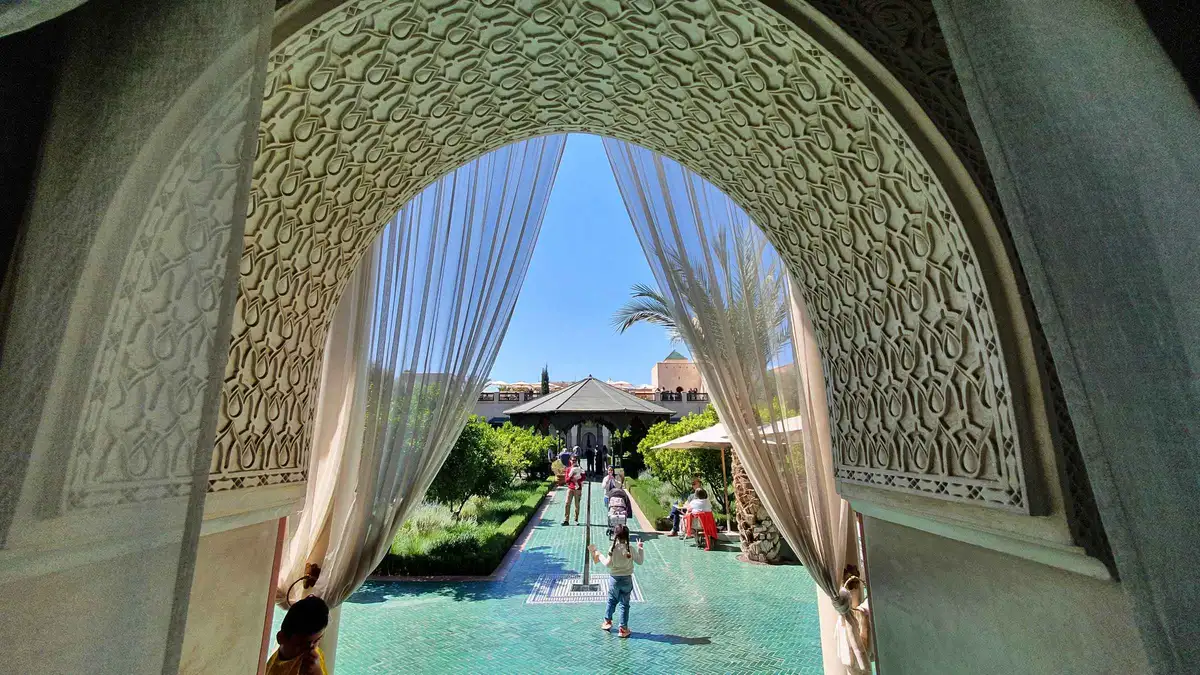 from $66.35
Marrakech: Tailor-Made City Tour With Your Own Private Guide
listed at $66.35
Half or full-day private tour built around what you ask to see, with pickup included. Up to two sights on the half-day and four on the full day; entrance fees are not included.
Check Availability from $8.29
Marrakech: Private Transfer to/from RAK Menara Airport
listed at $8.29
Private transfer between Menara airport and your Marrakech address, about 20 minutes. Vehicles cannot enter parts of the medina, so the drop-off can leave a 5-10 minute walk with luggage.
Check Availability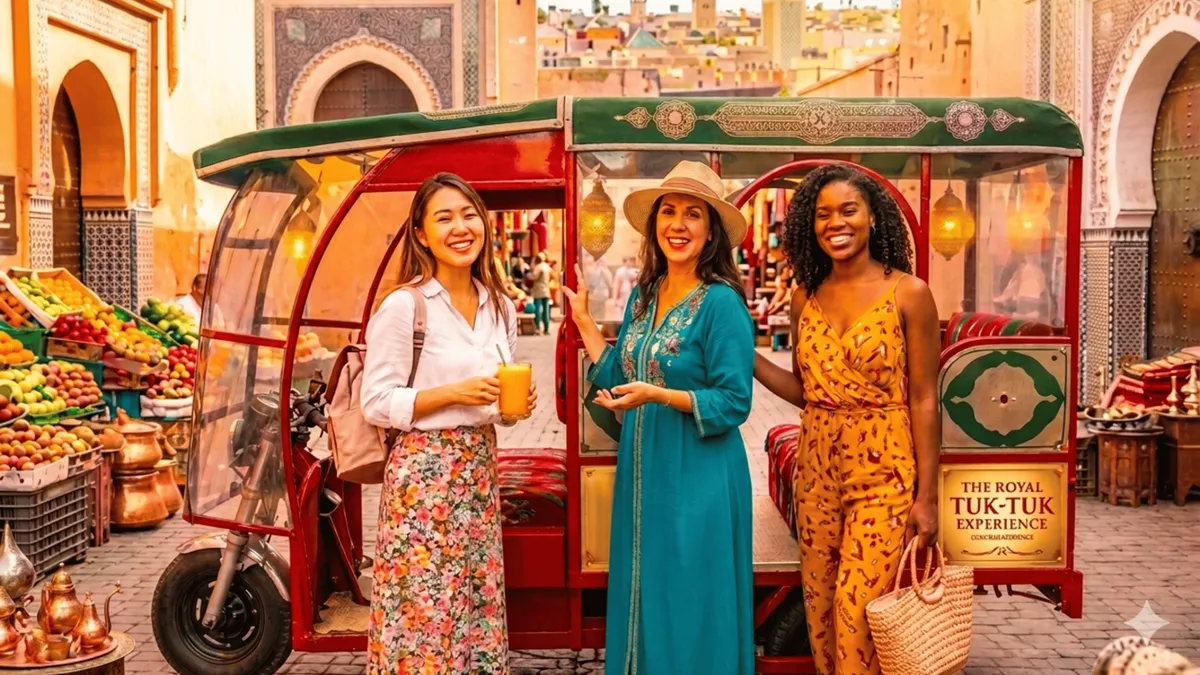 from $16
Tuk Tuk Marrakech Private Tour: Audio guide, Gift & Pastries
listed at $16
One to three-hour private tuk-tuk circuit with an audio guide, pastries and a gift; a driver, not a guide, is provided. Monument tickets are not included and Majorelle tickets have to be bought online first.
Check Availability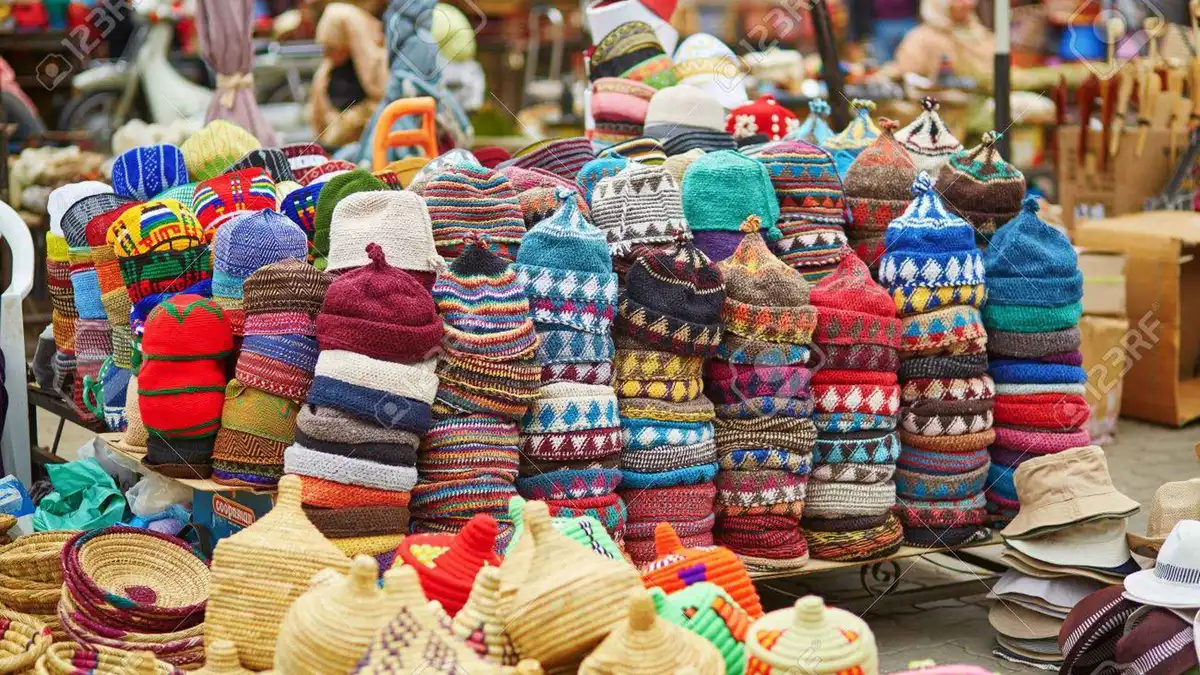 from $27.64
Marrakesh: Guided Souk Shopping Tour with a Local Guide
listed at $27.64
Three-hour shopping walk with a local guide who translates and handles the haggling in the artisan souks. Runs in English or Italian, no pickup.
Check AvailabilityPrices, ratings and details are the platform's own, checked in Q3 2026; dollar figures are the listed prices — the platform bills in your account's currency.
Where This Page Hands Over
Four pages that pick up the practical end of the questions above.
What to wear in Marrakech
The clothing recommendation quoted above is one sentence long, and the Moroccan authorities publish none of their own. What to wear sets it against the alcohol, Ramadan and photography rules.
The advisory sentence in fullGetting around Marrakech
The meter is compulsory and its rate unpublished, and no ride-hailing app operates lawfully. Getting around is where the fare disputes are settled.
The kerb-side argumentsWhat Marrakech costs
Card fraud is one of the two frauds the advisories name, and the medina runs on cash. What Marrakech costs covers the machine, the receipt and the closed currency.
Cards, cash and the machineJemaa el-Fna
The performers, the food stalls and the approaches all live in one place. The Jemaa el-Fna guide covers how the square works hour by hour.
The square itselfIs Marrakech Safe: The Questions
Is Marrakech safe for tourists right now?
No foreign ministry advises against travel to Marrakech. The British advisory carries no city-specific warning at all, Canada asks for a high degree of caution across Morocco because of the threat of terrorism, and France states that Morocco remains a safe country under the control of its authorities while naming the city for bag snatching. The documented risks are petty: theft in medina quarters, motorbike snatches, card fraud and goods substitution. The four advisories side by side show exactly who says what.
Is Marrakech safe for women travelling alone?
The advisories describe persistent unwanted attention rather than danger. The British page says women may receive unwanted attention, especially when travelling alone, and recommends loose clothing covering the arms, legs and chest; Canada notes harassment and advises staying on main roads inside medinas. The section above sets out both, and what to wear gives the clothing rule in full, including the fact that no Moroccan authority publishes one.
What are the most common scams in Marrakech?
The ones with a government source are card fraud, substitution of inferior goods for what you bought, people posing as official guides, and a fake travel agency that takes a card imprint to check your solvency and then makes fraudulent transfers. That last one is documented for Marrakech specifically and is worth reading in full. The henna, monkey and wrong-directions approaches everyone lists are documented by no authority at all, which does not make them fictional, only unsourced.
Is it safe to walk back to a riad after dark?
The main square is at its busiest and best lit after dark and the advisories publish nothing specific about it beyond their general medina wording. The lanes off it are the part worth thinking about, because a derb with the shutters down has no lighting and no witnesses. Walk the lit route, note it in daylight, and consider a night food walk with hotel pickup for a first evening. The square's own workings are on its own page.
What is the emergency number in Marrakech?
190 for police in the city, 150 for ambulance and fire, and 177 for the gendarmerie outside towns. Two official sets exist and disagree: a French government page still lists the older 19 and 15. The Marrakech tourist police publish a 24-hour line on 05 24 38 46 01 or 05 24 88 86 80, and the central police station is on +212 5 24 43 19 87. All of them, with who publishes each, are above.
Can I get in trouble for using an unofficial guide in Marrakech?
No. Loi 05-12 requires an approval to practise and a card and badge to be carried at work, and its penalties, three months to two years with a fine under Penal Code article 381, fall on the unlicensed guide. Nothing in the statute reaches the visitor. What you risk is a route that ends in a commission shop and a price that was never agreed, which is why checking the badge or booking a licensed souk walk is the practical answer.
Has there been a terrorist attack in Marrakech?
Yes, and France Diplomatie records it as the last bomb attack in Morocco: the April 2011 attack on Jemaa el-Fna, in which 17 people died. The same ministry states that Morocco remains a safe country under the control of the authorities but exposed to the terrorist threat, and Canada's national caution level rests on the same assessment. It is the reason for the visible security around the square and the monuments.
Marrakech Street Level, With the Approaches on Camera
Three films that show what the advisories describe in the abstract. Watch them for the texture of an approach rather than for their advice, which is traveller experience and not an authority.
Avoid These 7 Scams in Morocco
The approaches filmed as they happen, which is more instructive than any list of them.
Video: Where's Wataru7 Things to Know BEFORE Visiting Marrakech
A short brief on the city's habits, including the guide and shopping frictions this page covers.
Video: Jake BraymillerIs it Safe to Travel to Morocco?
A calm read of the risk picture, useful next to the advisory table above.
Video: TravRisk - Modern Travel PreparednessVideos load from YouTube only when you press play.
Reviewed Q3 2026 (July–September 2026); next review Q4 2026. Prices, hours and terms are set by the venue or operator and confirmed at checkout.
We may earn a commission if you book through one of our links, at no extra cost to you. Full affiliate disclosure