 Marrakech Guidebook
Marrakech, Morocco: An Independent City Guide
Four different authorities sell the tickets to the monuments of Marrakech, Morocco, and none of them agrees with the others on price. This guide reads all four, prints what a visitor actually pays, and says which door to use.
- Language Arabic and Amazigh; French everywhere in business, English in the tourist trade
- Currency Moroccan dirham (MAD), a closed currency you cannot buy abroad. 1,000 MAD ≈ $106.52 / €91.65 reference rate, 8 September 2026. What Marrakech costs
- Time zone UTC+1 all year, and UTC+0 during Ramadan
- Best months March to May and October to November, see when to go
- Airport Menara (RAK), 5 to 6 km out, getting in from the airport
- Tap water No authority publishes a drinkability statement, what that means
Quick answer What it costs, how long it needs, and the one thing that goes wrong
Marrakech's headline monuments cost $10.65 (100 MAD) each for a foreign adult at the Ministry of Culture's four sites, $5.33 (50 MAD) at the Ben Youssef Madrasa and $18.11 (170 MAD) at the Jardin Majorelle, and the medina, the Koutoubia gardens and Jemaa el-Fna cost nothing at all. Three nights covers the city; a fourth buys a day in the Atlas. Every figure on this page was read off the ticket authority's own page in Q3 2026.
Key takeaways
- The same monument charges a foreign adult 100 MAD and a Moroccan national 30 MAD, and Moroccans enter free on Fridays. That two-tier tariff is published, not a scam, and the tickets index sets out all four authorities side by side
- The Ministry of Culture now sells Bahia, El Badi, the Saadian Tombs and the Almoravid Koubba on its own platform, so a queue at the window is optional rather than compulsory
- The most expensive ticket in the city is the Jardin Majorelle at 170 MAD, and the Berber Museum inside it is a 60 MAD supplement rather than an inclusion, which is where most visitors are caught out
- Nothing about a taxi fare in Marrakech is published by an authority, so insist on the meter rather than trusting a quoted price, and expect the airport board to disagree with the tourism office's own figure
Marrakech in five decisions: what to see, what to book, where to sleep, when to come
The five hubs of this guide, each with the three facts that settle it.
What to see
Eighteen sites with their own entry, ranked by what they actually give you for the ticket.
- The four Ministry monuments at 100 MAD each share one tariff and one online shop
- The gardens run from 60 MAD at the Menara pavilion to 170 MAD at Majorelle
- The museums are the cheap layer: Dar Si Said is 30 MAD, the Maison de la Photographie 80 MAD
Tickets
Four separate authorities, four separate shops, and no combined city pass exists.
- The Ministry of Culture platform has sold its own tickets since April 2025
- Ben Youssef is under a different ministry at 50 MAD and sells separately
- Majorelle and the YSL museum are a foundation, with their own combined fares
Where to stay
A riad inside the walls or a hotel in the new town, and the difference is bigger than the price.
- The medina puts you inside the walls and out of reach of a taxi door
- Gueliz is the protectorate-era new town: pavements, addresses, and a taxi that finds you
- Where to stay sets out the six districts against what each one costs
Out of the city
The Atlas is an hour away and the Sahara is not a day trip, whatever the sign says.
- The Ourika valley and Imlil are genuine half or full days
- Essaouira is a three-hour coach each way on a scheduled service
- Every day trip compared, with the drive time and the do-it-yourself fare
Plan the practical part
The things that go wrong here are transport, money and closing days.
- Getting around: the meter is the rule, and no tariff is published
- What it costs: the dirham is closed and cannot be bought before you fly
- Friday and holiday openings: the day the tariff changes for everyone else
Where in Marrakech you actually go
Six places that divide a first visit. Each card says when in the trip it belongs.
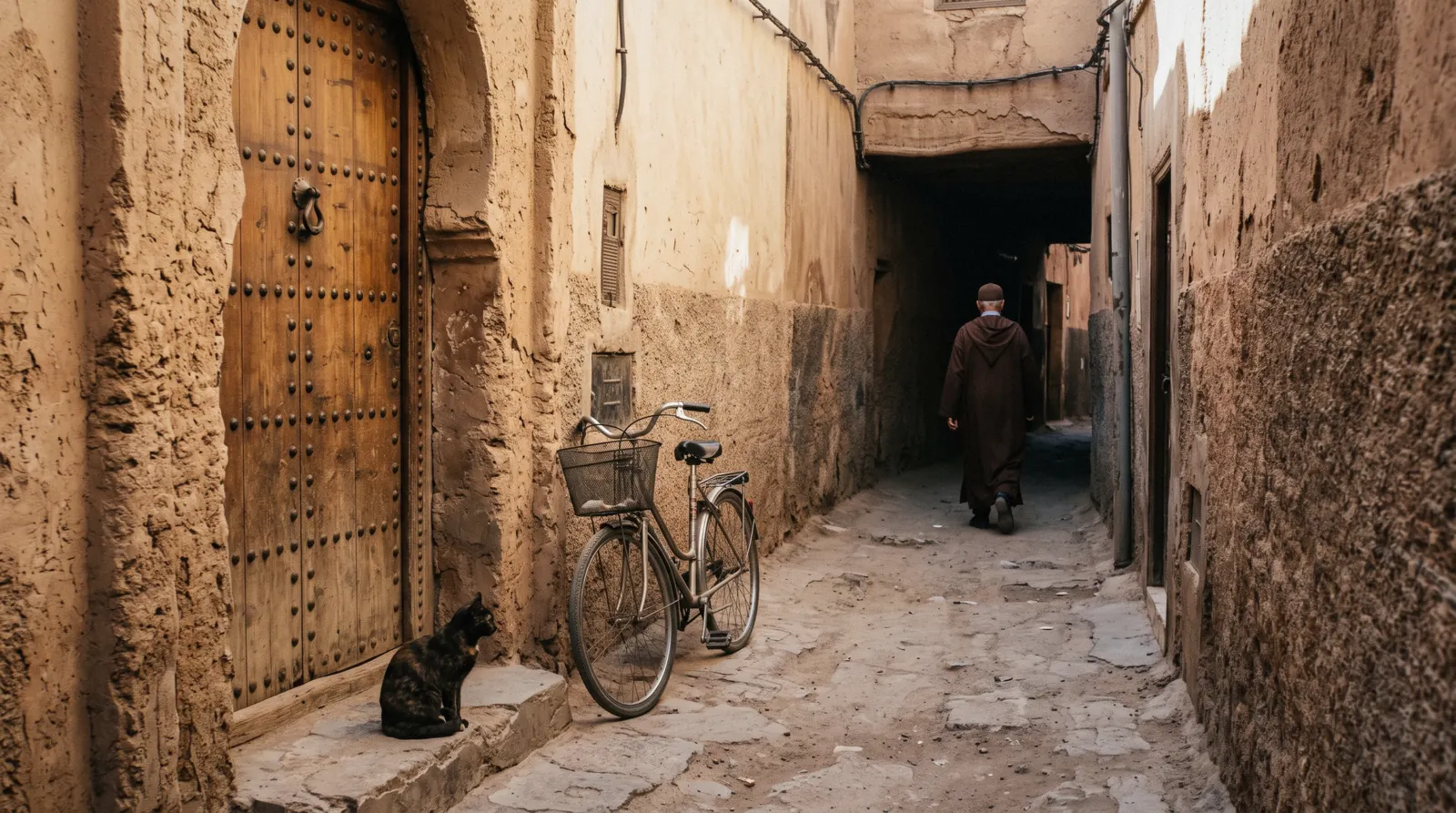
The medina
A UNESCO-listed walled quarter that is still lived in rather than preserved, and the address of almost every monument on this site. Lanes are numbered by derb rather than by street, and most riad doors cannot be reached by car.
- Free to walk; the monuments inside it are ticketed separately
- UNESCO World Heritage list 331, inscribed 1985
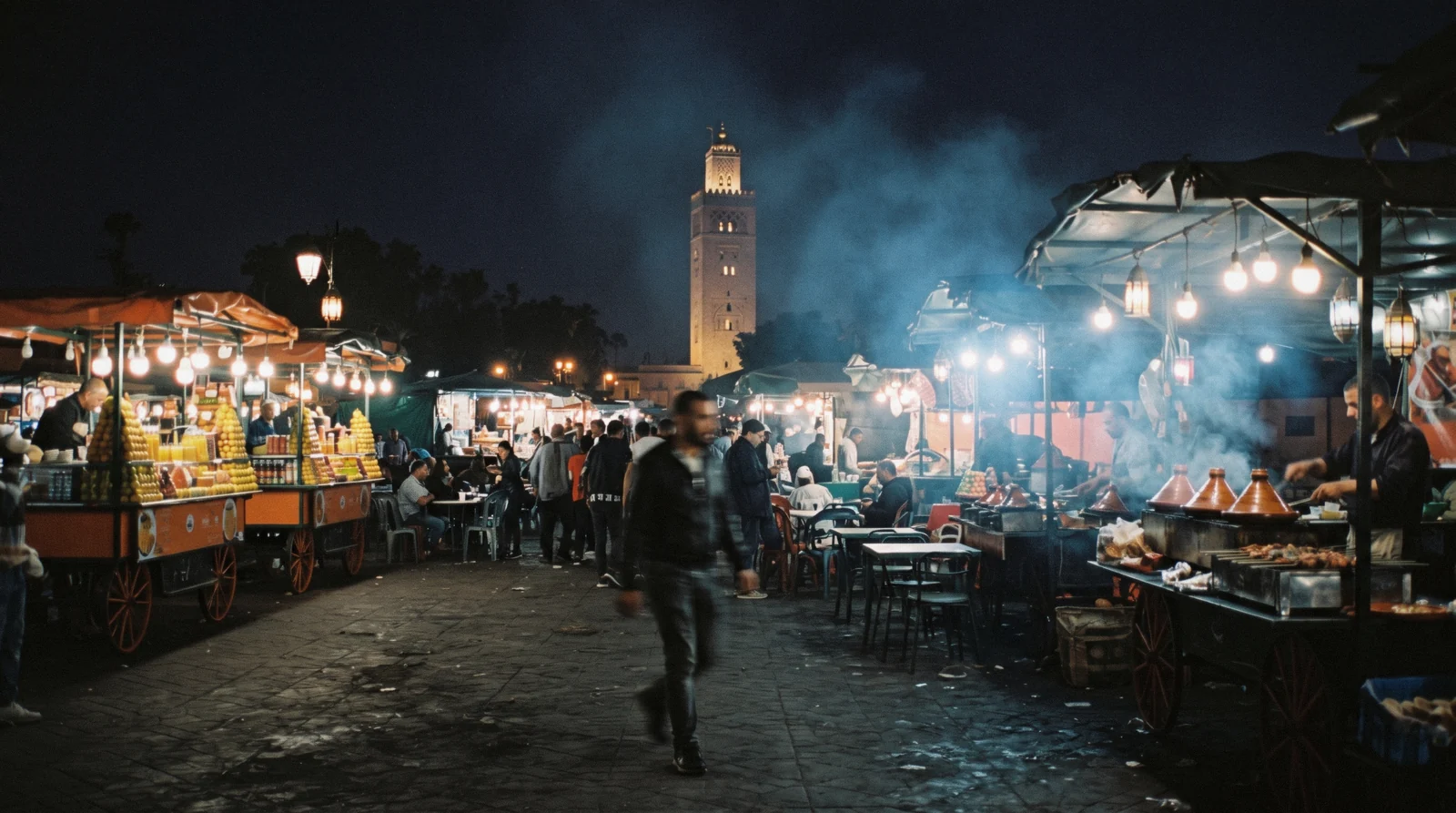
Jemaa el-Fna and around
The square is the medina's hinge: the souks run north from it, the Koutoubia stands at its western edge, and the food stalls take over the eastern half after dark. It carries its own UNESCO listing, for the storytellers rather than the buildings.
- No admission; performers ask for payment directly
- UNESCO Intangible Cultural Heritage, inscribed 2008
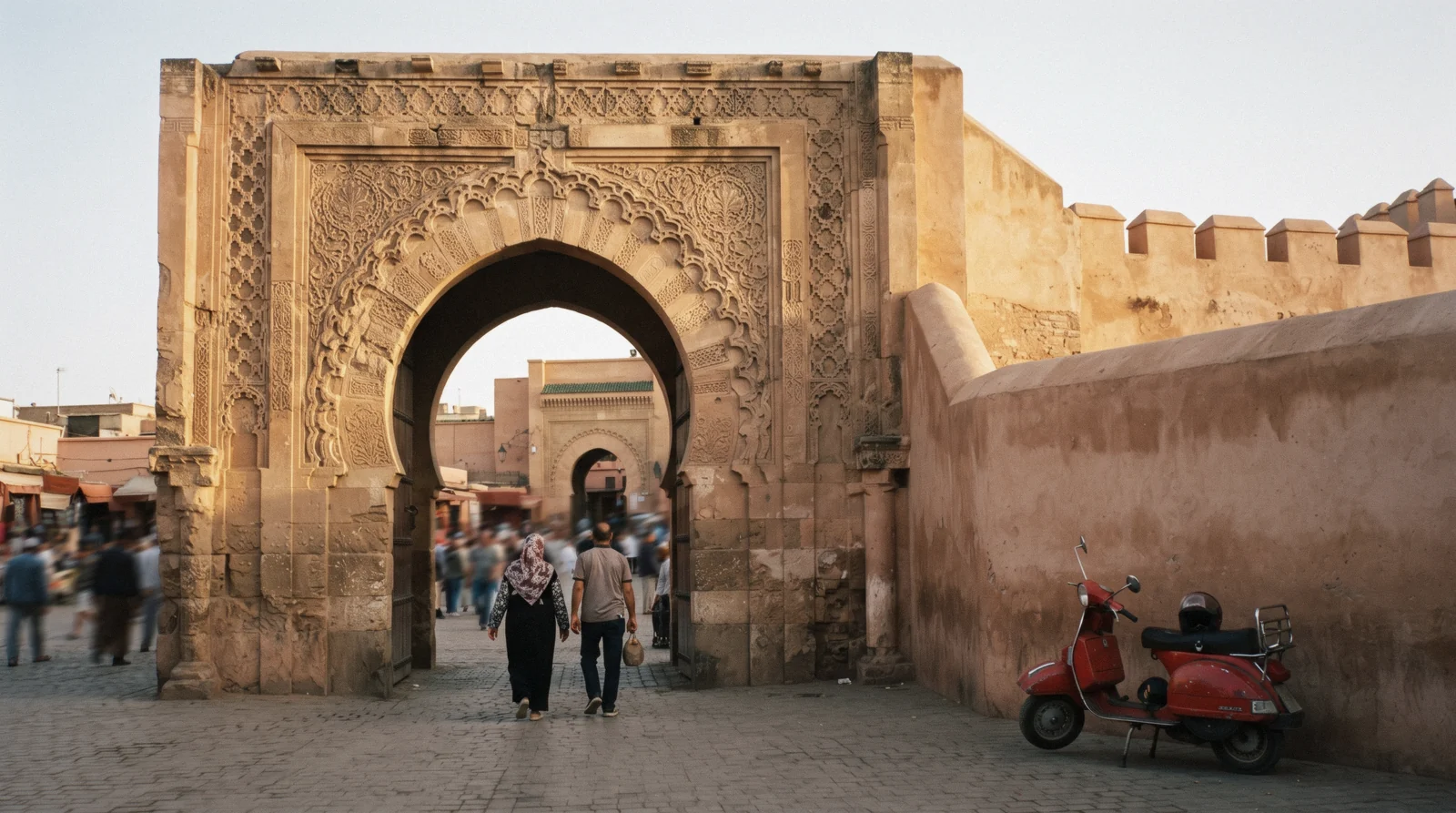
The Kasbah
The royal quarter in the south of the medina, and the densest square kilometre of ticketed sites in the city: the Saadian Tombs, El Badi and Bab Agnaou stand within a few minutes of each other.
- Two 100 MAD monuments inside one walk
- Bab Agnaou itself is free and always open
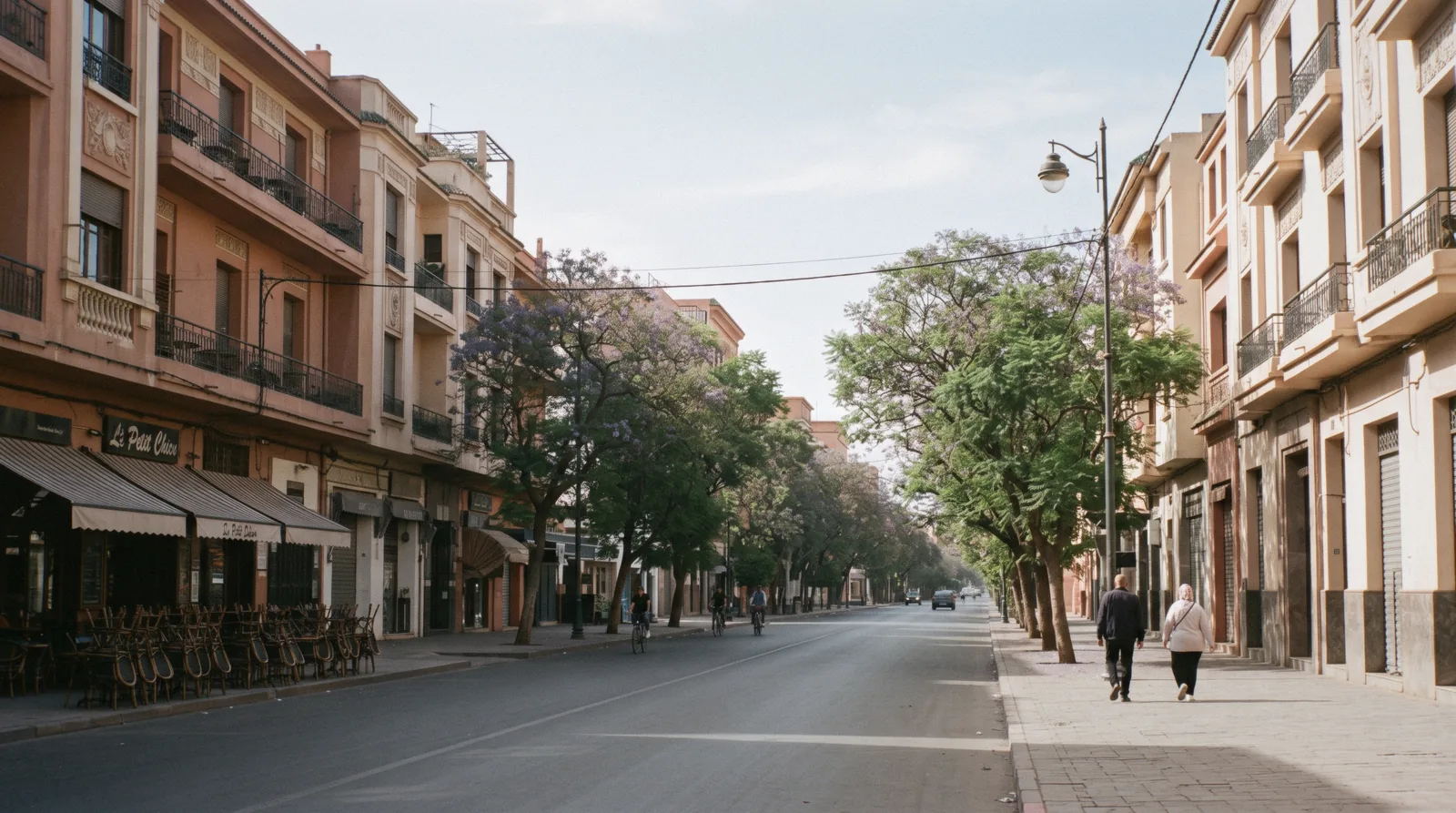
Gueliz
The new town laid out under the French protectorate, with pavements, street numbers and a grid. It is where the Jardin Majorelle, the railway station and most of the city's non-riad hotels are.
- Bus 19 from the airport terminates here
- A taxi can find your address, which is not true in the medina
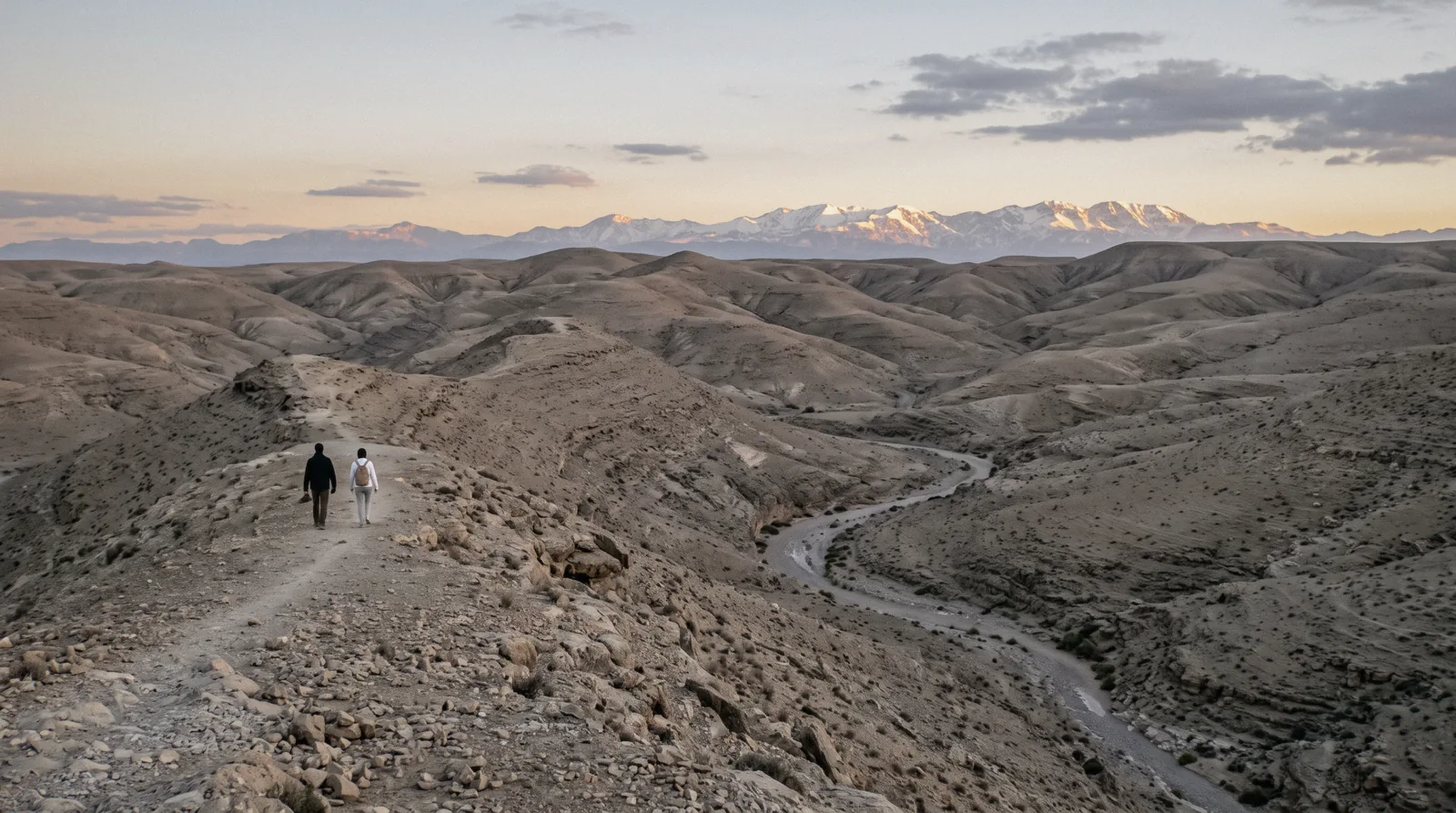
The Agafay desert
Forty minutes out and marketed as a desert, which it is: a stone hamada, not a sand erg. Nobody charges admission, and there is nothing to see in it but the light on the hills and the Atlas behind them.
- No admission and no public tariff of any kind
- The Sahara dunes are 560 km further, not here
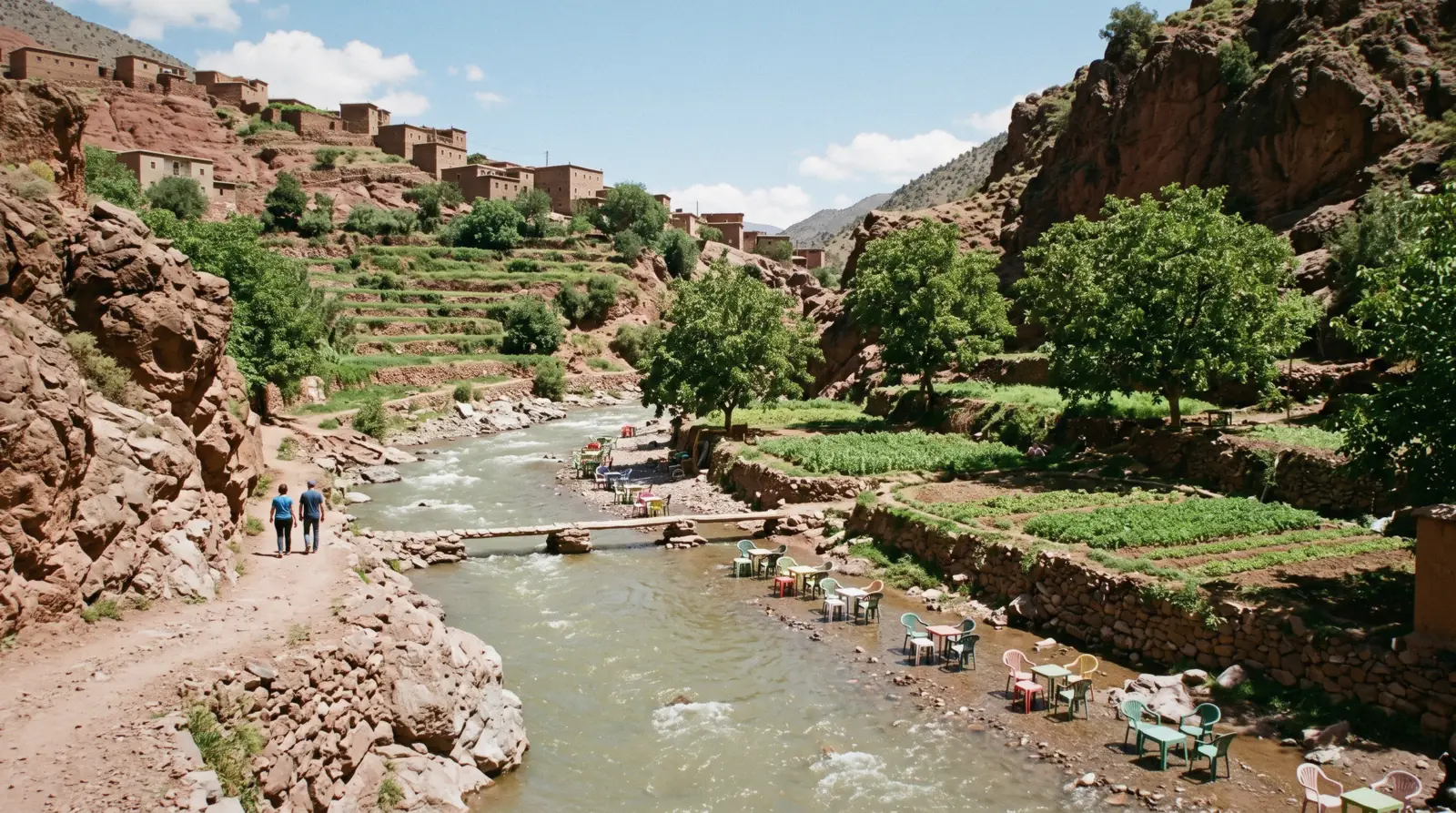
The Ourika valley and the Atlas
The nearest real mountains, about an hour south on the R203. The valley floor carries cafes built out over the river; the walking starts at Setti Fatma, where the waterfall path begins.
- About 60 km from the city, an hour each way
- Grand taxis run the route on a shared-seat basis
The Marrakech list, in the order a first visit actually walks it
Eighteen sites carry their own entry in this city. These eight are the ones a three-day visit reaches on foot, given in walking order rather than by importance, with the official adult fare for an international visitor.
Start at Jemaa el-Fna, because everything else is measured from it. The square costs nothing, the Koutoubia stands four minutes west of it, and the minaret is the one fixed point you can navigate the medina by. The mosque's interior is closed to non-Muslims, so what you are visiting is the exterior, the excavated first mosque beside it and the rose garden behind.
Nobody sells a ticket to any of it.
South, into the Kasbah
Bahia Palace is a fifteen-minute walk south-east through Riad Zitoun Jdid and the single most rewarding 100 MAD in the city: eight hectares of courtyards under painted cedar, built in two phases in the 1860s and 1890s. From its gate the Saadian Tombs and El Badi Palace are both inside ten minutes, on the same 100 MAD tariff, and the three of them make one morning. Buy all three on the Ministry's own platform before you leave the riad and you skip three separate windows.
North, into the souks
Ben Youssef Madrasa sits at the top of the souks, twenty minutes north of the square through the covered lanes, and at $5.33 (50 MAD) it is the cheapest ticket of the eight and the one people come out of talking about. The Almoravid Koubba is directly opposite it and the Maison de la Photographie five minutes further, so the three combine into an afternoon. Le Jardin Secret is on the way back down, on Rue Mouassine.
Out to the new town
The Jardin Majorelle is the one site outside the walls that a short visit still makes room for, about 25 minutes' walk or a short taxi from the square. It is also the most expensive ticket in Marrakech at $18.11 (170 MAD), and the Musee Yves Saint Laurent next door is a separate $14.91 (140 MAD). Go at opening or late; the queue at eleven is the longest in the city.
What each Marrakech monument charges, and who sets the price
The four ticket authorities of Marrakech in one table, with the fare an international adult pays and the fare a Moroccan national pays at the same door, read on each body's own ticket page on 8 September 2026.
| Site | Foreign adult | Moroccan adult | Who sets it |
|---|---|---|---|
| Bahia Palace | $10.65 (100 MAD) | $3.20 (30 MAD) | Ministry of Culture |
| El Badi Palace | $10.65 (100 MAD) | $3.20 (30 MAD) | Ministry of Culture |
| Saadian Tombs | $10.65 (100 MAD) | $3.20 (30 MAD) | Ministry of Culture |
| Almoravid Koubba | $10.65 (100 MAD) | $3.20 (30 MAD) | Ministry of Culture |
| Menara pavilion | $6.39 (60 MAD) | Not published separately | Ministry of Culture |
| Ben Youssef Madrasa | $5.33 (50 MAD) | $2.13 (20 MAD) | Ministry of Habous |
| Jardin Majorelle | $18.11 (170 MAD) | $7.99 (75 MAD) | Fondation Jardin Majorelle |
| Musee Yves Saint Laurent | $14.91 (140 MAD) | $5.86 (55 MAD) | Fondation Jardin Majorelle |
| Le Jardin Secret | $10.65 (100 MAD) | $5.33 (50 MAD) | Private foundation |
| Maison de la Photographie | $8.52 (80 MAD) | $5.33 (50 MAD), residents | Private museum |
| Dar Si Said | $3.20 (30 MAD) | $3.20 (30 MAD), one rate | Fondation Nationale des Musees |
| ANIMA garden | $14.91 (140 MAD) | $6.39 (60 MAD), residents | Private garden |
No combined Marrakech city pass exists; there is nothing to buy that covers more than one authority. The Moroccan-adult column is shown because it is published, not because a visitor can use it: proof of nationality or Moroccan residency is required at the gate. Moroccan nationals also enter the four Ministry monuments free on Fridays and on the first day of national and religious holidays. The Menara garden itself publishes no fare at all, and the Musee de Marrakech publishes no price anywhere we could reach.
How many days Marrakech needs
What each length of stay actually reaches, counted from Jemaa el-Fna on foot, with the entry money it costs at the international adult tariff.
| Length | What it reaches | Entry money | What you give up |
|---|---|---|---|
| One day | The square, the Koutoubia, Bahia, and the souks as far as Ben Youssef | $15.98 (150 MAD) | The gardens, El Badi and everything outside the walls |
| Two days | Add the Saadian Tombs, El Badi and the Kasbah, plus the Jardin Majorelle | $44.70 (420 MAD) | Any day trip, and the quieter museums |
| Three days | Add the Yves Saint Laurent museum, Le Jardin Secret and the Maison de la Photographie | $78.80 (740 MAD) | Only the Atlas and the coast |
| Four days | One full day out: the Ourika valley, Imlil or Agafay | Same, plus the road cost | Essaouira, which is too far to add to a short trip |
| Five or more | Essaouira or Ait Ben Haddou as an overnight rather than a dash | Same, plus a night away | Nothing a first visit needs |
The entry figures are cumulative and count one adult at the international rate; children of 7 to 13 pay half at the four Ministry monuments. Walking times are our estimates from the published coordinates, not an official figure. The three itineraries put the same stops in the hours that work: one day, two days, three days.
Marrakech itineraries: one, two or three days with the slots already placed
Each itinerary puts the ticketed sites in the hour they are quietest and leaves the square for the evening, where it belongs.
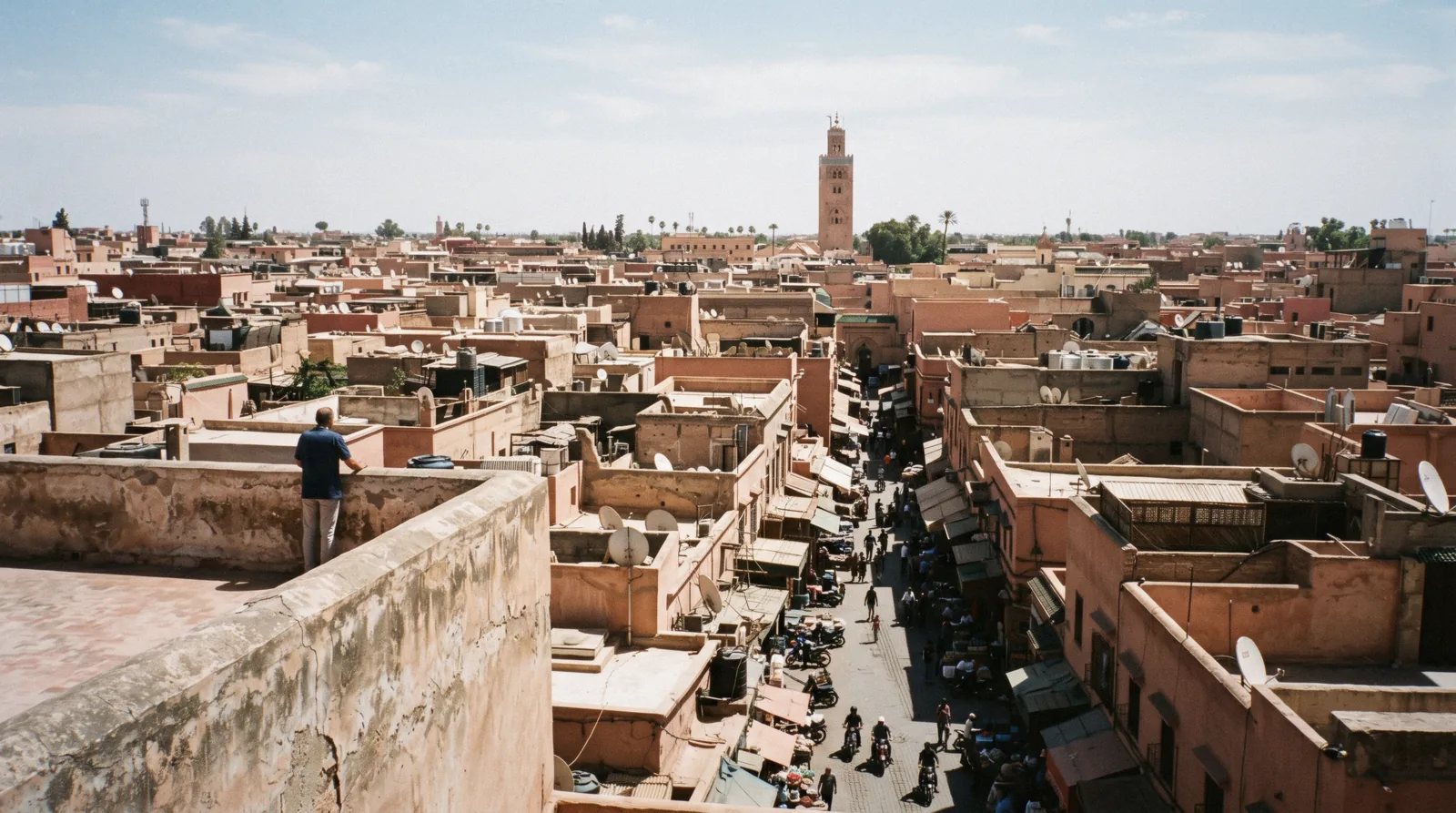
One day in Marrakech
The square, the Koutoubia, Bahia Palace and the souks, with the food stalls at the end of it.
- Bahia at opening, before the coaches
- Nothing outside the walls
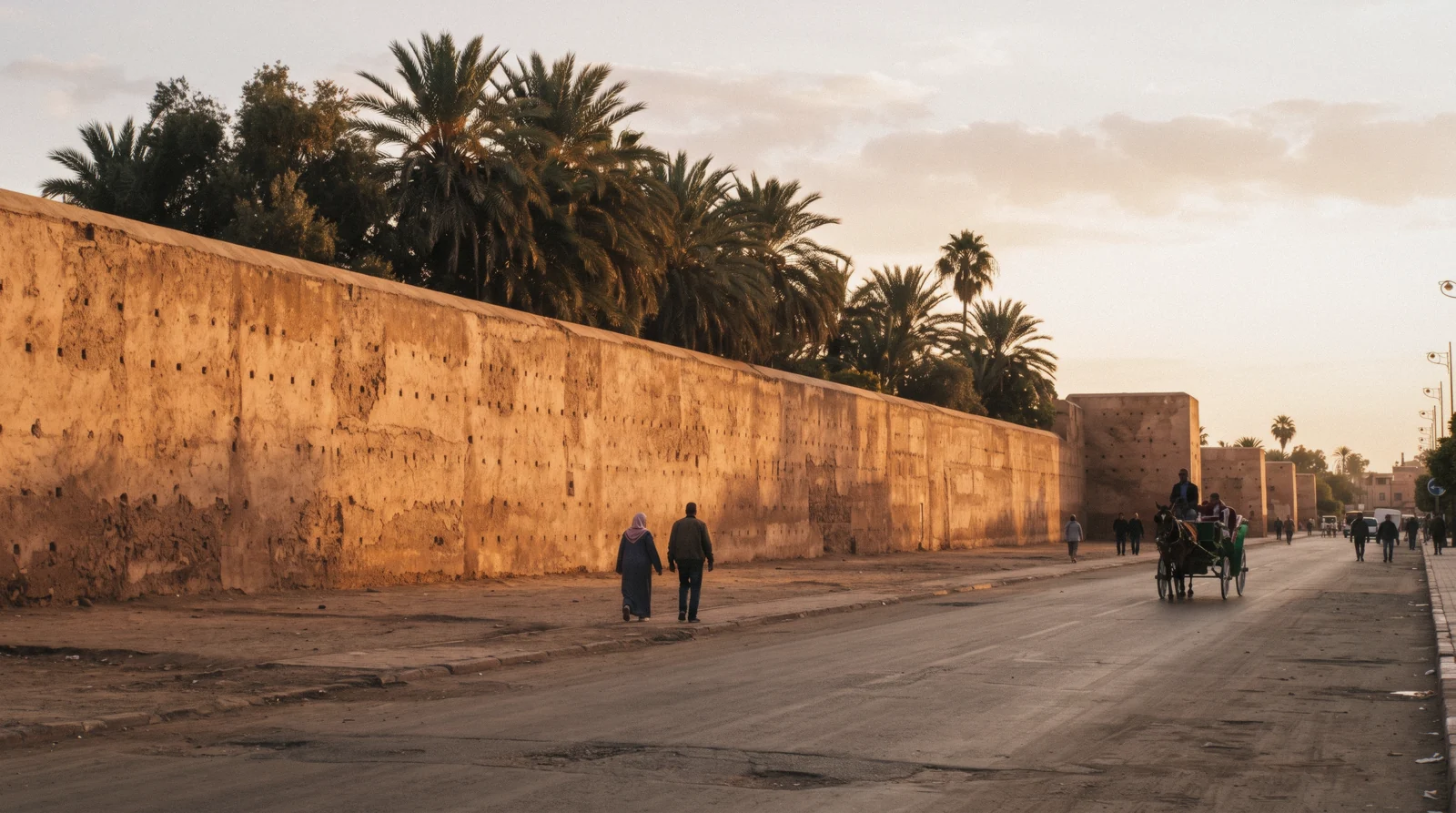
Two days in Marrakech
Adds the Kasbah morning and the Jardin Majorelle, with one taxi crossing to Gueliz.
- Three Ministry monuments in one walk
- Majorelle at 08:00 or after 17:00
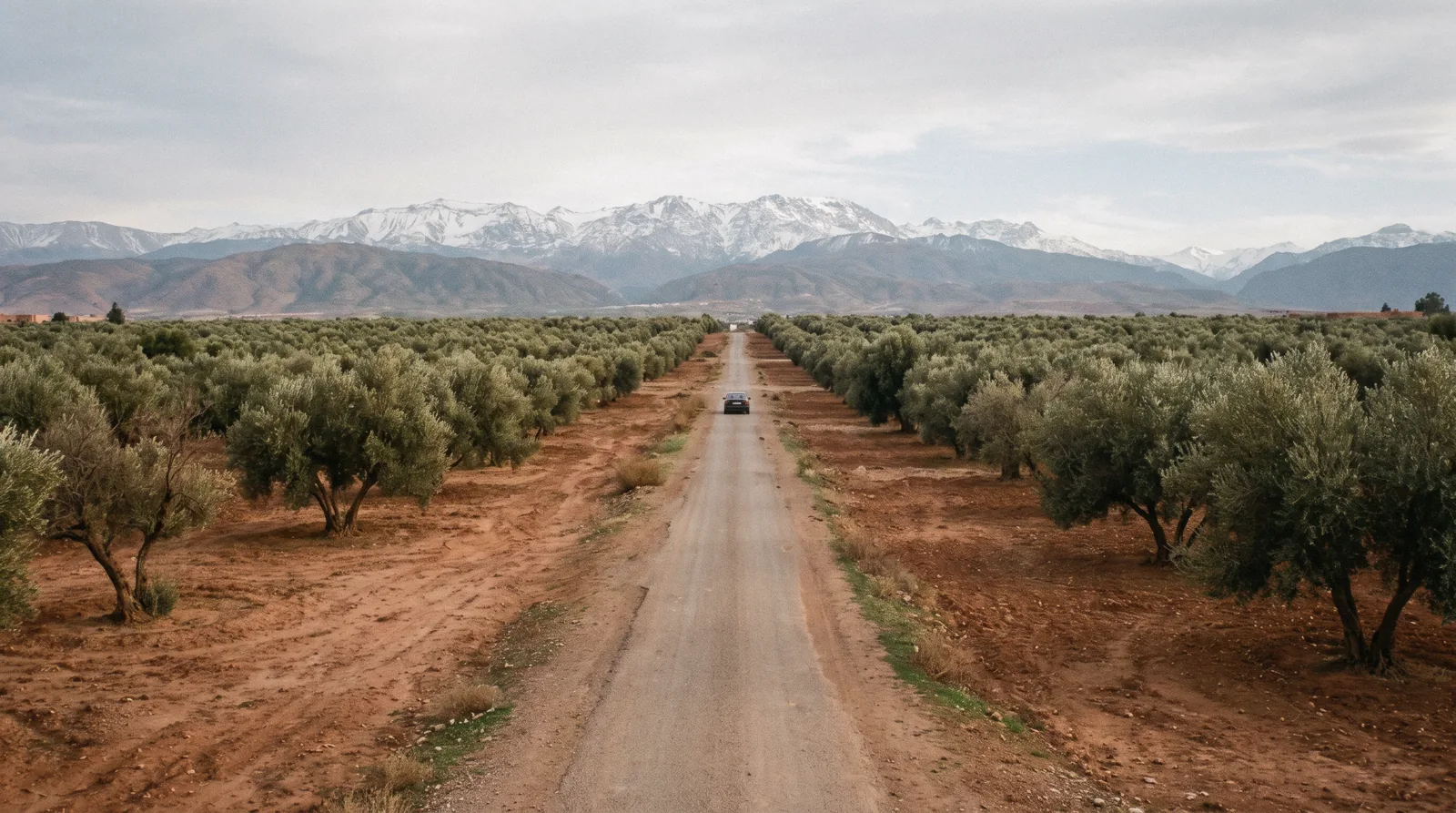
Three days in Marrakech
The full city list, then a choice between the Atlas, the Ourika valley and the Agafay hills.
- The quiet museums fit on day three
- A day out is the fourth day, not the third
Eating in Marrakech, and why this guide names almost no restaurants
There is no MICHELIN Guide restaurant selection for Morocco. Marrakech appears on the guide's own site under hotels only, so the citable list this site uses everywhere else does not exist here, and naming a restaurant would mean borrowing somebody's blog ranking.
What can be cited is the food itself. Couscous went on the UNESCO Representative List of the Intangible Cultural Heritage of Humanity in 2020, with Morocco among the submitting states, and UNESCO's own inscription for Jemaa el-Fna describes what the square's stalls sell: roast lamb, kebabs, tajines, snails and orange juice. That is the whole of the authoritative record, and it is more than most pages about Marrakech food are working from.
How the eating layer is actually organised
Three separate things get called Marrakech food and behave completely differently. The square's stalls set up in the late afternoon and are numbered rather than named; you sit at a trestle and the bill is negotiated in the open, which is either the best hour of the trip or an argument, depending on whether you asked the price first. The souk cook-shops around the medina serve one dish at lunchtime and close.
And the riad and rooftop restaurants take a booking and print a menu, which is the only one of the three where you know the price before you sit down.
The one dish that is local rather than Moroccan
Tanjia is Marrakech's own: beef or lamb sealed in a clay urn with preserved lemon and cumin and left in the ashes of a hammam furnace for hours. No authority publishes anything about it, so this guide does not print a price or a name for it, only what it is and where to ask. Where to eat sets out the three layers and what each one costs to sit down in.
The dates that change a Marrakech trip
Three things move the ground under a plan here: Ramadan, the Moroccan holiday calendar and the summer heat. All three are published, and two of them are not published far in advance.
Ramadan next begins in February 2027 according to UK government travel advice, and the exact date is not fixed in advance: it is determined by crescent observation and announced by the Ministry of Habous shortly before it starts. Two Marrakech sites publish Ramadan hours outright. The Ben Youssef Madrasa runs 09:00 to 16:30 instead of 09:00 to 19:00, and Le Jardin Secret 09:30 to 16:30.
Eating, drinking and smoking in the street during daylight causes offence, restaurants change their hours, and the hour before sunset is the quietest the souks get all year.
The holiday calendar, and one date that is not on it
Moroccan public holidays are set by decree and the religious ones follow the lunar calendar, announced only shortly before they fall. They matter here because the four Ministry of Culture monuments give Moroccan nationals free entry on the first day of a national or religious holiday, which is exactly when they are busiest. One correction worth carrying: 31 October, often printed by commercial calendars as the Fete de l'Unite, is not on the ministry's own list. Friday and holiday openings has the full picture.
The heat is a schedule, not a warning
July averages a daily high of 36.6°C and August 36.2°C over the thirty years to 2024, against 22.7°C in March. That does not make summer impossible, but it does mean the day splits: monuments from opening until about eleven, a long gap, and the square from six. The best time to visit page has the month-by-month figures and what each one does to a walking day.
What actually goes wrong in Marrakech
Four things, in the order they happen to people. All four are avoidable and none of them is the city being hostile.
The fare, at the airport and afterwards. No Moroccan authority publishes the Marrakech petit-taxi meter rates. What is published is that the meter is compulsory, under a 1963 dahir restated by Ministry of the Interior circulars in 2022 and 2024, and that each city's numbers are fixed by a local arrete nobody has put online. At the airport there are two official figures that disagree: a 2023 prefectural decision setting seven distance zones from 100 MAD, and the official destination guide's own 70 MAD by day.
The board at the rank is the only citable object. Getting around and airport to city set out both.
The guide who is not one
UK government travel advice names "people posing as official tourist guides" as a specific Morocco problem and tells visitors to ask for the official badge. Guiding is a licensed profession here, under Loi 05-12 as amended, with two statutory categories and a card. The approach usually starts as directions rather than an offer, somewhere in the souks where the lane forks. Safety and scams has what the advisories actually say, quoted rather than paraphrased.
The ticket you did not know was two tickets
The Jardin Majorelle's 170 MAD gets you the garden. The Berber Museum inside the same walls is a 60 MAD supplement, and the Musee Yves Saint Laurent next door is a separate 140 MAD ticket that is closed on Wednesdays. Work out which combination you want before the window rather than at it: the Majorelle ticket page lists all seven combinations the foundation sells.
The dirham you cannot buy in advance
The dirham is a closed currency. The Office des Changes states plainly that importing and exporting dirhams is prohibited, with a traveller's allowance of 2,000 MAD as the only exception, and UK travel advice describes it as not easily exchangeable outside Morocco. So you arrive with nothing and change at the airport or in town, and you spend what is left before you fly. What Marrakech costs covers the cards, the machines and what the banks publish.
Marrakech month by month
Average daily high temperature by month in Celsius with the Fahrenheit reading underneath, computed from the Open-Meteo ERA5 reanalysis for 31.63 N, 7.98 W over the thirty complete years from 1 January 1995 to 31 December 2024. Ten thousand nine hundred and fifty-eight daily records, none missing.
Marrakech is dry rather than arid: 269.6 mm of rain a year across 48 rain days, almost all of it between November and April. The winter nights are the surprise, averaging 3.8°C in January, and few riads are heated. Full figures on the best time to visit.
Rain, nights and what each month does to the plan
The same ERA5 series read as a planning table: the low that decides whether a riad courtyard is usable after dark, the rainfall, and what the month costs you.
| Month | Average high | Average low | Rain | What it means |
|---|---|---|---|---|
| January | 18.1°C (65°F) | 3.8°C (39°F) | 34.5 mm over 5.4 days | Bright days, cold courtyards, few riads heated |
| February | 19.9°C (68°F) | 5.2°C (41°F) | 31.8 mm over 5.5 days | The Atlas snowline is at its lowest and visible from the city |
| March | 22.7°C (73°F) | 7.5°C (46°F) | 37.3 mm over 5.8 days | Wettest month on the record, and still the best walking weather |
| April | 24.7°C (76°F) | 10.1°C (50°F) | 36.9 mm over 5.5 days | The month everything is open and everything is busy |
| May | 28.5°C (83°F) | 13.0°C (55°F) | 17.3 mm over 4.2 days | Rain stops; the afternoon starts to close the day down |
| June | 32.5°C (90°F) | 16.2°C (61°F) | 6.2 mm over 2.1 days | Monuments before eleven, square after six |
| July | 36.6°C (98°F) | 19.0°C (66°F) | 2.7 mm over 1.1 days | The hottest month on the record; the Atlas is the escape |
| August | 36.2°C (97°F) | 19.4°C (66°F) | 5.5 mm over 2.2 days | Same heat, and Moroccan holiday season on top of it |
| September | 31.4°C (89°F) | 16.8°C (62°F) | 11.3 mm over 2.4 days | The heat breaks in the second half of the month |
| October | 28.0°C (82°F) | 13.5°C (55°F) | 22.2 mm over 4.0 days | The best single month on this table |
| November | 22.4°C (72°F) | 8.3°C (46°F) | 34.3 mm over 4.9 days | Short warm days, cold evenings, thin crowds |
| December | 19.1°C (66°F) | 5.1°C (41°F) | 29.6 mm over 5.0 days | Cheap, quiet, and genuinely cold after dark |
Thirty-year means, Open-Meteo ERA5 archive, 1995 to 2024, computed on 8 September 2026 from 10,958 daily records. A rain day is a day with at least 1 mm. Marrakech publishes no monthly visitor count, so the crowd readings above are ours.
Getting around Marrakech: the meter, the bus that changed hands, and the walk
Marrakech has no tram and no metro. The surface network is buses, beige petits taxis inside the city, shared grands taxis out of it, and horse-drawn caleches, and the rules governing all four are more interesting than the fares, because the fares mostly are not published.
The medina is walking, and not by choice: most riad addresses cannot be reached by any vehicle, which is why arriving guests are met and portered. Everything on the must-see list except the Jardin Majorelle sits inside a 25-minute walk of Jemaa el-Fna.
| Getting there | What it is | Fare position | The catch |
|---|---|---|---|
| Petit taxi | Beige, city limits only, three passengers | Metered by law; no Marrakech tariff is published anywhere | Insist on the meter before the car moves |
| Grand taxi | Cream sedan, fixed routes, six shared seats | Set administratively per route; no table published | Leaves when full, not on a timetable |
| City bus | Supratours since 14 December 2025, ALSA before | 4 MAD was the last published fare, under the old operator | Every fare and timetable online predates the handover |
| Bus 19, airport | Airport to Gueliz, 30 minutes | 30 MAD single, 50 MAD return, per the official guide | First 06:15, last 21:15, every 30 minutes |
| Caleche | Horse-drawn, rank at Place Foucauld | No tariff arrete has ever been published | Agree the price and the route before you get in |
The operator change nobody has updated
Supratours, a subsidiary of the national rail operator ONCF, took over the Marrakech urban and suburban bus network on 14 December 2025, ending a 26-year ALSA contract. ALSA's own site now lists four Moroccan cities and Marrakech is not among them; every Marrakech URL on it returns a 404. The commune still hosts the line 19 timetable under the heading HORAIRE BUS ALSA MARRAKECH, so the one primary document on the network predates the handover too.
Treat 4 MAD as the last officially published urban fare rather than as today's.
Why the apps do not work here
Morocco has no legal framework for ride-hailing. Uber withdrew in 2018 saying it had received no clarity on how such apps fit the existing transport model; Careem was challenged before the competition authority; inDrive and Bolt operate outside the framework; Heetch is lawful only because it dispatches already-licensed taxis rather than running its own. Interior circulars in 2022 and 2024 instructed governors to suppress clandestine transport.
The metered petit taxi is the lawful option, and getting around explains what to do when the meter stays off.
What Marrakech costs, and the two figures nobody will tell you
Entry money is the one part of a Marrakech budget that is fully published. Beyond it, two of the numbers a visitor most needs, the tourist tax and the taxi fare, are set by documents that are not online.
Three days of the full city list costs one adult $78.80 (740 MAD) in entry at the international tariff. That is the floor and it is knowable in advance, which is more than can be said for the bed tax on top of it.
The tourist tax, as far as it can be established
Marrakech levies a taxe de sejour per person per night under loi 47-06 on local taxation, with the commune fixing the exact rate inside statutory brackets. The brackets in the 2007 text put maisons d'hotes and riads at 15 to 30 MAD, five-star hotels at 10 to 25, four-star at 5 to 10 and three-star at 3 to 7, with children under twelve exempt. Two caveats matter: loi 07-20 amended those tariffs in 2021 and the amended table could not be reached, and the commune's own decision fiscale locale, which carries the Marrakech rate, returns a 404.
The figure on your invoice is the authority. What Marrakech costs shows the working.
Cash, cards and a currency you cannot take home
No Moroccan bank publishes a surcharge for a foreign-issued card at a cash machine. Al Barid Bank's published 2026 grid charges its own customers 6 MAD to withdraw at another bank's machine, which is not what a visitor pays and should not be quoted as though it were. What is certain is the closed-currency rule: the Office des Changes prohibits importing and exporting dirhams beyond a 2,000 MAD traveller's allowance, so you cannot buy dirhams before you fly and you should not fly home with a pocketful.
Friday, Monday and the openings trap
Marrakech has no single closing day, which is the trap: each authority closes on its own schedule, and one of them changes its price rather than its hours.
Friday is the one to understand. The four Ministry of Culture monuments do not close, but Moroccan nationals enter them free that day, so Bahia and the Saadian Tombs are at their busiest on a Friday afternoon while costing a visitor exactly the same 100 MAD. Friday is also the couscous day and the main prayer day, and the souks thin out around midday.
| Site | Closed | Open | Worth knowing |
|---|---|---|---|
| Bahia, El Badi, Saadian Tombs, Koubba | No closing day published | 09:00 to 17:00 | Free for Moroccans on Friday, so busiest then |
| Ben Youssef Madrasa | No closing day published | 09:00 to 19:00, and 09:00 to 16:30 in Ramadan | The only site under the Ministry of Habous |
| Jardin Majorelle | Open every day | 08:00 to 18:30, last entry 18:00 | The Villa Oasis private garden closes Wednesdays |
| Musee Yves Saint Laurent | Wednesdays | 10:00 to 18:30, last entry 18:00 | The one weekly closure that catches people out |
| Dar Si Said | Mondays | 10:00 to 18:00, Tuesday to Sunday | The only Monday closure on this list |
| Le Jardin Secret | Open every day | 09:30 to 19:30 March to September, shorter in winter | Ramadan hours 09:30 to 16:30 |
What this means for a two-day plan
If your two days include a Wednesday, do the Jardin Majorelle that day and leave the Yves Saint Laurent museum for the other one. If they include a Monday, Dar Si Said comes off the list. Everything else is open, which makes Marrakech easier than most European cities in this respect and is why the itineraries can be built around the heat rather than around the closures.
Pick a district before you pick a riad
The choice is not between hotels here, it is between two different cities: a walled medina where no car reaches your door, and a protectorate-era grid where one does.
A riad is an inward-facing courtyard house, and inside the medina that means a lane too narrow for a vehicle, a porter with your suitcase, and a five-minute walk to the nearest point a taxi can stop. In exchange you are inside the walls, four minutes from the square, and out of the traffic entirely. Gueliz is the opposite trade: pavements, street numbers, cafes with printed menus, and a taxi that finds you, but a fifteen-minute ride to everything on the must-see list.
What the law now says a riad is
Moroccan accommodation law was rewritten by Law 80-14 and Arrete 985-24: riad and kasbah became classified categories in their own right, and maisons d'hotes moved from a category system to a star scale, with reclassification every five years, mystery audits against several hundred criteria, and a 24-month transition. The practical consequence for 2026 is that most riads advertising a star rating have not yet been reclassified under the new scale. Where to stay sets out the six districts, what each one suits, and what a night in it costs.
Seven questions before you book
The things visitors ask before anything is paid for, answered from the pages that own them.
Is Marrakech safe?
UK government travel advice carries no advise-against-travel wording for Marrakech and names petty crime in the medina quarters and people posing as official guides as the specific risks. Canada advises a high degree of caution nationally. The emergency numbers are 190 for police and 150 for an ambulance. What the advisories say
Can you drink the tap water?
No Moroccan authority publishes a drinkability statement for Marrakech. The distributor and the regional utility both failed to answer, and the national standard, NM 03.7.001, was not retrievable either. That silence is the honest answer. What is and is not published
What should I wear?
UK travel advice recommends loose clothing covering the arms, legs and chest, and notes that drinking alcohol anywhere but a licensed restaurant or bar is illegal. It is a dress convention rather than a rule at the monuments. Dress, Ramadan and photography
Do I need to book monuments in advance?
Only if you want to skip a window. The Ministry of Culture has sold Bahia, El Badi, the Saadian Tombs and the Koubba on its own platform since April 2025, and no site in the city uses timed entry slots. The four ticket authorities
Can I go inside the Koutoubia?
No. The interior is closed to non-Muslims, and that applies to working mosques across Morocco. The exterior, the excavated first mosque and the gardens are open to everyone and free. What you can actually see
How do I get in from the airport?
Bus 19 runs airport to Gueliz in 30 minutes, every half hour from 06:15 to 21:15, for 30 MAD. A taxi has a posted zone tariff at the rank starting at 100 MAD, and the tourism office's own guide prints a different figure. Both figures, side by side
Is the Sahara a day trip?
No. The Erg Chebbi dunes at Merzouga are about 560 km away and take nine hours each way. What is 40 minutes out is the Agafay, a stone desert rather than a sand one. Every day trip, with drive times
Marrakech questions people ask before they land
Is Marrakech worth visiting?
It is the densest concentration of ticketed Islamic architecture in Morocco inside one walkable walled city, with the High Atlas an hour away, and the entry money for the whole city list is $78.80 (740 MAD). It is also loud, hot for four months of the year and relentless in the souks, which is why our honest assessment sets out who it does not suit.
How many days do you need in Marrakech?
Three for the city itself, four if you want a day in the mountains. One day reaches the square, the Koutoubia, Bahia and the souks; two adds the Kasbah and the Jardin Majorelle; three covers everything on this page. The comparison above sets out what each length gives up, and the three-day itinerary places the stops by the hour.
What language is spoken in Marrakech?
Arabic and Amazigh are the official languages, French is the language of business and signage, and English is widely spoken in the tourist trade but not outside it. Nothing on the monument tariff sheets is published in English only, and the Ministry's ticket platform runs in French, English and Arabic.
Is there a Marrakech city pass?
No. Four separate authorities sell the tickets and none of them sells a combined pass, so there is nothing to buy that covers more than one of them. The nearest thing is the Fondation Jardin Majorelle's combined garden and museum ticket, which covers its own two sites only and is set out on the Majorelle ticket page.
When is the best time to visit Marrakech?
March to May and October to November, on the thirty-year record: highs of 22.7°C to 28.5°C against 36.6°C in July. October is the single best month on the table above, being warm, dry and past the summer. The month-by-month figures show what each one does to a walking day.
Do I need cash in Marrakech?
Yes, and you cannot bring it. The dirham is a closed currency that the Office des Changes prohibits importing beyond a 2,000 MAD allowance, so you change money on arrival. Cards work in hotels, the ticketed monuments and Gueliz restaurants; the souks, the taxis and the food stalls are cash. What Marrakech costs has the detail.
Marrakech, Morocco at a glance
- Coordinates
- 31.6295, -7.9811
The office, phone and email above belong to the city's own visitor service — they are not this site's contact details. To reach us, use the contact page.