 Marrakech Guidebook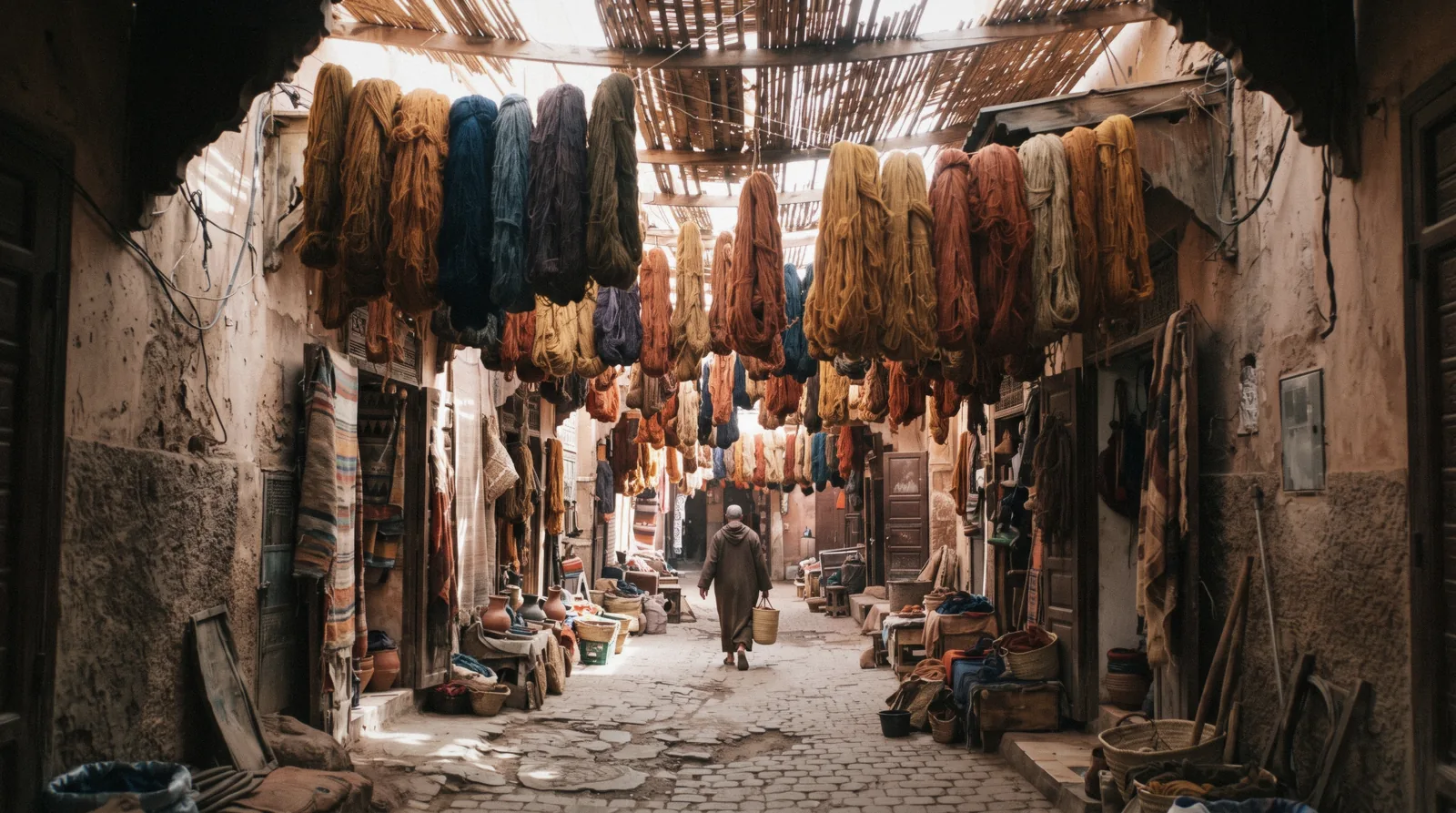
Marrakech Souks: Which Lane Sells What, and What Nobody Publishes
The Marrakech souks cost nothing to walk into, close whenever each shopkeeper decides, and price nothing on a label. That is not a gap in this page: it is the finding. No Moroccan authority publishes opening hours for the souks, no register of the lanes exists, and no body sets or records a price for anything sold in them, which is why every other guide's confident hours table is somebody's memory of one afternoon. What can be sourced is the frame around the shopping: UNESCO's own inscription text for the medina, the law that decides who may guide you through it, and the one currency rule that governs how much cash you can carry home. Start here, then walk the lanes north from Jemaa el-Fna with the rest of this Marrakech city guide in your pocket.
Quick answer What it costs, when it is open, and how a price gets set
Entry is free and there is no ticket, no gate and no closing time published by anyone: the souks are ordinary public streets covering part of a 700-hectare medina, and every price in them is agreed between two people rather than printed.
Key takeaways
- Nobody official publishes souk hours or shop prices, so plan around daylight rather than a timetable, and expect the lanes to thin around Friday midday; the wider medina picture is on the medina page
- Guiding is a licensed profession here and a real guide carries a card and a badge, which is what makes a three-hour guided souk walk different from the man who offers to show you the tanneries
- A shopping walk with a local guide is listed at $27.64 and buys you translation and a second opinion on quality rather than a discount you could not have got yourself
- You cannot bring dirhams into Morocco or take more than 2,000 of them out, so budget your shopping in cash you change here, as what Marrakech costs sets out
The souks, trade by trade, north from the square
The lanes are named for their trades, not for streets: a souk is a craft with an address rather than a market with a door. No authority publishes a register of them, so the names below are the trade names in daily use, given in the order you meet them walking north from Jemaa el-Fna. Each entry says what is actually made there and what to look at before you talk about money.
The spine, straight up from the square
-
Souk Semmarine, the covered main street
Textiles, souvenirs, everything
The wide covered lane running north out of the top-right corner of Jemaa el-Fna, roofed with slatted reed that throws the striped light every photograph of Marrakech uses. It is the busiest, the most popular and the most souvenir-heavy stretch in the city, and the one souk most people mean when they ask which is the main one, and it is also the one lane you cannot get lost on, because it runs in a single line. Treat it as the corridor to the real workshops rather than the destination.
Tip: Prices on this stretch open higher than anywhere else, for the simple reason that most people never walk past it.
-
Rahba Kedima, the old square
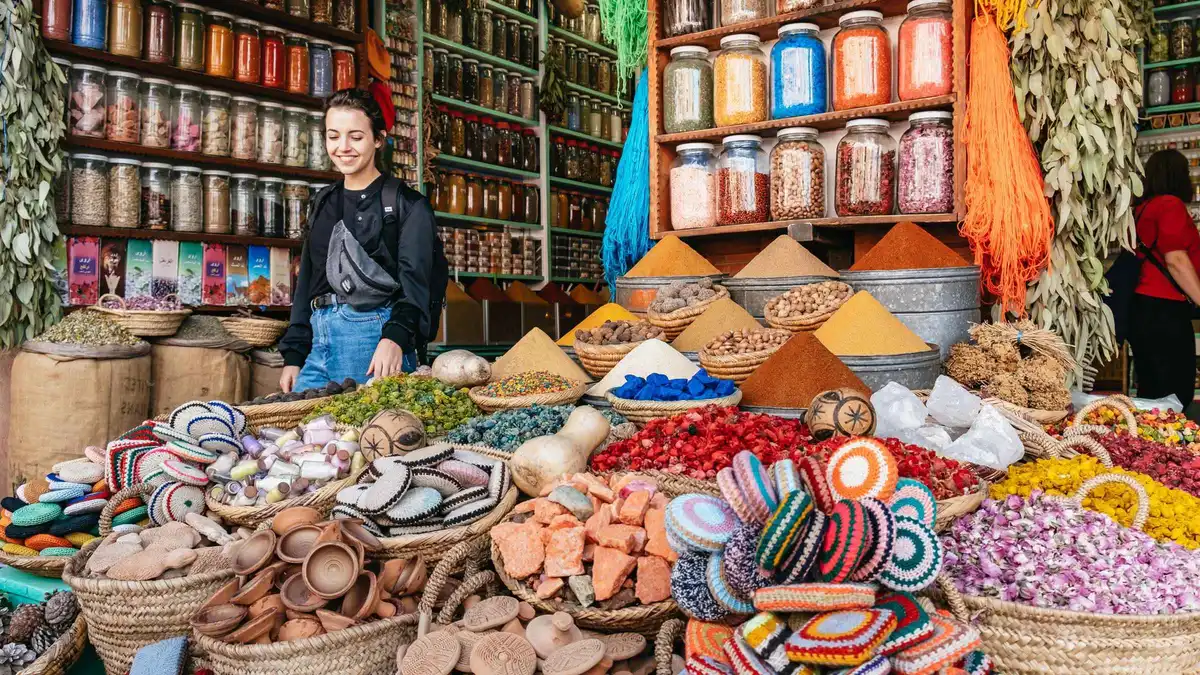
Spices, herbs, baskets
A small open square off the spine, ringed by apothecary stalls selling cumin, ras el hanout, dried roses, ghassoul clay and the woven baskets stacked in the middle. It is one of the few named places in the souks that carries its own record in Wikidata, listed simply as a square in Marrakesh.
Tip: Spices are the one purchase where weight rather than charm decides the value: ask for a hundred grams and watch the scale.
-
Souk el Attarine, the perfumers
Perfume, brass, lanterns
North of the old square the lanes narrow and the trade shifts to scent and metal: attar oils, argan, amber blocks, and the pierced brass and iron lanterns that sit half-finished on the workshop floor. The lantern makers work in the open, which is the fastest way to tell a hand-pierced piece from a stamped one.
-
Souk Cherratine, the leather
Bags, babouches, belts
The leather lanes sit east of the spine and are the noisiest workshop quarter in the medina: cutting, stitching and dyeing all happen at the counter you are buying from. The hides come from the pits at the tanneries a fifteen-minute walk north-east, which is worth seeing before you buy rather than after.
The workshop lanes, west and north
-
Souk Haddadine, the ironworkers
Iron, lanterns, grilles
You hear this one before you see it. Hammering, sparks and open forges, with finished lanterns hung in rows above the working benches. It is the least touristed of the craft lanes and the one where prices start closest to what the work is worth.
-
Souk Sebbaghine, the dyers
Wool, silk, dyed skeins
Skeins of freshly dyed wool hung across the lane to dry overhead, which is the image on the top of this page. The colour is the product: ask what the dye is, because natural indigo, saffron and poppy behave differently in the wash from the synthetic dyes sold beside them.
-
The carpet dealers around Souk Zrabi
Rugs and kilims
Carpets are sold in first-floor rooms rather than street stalls, over mint tea, in a session that takes an hour whether or not you buy. It is the single largest purchase most visitors make in Marrakech and the one where the price gap between a good and a bad negotiation is widest.
-
Ensemble Artisanal, Avenue Mohammed V
Craft complex
A state-linked craft complex on the road out towards Gueliz, mapped in OpenStreetMap but with no official page, no published hours and no published prices. Visitors use it as a calibration stop before the souks. We could not source a single official fact about it beyond its existence, and we say so rather than repeat what the blogs claim about fixed prices.
Where the souks stop and something else starts
-
Ben Youssef Madrasa, at the top of the lanes
Monument from $5.33 (50 MAD)
The souks end at the madrasa quarter, and the cheapest important ticket in Marrakech is right there at $5.33 (50 MAD). Most souk walks finish here because it is the one door in the northern medina worth going through.
-
Jemaa el-Fna, at the bottom
Square free
Every route through the souks starts or ends on the square, and the food stalls that set up there in the late afternoon are the other half of a souk evening. UNESCO inscribed the square's cultural space in 2008, twenty-three years after the medina itself went on the World Heritage list.
-
Gueliz, the shops with price tags
New town
Twenty-five minutes' walk west of the square, the French-built new town sells the same crafts through galleries and concept stores at posted prices. It is the honest comparison point: see what a rug or a lantern costs with a label on it, then decide what the souk price is worth to you.
There is no official list of the Marrakech souks. These are the trade names in everyday use, checked against the layout of the medina rather than against a register, because no register exists.
What each trade makes, and what to look at before you talk about money
Four crafts account for most of what leaves Marrakech in a suitcase. The judgement column is the practical one: it is what the workshop itself shows you if you stand still for two minutes, and it is why walking the lanes where the work happens beats buying on the covered spine.
| Craft | Where the work happens | What tells you it is hand-made | What goes wrong |
|---|---|---|---|
| Leather (bags, babouches) | Souk Cherratine and the lanes east of the spine | Stitching is slightly uneven and the edges are burnished, not glued; the smell is strong for weeks | Split leather sold as full grain, and dye that transfers onto everything for a month |
| Pierced metal lanterns | Souk Haddadine and Souk el Attarine | The piercings vary by a fraction and the solder is visible inside the seams | Stamped sheet with identical holes, sold at the hand-worked price |
| Wool rugs and kilims | First-floor rooms around the carpet lanes | Knots are visible and slightly irregular on the back; the pile pulls apart to show the same colour beneath | Cotton warp described as wool, and a chemical shine that natural dye does not give |
| Spices and argan | Rahba Kedima and the apothecary stalls | Sold by weight on a scale you can see; whole spices you can smell before grinding | Powdered ras el hanout padded with cheaper filler, and cosmetic argan sold as culinary |
This is craft judgement, not certification. No Moroccan authority operates a quality mark for souk goods, so nothing here can be checked against a register, and this guide names no shop for exactly that reason.
Guided souk walks compared
Two products, doing two different jobs. The first is orientation, the second is translation and a second opinion at the counter. Prices are the platform's own listed figures for one adult and are confirmed at checkout.
 from $17.90
Marrakech: Colorful Medina Souks Guided Walking Tour
listed at $17.90
Three-hour guided walk through the dyers', metalworkers' and spice souks with a local guide. Sold as a shared small group or a private walk, pickup optional.
Check Availability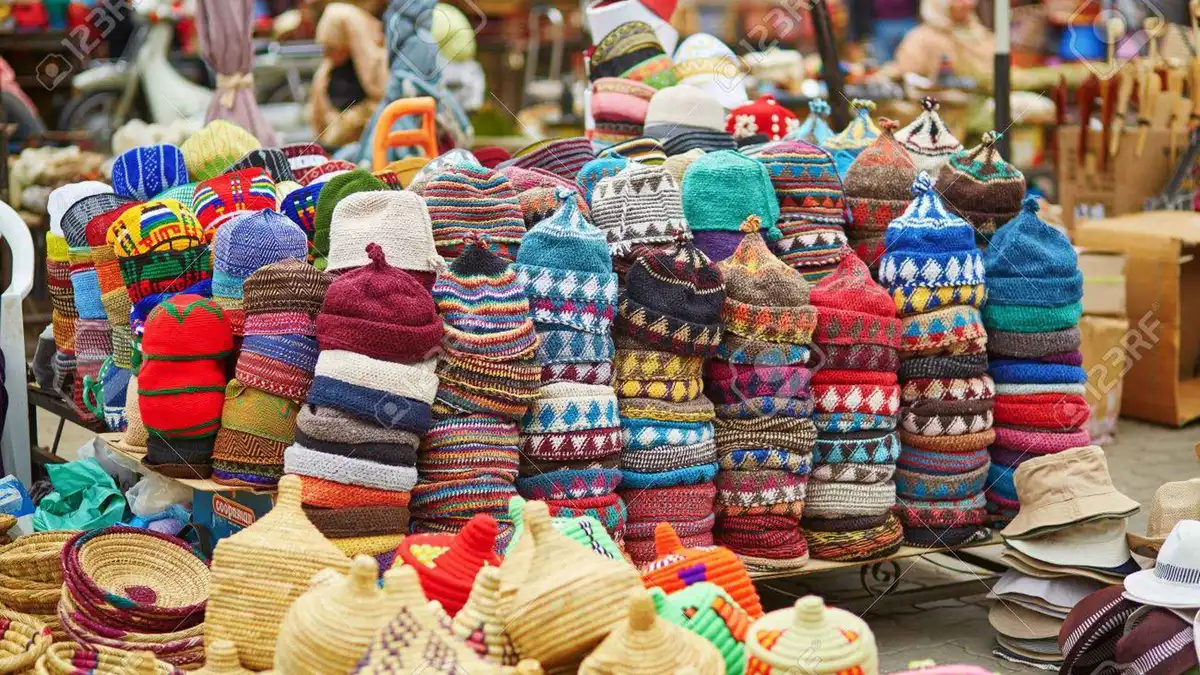 from $27.64
Marrakesh: Guided Souk Shopping Tour with a Local Guide
listed at $27.64
Three-hour shopping walk with a local guide who translates and handles the haggling in the artisan souks. Runs in English or Italian, no pickup.
Check AvailabilityPrices, ratings and details are the platform's own, checked in Q3 2026; dollar figures are the listed prices — the platform bills in your account's currency.
What the Souks Actually Are, Legally and Physically
The one authoritative description of the souks is inside a document about something else: the file that put the medina on the World Heritage list in 1985.
The evaluation ICOMOS wrote for that inscription describes the property as an ancient habitat that, "with its maze of narrow streets, its houses, its sooks (markets), fonduks, its traditional crafts and trade activities, its medina of 700 hectares", stands as an eminent example of a living historic city. That sentence is the whole of the official record of the Marrakech souks. There is no ministry page, no craft-authority register, no published map.
The souks are streets inside the Medina of Marrakesh, and the medina is a World Heritage property of 700 hectares which people live and work in, which is why nothing about it behaves like an attraction.
So there is no gate, no ticket and no closing time
You do not enter the souks, you walk up a street. There is no admission and nobody to pay. Shops open when their owners open them and shut when they shut, which in practice means the lanes fill from mid-morning, hold until the early evening, and go quiet around Friday midday prayers, when many shopkeepers close for an hour or two.
That last point is the most useful one on the page and it is also the one we cannot source: no authority publishes it, so treat it as an observed rhythm and not a timetable. If you need a guaranteed open door on a Friday, the openings page sets out which ticketed monuments keep normal hours.
At night the lanes are not a night market
Search results promise the souks at night, and the reality is narrower: the craft lanes shut with the daylight trade, and what stays open after dark is the covered spine near the square, the food stalls on Jemaa el-Fna and the cafes around it. The square's own cultural space is what UNESCO inscribed in 2008, separately from the medina, and it is genuinely a nightly event. The workshops are not.
How a Price Gets Set When Nobody Publishes One
Bargaining is the part every visitor worries about and the part no authority regulates, so this section separates what is legally true from what is simply how the trade works.
Nothing sold in the souks carries a published or regulated price. There is no maximum, no posted tariff and no consumer register you can check a figure against, which means the widely quoted rules of thumb about opening at a third and settling at a half are folklore, not a standard. What is actually true is narrower and more useful: the seller's first number reflects what the last visitor paid, so the number you are given says more about the lane you are standing in than about the object in your hand.
Walking two hundred metres off the covered spine changes the opening figure more reliably than any negotiating technique.
Cash, cards and the currency you cannot take home
The dirham is a closed currency. The Office des Changes states that importing and exporting dirhams is prohibited, with a traveller's allowance of 2,000 MAD, worth about $213.00, as the only exception. So you cannot buy dirhams before you fly, you change money here, and you should not fly home with a pocketful.
In the souks that has one practical consequence: bring cash for the day and decide your ceiling before you start, because the machine that would let you top up is a walk away and no shopkeeper's card terminal is a given. What Marrakech costs covers the banks, the machines and what nobody publishes about card fees.
Shipping a rug is a separate negotiation
Carpet dealers offer to ship, and the shipping price is a second deal you make after the first one is settled, which is exactly when your attention is lowest. Agree the object, then agree the freight, then pay. No Moroccan authority publishes anything about craft exports to travellers, so what protects you is a written receipt with the dealer's name and address on it and a card payment where one is possible.
The Man Who Offers to Show You the Tanneries
This is the one souk problem that has a legal answer, and it is a much stronger answer than the travel forums suggest. Guiding in Morocco is a licensed profession with a card, a badge and a criminal penalty for impersonation.
Loi 05-12, published in the Bulletin Officiel in 2012, governs the profession. Article 5 states that nobody may practise as a tourist guide without an approval issued by the competent administration. Article 10 requires a working guide to carry a professional card and a badge issued by that administration and to produce them at any moment on the request of sworn officials.
The frequently repeated story about a 1956 law is not supported by any official text; the 2012 statute repealed the 1997 one and mentions nothing from 1956.
The penalty falls on him, not on you
Article 21 sends the offence of usurping the title of guide to Article 381 of the Penal Code, which sets three months to two years in prison and a fine of 120 to 5,000 dirhams. A licensed guide who lends or rents out his own card faces six months to a year and a fine of 10,000 to 20,000 dirhams, and a company operating without approval faces 100,000 to 200,000 dirhams. Nothing in the law penalises the tourist.
Knowing that changes the encounter: you are not doing anything wrong by declining, and asking to see a badge is a normal request that a real guide answers in two seconds.
| Who | What the law says | The penalty |
|---|---|---|
| An unlicensed person acting as a guide | Loi 05-12 Article 21, referred to Penal Code Article 381 | 3 months to 2 years, fine 120 to 5,000 dirhams |
| A licensed guide lending out his card or badge | Loi 05-12 Article 22 | 6 months to 1 year, fine 10,000 to 20,000 dirhams |
| A guiding company with no approval | Loi 05-12 Article 23 | Fine 100,000 to 200,000 dirhams |
| The tourist who went along with it | Nothing in loi 05-12 applies | None |
What the advisories actually say
UK travel advice states plainly that "it is common for people posing as official tourist guides to harass tourists" and that if you use a guide in a medina quarter you should "make sure they have an official badge and permission from the local authority". France's foreign ministry documents the only Marrakech-specific scam any authority records, and it is not the souk approach at all: fake agencies offering preferential travel deals or VIP contracts, which "exigent un paiement initial ou une empreinte bancaire pour verifier la solvabilite des clients" and then take fraudulent transfers from the account. Both governments describe pickpocketing and drive-by motorcycle theft of bags and visible jewellery in medina quarters. Safety and scams quotes both advisories at length rather than paraphrasing them.
There is no official guide tariff either
Article 12 of the same law leaves guides' rates indicative only, set by the national federation of guides. So there is no published half-day rate to hold anybody to, and the platform products are the only Marrakech guiding prices with a number attached: the three-hour souk walk at $17.90 and the shopping walk at $27.64, both cancellable free up to 24 hours before.
What to avoid in the souks
What to avoid here is short, and it is mostly not what the forums say. Avoid handing a card to anybody who asks for an imprint, because the fake agency taking a card imprint and then moving money out of the account is the only Marrakech-specific scam a government documents. Avoid following an unbadged stranger down a lane to a workshop or a tannery, and then avoid worrying about having declined, because the offence is his and nothing in the law touches you.
Avoid a visible watch or a bag carried on the street side, which is exactly what both advisories describe being taken off pavements by riders. Avoid changing more cash than you intend to spend, because you cannot legally carry more than 2,000 dirhams out of the country. And avoid treating the first number as either an insult or a fixed price: no authority sets or records a price for anything sold in these lanes, so the number is an opening position and nothing more.
The Carpet Room, and the Hour You Are About to Spend
Rugs are the biggest purchase in the souks and the one with the longest ritual around it. Knowing the shape of that ritual is most of the defence.
The pattern is consistent: you are invited upstairs, mint tea arrives, and a young assistant unrolls between fifteen and forty rugs onto the floor while the dealer reads which ones you looked at twice. Nothing is priced until you ask, and the first number comes late. It is hospitality and it is also sales technique, and the two are not in conflict.
What matters is that the tea does not obligate you. Leaving after an hour without buying is normal and nobody is insulted by it.
What you are actually judging
Turn the rug over. Hand-knotted work shows irregular knots on the back and the pattern reads clearly through; a machine or a glued piece does not. Pull the pile apart with a thumb and look at the colour at the root, because a natural dye is the same shade at the base as at the tip and a surface dye is not.
Ask whether the warp is wool or cotton and expect a straight answer. A flat-woven kilim is a different object from a knotted pile rug and costs less to make, which the price should reflect.
The one thing to settle before the price
Ask what the rug is and where it was made before you ask what it costs, because the answer sets the frame for everything after it. Then agree the object and the price, then, separately, the shipping. If a guided pair of eyes helps, the shopping walk with a local guide at $27.64 is three hours and puts a Moroccan speaker between you and the room.
It carries a 4.9 rating from 719 reviews on the platform, and it is sold in English and Italian.
Is There Anywhere in Marrakech With Price Tags?
Yes, in two places, and only one of them is a shop in the ordinary sense. Neither publishes anything official about itself, and that is worth saying out loud.
The Ensemble Artisanal on Avenue Mohammed V is the answer everyone gives. It exists, it is mapped in OpenStreetMap on the Bab Doukkala stretch of the avenue, and it is described everywhere as a fixed-price state craft complex. What could not be found on any official Moroccan site was a page for it, an opening time, or a price for anything in it; the national craft body's own site failed to connect.
So we record what is verifiable, which is that the building is there, and we do not repeat the fixed-price claim as a fact. Go if you want a calibration stop, and treat any figure you see there as one data point rather than the official rate.
Gueliz, where the tags are real
The new town west of the medina sells the same crafts through galleries and design shops with prices on them. It is a twenty-five minute walk or a metered petit taxi from the square. Nothing there is cheaper, and that is the point: it tells you what a lantern or a rug is worth to a shop paying commercial rent, which is the number your souk negotiation is happening around. Gueliz has the layout and the transport.
What the souks do better than either
The workshops. In Souk Haddadine and the dyers' lanes you buy from the person who made the thing, standing where it was made, and no gallery reproduces that. It is also why the price is negotiable there and not in Gueliz: you are dealing with a maker, not a retailer with a payroll.
Marrakech Souks Map: the Lanes and What Bounds Them
The souk quarter with its two anchors and the monuments embedded in it. There is no official coordinate for the souks as an entity, so the central pin is the medina centroid from Wikidata; everything else is that place's own verified point.
Coordinates from each venue's own ticket platform or its verified Wikidata point. No souk-specific official coordinate exists, which is why the red pin is the medina centroid.
Where to Go Next From the Souks
Walking minutes are our estimates from the coordinates above, along the lanes rather than in a straight line.
Ben Youssef Madrasa
The obvious full stop to a souk morning, and at $5.33 (50 MAD) the cheapest important ticket in the city. It sits under a different ministry from every other monument here, which is why you cannot buy it on the Ministry of Culture platform. The madrasa page has the hours and the ticket.
5 min walk from the top of the lanesThe Bab Debbagh tanneries
Where the hides in the leather lanes are actually processed. Nobody publishes a price or a guide fee for the tanneries, and the approach is the classic setting for the unofficial guide, so read the tanneries page before you go rather than after.
15 min walk north-eastJemaa el-Fna after dark
The square is the other half of a souk day: the stalls set up in the late afternoon and UNESCO's inscription for its cultural space describes exactly what they sell. The square's page covers the food layer and the henna question.
8 min walk southMarrakech Souks: Questions
What are the opening hours of the Marrakech souks?
There are none published by anyone. The souks are public streets, so there is no operator to set hours, and no Moroccan authority publishes a trading timetable for them. In practice the lanes fill from mid-morning and empty in the early evening, with a quiet stretch around Friday midday prayers, but that is our reading rather than a stated fact. If you want a door that is certainly open, the ticketed monuments publish real hours and the openings page lists them.
Is there an entrance fee for the souks in Marrakech?
No. Nobody sells a ticket to a street. The only fee you meet in the souk quarter belongs to the monuments inside it, such as Ben Youssef Madrasa at $5.33 (50 MAD) or Le Jardin Secret at $10.65 (100 MAD). Everything else costs what you agree to pay for an object.
Should I book a guided souk tour or walk the lanes alone?
Walk them alone if you are comfortable being approached and want to browse at your own pace, which most people are by the second day. Book a walk if you want the trade geography explained in one go, or if you are buying something significant and want a Moroccan speaker with you. The three-hour souks walk is listed at $17.90 with a 4.7 rating from 2,933 reviews, and the shopping walk at $27.64 is the one built around buying rather than seeing.
How much should I pay in the souks, and is haggling expected?
Nothing is priced or regulated, so there is no correct figure to give you and this guide will not invent one. The seller's opening number reflects the lane you are standing in more than the object itself, which is why the workshop lanes open lower than the covered spine. Decide your own ceiling before you start, carry it in cash, and remember the 2,000 MAD limit on dirhams you can take out of the country, which is about $213.00.
What is the safest way to carry money and shop in the lanes?
Both the UK and the French foreign ministries describe pickpocketing and drive-by motorcycle theft of bags and visible jewellery in medina quarters. Carry the day's cash rather than everything, keep the bag on the wall side of the lane away from passing scooters, and be deliberate at cash machines, which UK advice singles out. Safety and scams quotes both governments in full.
Are the souks open at night?
Partly. The craft workshops close with the day trade, and what stays lit after dark is the covered stretch nearest the square plus the food and cafe layer around it. If your plan is an evening in the medina rather than shopping, the square is the event: its cultural space went on the UNESCO Representative List in 2008 and the stalls run well into the night. Jemaa el-Fna has the timings.
Can I take photographs in the souks?
Of the lanes, yes. Of people, ask first: UK travel advice states that you should always ask permission before photographing people, especially children, and photography near sensitive political or military sites is illegal. Some stallholders will ask for money in exchange, which is a transaction rather than a scam; agree it or put the camera down.
The Souks on Film, Before You Walk Them
Three walk-throughs that show the width of the lanes, the light under the reed roofs and the pace of the approach, which is the part the photographs never convey.
Exploring The Souks of Marrakech. Walking Tour | Morocco
An unbroken walk through the covered spine and the craft lanes at normal pace, which is the best sense of the layout you will get before arriving.
Video: Nicolai WinnerSouks of Marrakech Morocco: What Can You Buy?
A trade-by-trade look at what is actually on sale, useful alongside the craft table above.
Video: TravelandTellno1Marrakech Souks Survival Guide: All You Need To Know
The approach, the haggling and the getting-lost problem, from visitors who clearly did all three.
Video: Tom and Nikki TravelVideos load from YouTube only when you press play.
Reviewed Q3 2026 (July–September 2026); next review Q4 2026. Prices, hours and terms are set by the venue or operator and confirmed at checkout.
We may earn a commission if you book through one of our links, at no extra cost to you. Full affiliate disclosure