 Marrakech Guidebook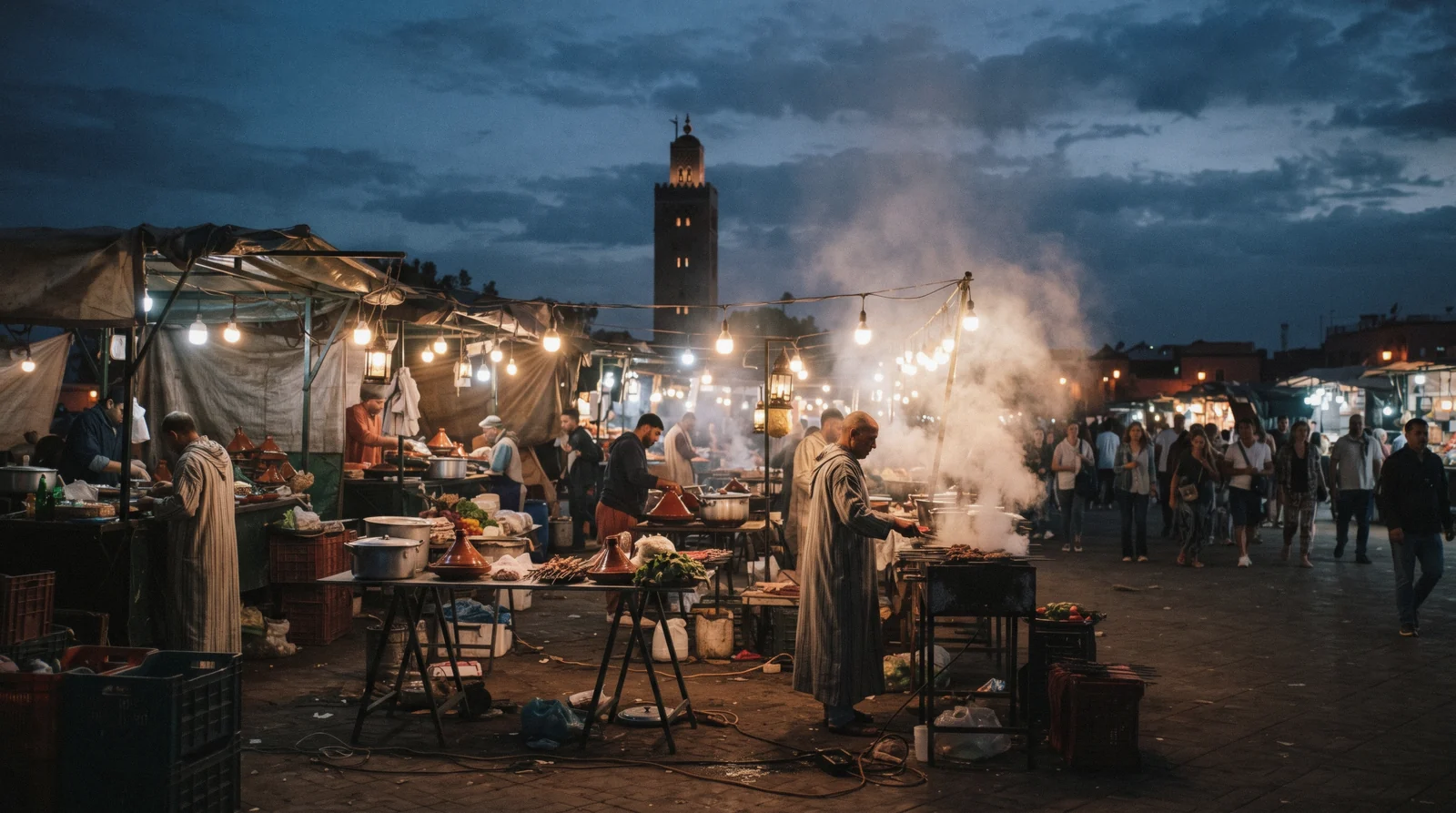
Where to Eat in Marrakech: Three Layers, and Why No Restaurant Is Named Here
Deciding where to eat in Marrakech is not really a question about restaurants. It is a question about which of three completely different systems you want to deal with that evening: the numbered stalls that are assembled on the main square after dark and settled dish by dish in cash, the souk cook-shops that serve one thing at lunchtime and shut, or the riad and rooftop restaurants that take a booking and print a menu with prices on it. Each one prices differently, each one settles the bill differently, and only the third one lets you know the number before you sit down. This page sets those three out, prints what an official source will actually vouch for about the food itself, and says plainly why it names no restaurant: there is no MICHELIN Guide selection anywhere in Morocco, so the citable list this site uses elsewhere simply does not exist for eating here. The square's own food layer is covered on the Jemaa el-Fna page, the spice and apothecary lanes on the souks page, and the Marrakech guide behind this page puts a first trip in order.
Quick answer The three layers, what each costs to sit down in, and what to order
Eating here splits three ways, and only one of the three publishes a price before you sit down. There is no MICHELIN Guide restaurant selection anywhere in Morocco, so this guide names no restaurant at all. What official sources do vouch for is the food itself: couscous went onto the UNESCO Intangible Cultural Heritage list in 2020 in a joint file with Algeria, Mauritania and Tunisia, and the national tourist office names tanjia as the staple dish of Marrakech.
Key takeaways
- The square's stalls are cash, dish by dish, with nothing priced on a board: agree each figure before it is put down, as the Jemaa el-Fna page sets out in full
- For a first evening, a guided walk removes the whole negotiation: the medina food tour with more than 15 tastings runs 4 hours at $55.51 and carries a 4.9 rating from 193 reviews
- To learn the dishes rather than just eat them, the cooking class with a market shop is $38.70 for two and a half to three hours, ending with the tagine you cooked
- Bring cash. The dirham is a closed currency you can only change on arrival, and stalls and cook-shops take nothing else, which what Marrakech costs explains
The three eating layers, and how each bill actually works
This is the table this page exists for. The three layers are not price brackets, they are three different systems for arriving at a number, and the column that matters is the third one. Nothing here carries a currency figure because no authority and no citable guide publishes restaurant or stall prices in Marrakech, and this site does not reprint blog numbers as though a city hall stood behind them.
| The layer | Where it is | How the price is set | What you must agree first | Book? |
|---|---|---|---|---|
| The square's numbered stalls | Jemaa el-Fna, assembled on the tarmac from the late afternoon | Negotiated dish by dish; nothing is posted and no register exists | The price of each dish before it is served, and that extras are extras | No. Walk up, cash only |
| Souk cook-shops and lunch counters | The lanes north of the square, around the trade souks | A short fixed repertoire, usually one or two dishes at a set figure the counter states | What is actually on today, since most sell out and close | No. Arrive by 13:00 |
| Riad and rooftop restaurants | Inside the medina behind unmarked doors, and across Gueliz | A printed menu, and the only layer where the number is knowable in advance | Nothing, beyond whether the roof or the courtyard is where you want to sit | Yes, and worth doing |
| Guided walks and classes | The medina lanes, on a 4 hour tasting walk or a class with a market shop | Published in advance: $55.51 and $38.70, confirmed at checkout | Any allergy, at the time of booking rather than on the day | Yes. Free cancellation up to 24 hours before |
The gap between the layers is not quality. It is how much you have to negotiate while hungry. A visitor who is comfortable asking prices out loud eats extremely well for very little on the first two; a visitor who is not will have a better evening on the third, and neither is the wrong answer.
What to eat in Marrakech, grouped by what a source will vouch for
Every dish below is grouped by the strength of the record behind it rather than by course, because that is the honest way to present food writing. The first group has a UNESCO inscription or the national tourist office's own words behind it; the last group has nothing at all, and says so. Quotations are as published, including their spelling.
Marrakech's own dish
-
Tanjia, the dish this city owns
Slow-cooked meat
The national tourist office is unambiguous about it: traditionally prepared with lamb or veal in a terracotta jar, tanjia is the staple dish of Marrakech. It is a single-portion urn of meat with preserved lemon, cumin and saffron, sealed and cooked slowly in embers rather than on a stove, and it is the one thing on this page that belongs to this city rather than to Morocco.
Tip: It is traditionally a working man's dish rather than a restaurant one, so it is ordered ahead in many places rather than picked off a menu.
On the UNESCO Intangible Cultural Heritage list
-
Couscous
Inscribed 2020
Inscribed under reference 01602 in a joint file submitted by Algeria, Mauritania, Morocco and Tunisia. UNESCO calls it a dish replete with symbols, meanings and social and cultural dimensions all linked to solidarity, conviviality, sharing meals and togetherness, and describes the semolina being rolled by hand, steamed and then cooked.
Tip: The tourist office adds the timing that decides your week: couscous is traditionally eaten on Fridays.
-
The Mediterranean diet, with Morocco among the states parties
Inscribed 2013
Reference 00884, whose current inscription dates from 2013 and extends an earlier one from 2010, lists Morocco alongside Cyprus, Croatia, Spain, Greece, Italy and Portugal. It is the reason the vegetable, pulse and olive oil half of Moroccan cooking has an international listing behind it rather than only the meat dishes.
Tip: Useful if you eat little meat: the pulses and vegetables here are the tradition, not a concession to you.
-
The food stalls of the square
Inscribed 2008
The cultural space of Jemaa el-Fna, reference 00014, is inscribed for its practices rather than its buildings, and the file describes the trade in its own words: all through the day, and well into the night, a variety of services are offered, and water-carrying, fruit and traditional food may be bought.
Tip: That sentence is the entire official record of eating on the square. Everything else about it is somebody's evening.
Described by the national tourist office: the dishes
-
Tajine
Stew, and the pot it is named after
The tourist office puts it simply: amongst the most sought-after dishes in Morocco is tajine. The conical lid returns condensation to the pot, which is why the meat is stewed rather than dried out, and why a tajine on a menu means a method rather than one recipe.
Tip: Chicken with preserved lemon and olives, and lamb with prunes, are the two versions on almost every medina menu.
-
Harira
Soup
Described by the tourist office as a typical Moroccan soup known for its nutritious formula, composed of a subtle mixture of pulses, tomatoes, pasta and flour. Its gastronomy page ties it to Ramadan, when it is the standard dish for breaking the fast.
Tip: It is the cheapest hot thing on the square and among the best, sold from stalls with a stack of bowls rather than a menu.
-
Pastilla
Filled pastry
Served in puff pastry form, in the tourist office's words, and filled either with fish, chicken, pigeon or with almond. The sweet and savoury combination in the poultry version is the thing visitors either love or find baffling, and it is worth ordering once to find out which.
Tip: It is a restaurant dish rather than a stall one, so it belongs to the third layer.
-
Mechoui
Whole roast lamb
Published by the tourist office as a traditional way of cooking a whole lamb or sheep smothered in a clay oven, and attributed there to Turkish culture. In practice it is sold by weight, carved off the carcass and handed over with bread, salt and cumin.
Tip: Ask for the weight you want rather than a portion, and expect to eat it standing or sitting on a bench.
Described by the national tourist office: the drink and the dairy
-
Mint tea
The drink everything happens over
More than just a tea, in the tourist office's words: a ceremonial beverage deeply rooted in Moroccan traditions, often used to welcome guests in a friendly atmosphere, and traditionally poured one metre high. The height is not a performance for tourists; it aerates the tea and builds the foam.
Tip: It is offered in carpet shops for the same reason it is offered anywhere. Accepting it obliges you to nothing.
-
Lben and raib
Dairy
The tourist office records that in every region you will be served lben, fermented milk, as a side dish to your couscous, and raib, traditional Moroccan yoghurt. Both are the standard accompaniment rather than a curiosity, and both are widely sold from refrigerated counters in the lanes.
Tip: Lben is sour and thin rather than sweet, which surprises people expecting a milkshake.
On no official list at all
-
Khlii and msemen
No source found
Two of the most recommended things to eat in Marrakech appear on no official Moroccan source we could find. Khlii is preserved spiced meat, usually fried with eggs at breakfast; msemen is the layered folded flatbread cooked on a griddle. Both are everywhere and both are excellent, and neither is documented by the tourist office's gastronomy pages or by any UNESCO file.
Tip: Eat them anyway. This entry exists so that you know which parts of this page are sourced and which are simply true.
Sources: UNESCO Intangible Cultural Heritage files 01602, 00884 and 00014, and the national tourist office's gastronomy and food and drink pages, all read in Q3 2026. Quotations are verbatim, including the spellings as published. Nothing here names a venue, because no citable Moroccan restaurant list exists to name one from.
The two booked ways to eat your way into the city
One walks you through the medina and orders for you across more than fifteen tastings; the other starts in the market and ends with you cooking a tagine and eating it. Prices are the operator's own listing in US dollars for one adult, read in Q3 2026, and each card links to the calendar for your date.
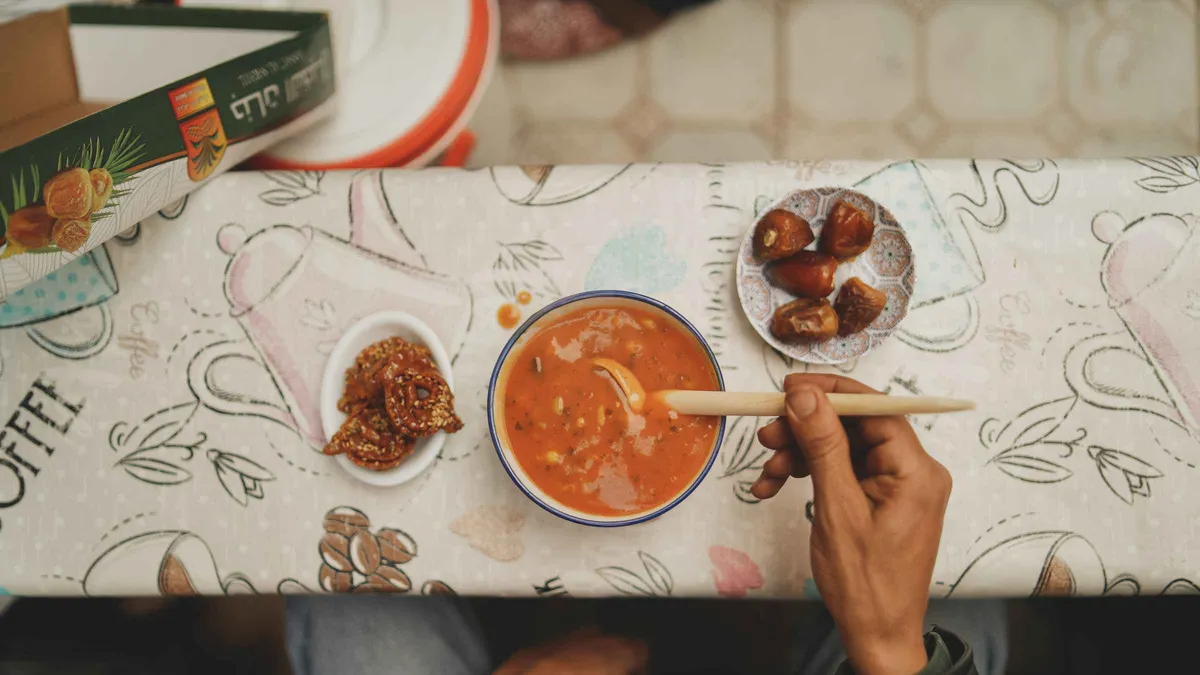 from $55.51
Marrakech: Medina Stories Food Tour with 15+ Tastings
listed at $55.51
Four-hour small-group medina food walk with more than fifteen tastings, run in English. The operator says it cannot cater for severe allergies or celiac diets because of cross-contamination at street stalls.
Check Availability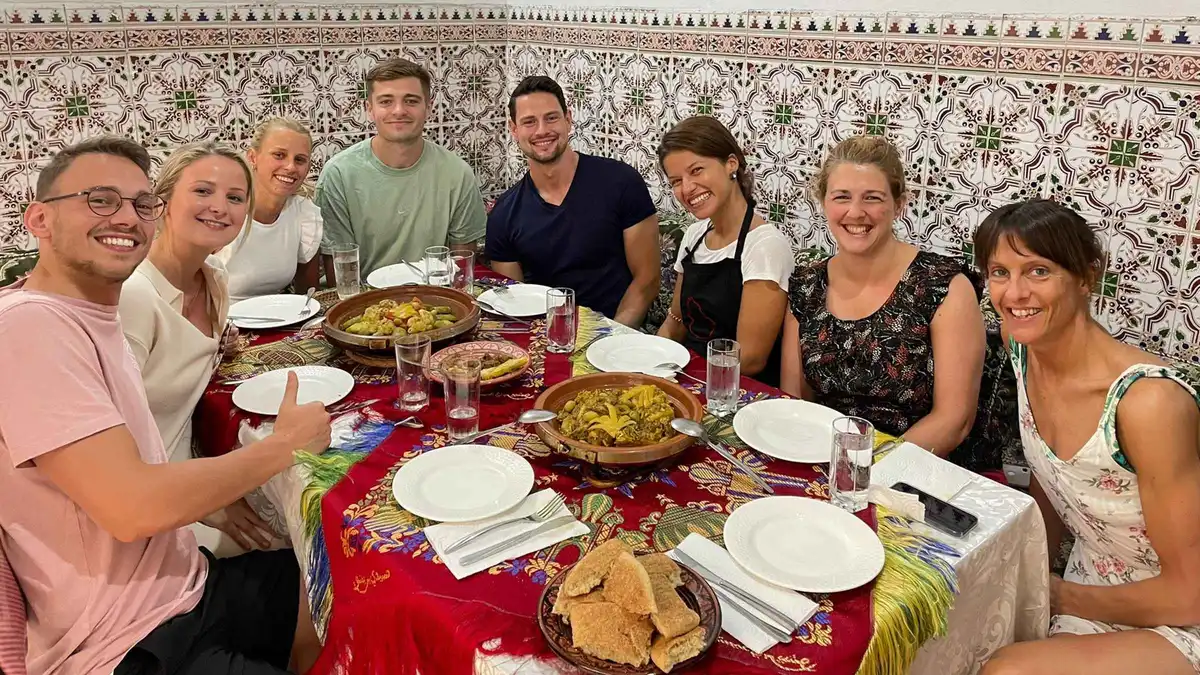 from $38.70
Marrakech Traditional Moroccan Cooking Class & Food Market
listed at $38.70
Two-and-a-half to three-hour cooking class starting with a market shop, then a tagine cooked and eaten at the workshop. Only people booked on the class can attend.
Check AvailabilityPrices, ratings and details are the platform's own, checked in Q3 2026; dollar figures are the listed prices — the platform bills in your account's currency.
Why This Guide Names No Restaurant in Marrakech
This is the most important paragraph on the page, and it is an admission rather than a recommendation. Read it and you will know exactly how much weight to give every other food page you find.
Everywhere else on this site, naming a place requires a citable list: a Michelin selection, a Slow Food guide, a Gambero Rosso entry, or the venue's own published facts. That rule is what stops a guide turning into a collection of somebody's favourites. In Morocco the rule cannot be met.
The MICHELIN Guide has no restaurant selection for this country at all: searching its own site for restaurants in Marrakech returns the message that there are no selected restaurants in the area searched, and Casablanca returns the same. Marrakech appears on the guide's site under hotels and stays only, and a hotel write-up that mentions the kitchen inside it is not a restaurant distinction, so nothing on this site will ever present one as though it were.
What we will not use instead
Morocco does have an official restaurant classification and it is no help. Arrete conjoint 986-24 fixes the classement standards for the restaurant touristique and was published in Bulletin Officiel 7407 bis, but the ministry publishes the legal text and not the resulting list: there is no public register of classified Moroccan restaurants to read a name out of, and the ONMT is a promotion body rather than a register. Gault et Millau's Moroccan operation is press-sourced and could not be verified, so it is not used here either.
Neither are the aggregator rankings, the newspaper lists or the influencer round-ups, all of which are recycled from each other and none of which discloses how anything was chosen. If this page named ten restaurants, the honest footnote under them would read that they came from three blogs and a booking platform, and that footnote is the reason the names are absent.
What you get instead, and why it is more useful
Three things. First, the type of place and the street, which is what a guide did before ranking sites existed and what still works: this page tells you what a cook-shop is, what a riad restaurant is and which lanes hold each. Second, the food itself, sourced to UNESCO inscriptions and to the national tourist office's own words, so you know what to order and why it matters here.
Third, the mechanics of the bill in each layer, which is where visitors actually lose money and temper. A list of ten names would have gone stale within a season; none of those three will.
How to choose a place yourself, in four moves
Look at who is eating there, and at whether any of them are Moroccan. Ask the price of the dish before it is cooked, in every layer including the printed-menu one, where a fish is often priced by weight. Prefer a short menu to a long one, because a cook-shop with one pot has sold that pot every day for years.
And walk one street further from the square than you meant to: the first ranks of tables on any tourist route are priced for people who will not walk.
Checked in Q3 2026 against the MICHELIN Guide's own site, which returns no restaurant selection for Marrakech or for Casablanca, and against the site's own naming rule, which requires a citable published list before any venue is named.
Layer One: the Numbered Stalls, and How That Bill Works
The stalls on the main square are the most photographed food in Morocco and the least documented. Here is what is actually established, and what follows from it for your wallet.
What is documented is one sentence from the UNESCO file: all through the day, and well into the night, a variety of services are offered, and water-carrying, fruit and traditional food may be bought. That is the whole official record of eating on the square. There is no stall register, no hygiene rating, no published price and no opening hour, and the numbers painted on the awnings are the operators' own signage rather than a rating of any kind.
The stalls are assembled on the tarmac in the late afternoon, trade hardest from about an hour after sunset until 22:00, and break down late.
The bill, which is the whole skill
Nothing is priced on a board and nothing arrives with a total attached. The sequence that goes wrong is always the same: you sit, dishes you did not order appear as a welcome, bread and olives land, and the figure at the end covers all of it. None of that is a scam and all of it is avoidable with one habit: ask the price of each dish before it is put in front of you, and say plainly that you did not order anything that arrives unrequested.
Pay in cash, in small notes, and count it in the open. If you would rather not do any of that on a first evening, that is exactly what the guided walks are for.
What is genuinely good there
Harira from a bowl-stack stall, grilled skewers, merguez, and the fish counters, all of which are cooked in front of you, which is the only inspection available. Snails in broth are a Marrakech fixture and cost very little. Avoid anything that has been sitting under a lamp rather than going straight from the grill, and prefer a busy stall to an empty one for the obvious reason that its turnover is faster. The Jemaa el-Fna page has the square's hours, safety picture and the services table that prices everything else on the tarmac.
UNESCO Intangible Cultural Heritage file 00014 for the cultural space of Jemaa el-Fna, read in Q3 2026. No municipal stall register, hygiene rating, price list or opening time exists online for the square.
Layer Two: Souk Cook-Shops and the Lunch Hour
The layer visitors miss entirely, because it is finished by the time they are hungry. This is where the medina actually eats at midday.
Scattered through the lanes north of the square are counters that do one thing: a pot of tanjia in the ashes, a tray of grilled meat, a lentil pan, a stack of harira bowls, a griddle turning out msemen. They open around the middle of the morning, sell until the pot is empty, and close, which is usually somewhere between 13:00 and 15:00. There is no sign in English, no menu, and no evening service.
Nothing about them is registered or published anywhere, so this page describes the type of place and the lanes rather than naming any of them, exactly as the site's rule requires.
Where they are, in trade geography rather than addresses
The reliable rule is to follow the working lanes rather than the shopping ones. Around Rahba Kedima, the small open square of spice and apothecary stalls, and in the metalworkers' and dyers' lanes beyond it, the food is for the people working there and priced accordingly. The covered spine running north out of the main square is the opposite: it is the busiest and most souvenir-heavy stretch in the city, and its food is priced for people who never walk past it. The souks page maps the trades lane by lane, which doubles as a map of where lunch is honest.
How the bill works here
Simply, and in cash. A counter with one dish has one price, it is usually stated without argument, and the transaction takes ten seconds. This is the layer where you eat best for least in Marrakech, and the only real barrier is language and confidence rather than money.
If a guide is doing the ordering, this is also the layer a food walk spends most of its time in: the medina walk with more than 15 tastings at $55.51 is essentially four hours of this, with the language problem solved.
Layer Three: Riads, Rooftops and Gueliz
The only layer where you know the number before you sit down, and the only one where a reservation means anything.
Inside the medina, restaurants live behind the same unmarked doors as the guest houses, because they are usually in converted houses: a plain wall, a studded door, a courtyard with a fountain and tables around it, and a roof terrace above with the Koutoubia lit in the distance. You will not find them by walking past, which is why this is the layer people book. Almost all of them print a menu with prices, which makes them the only part of eating here that behaves the way a visitor expects, and the reason to choose the roof or the courtyard is entirely seasonal: the courtyard is sheltered in winter, when January nights average 3.8°C, and the roof is the only tolerable option in July, when daily highs average 36.6°C.
Gueliz, where eating looks European
The new town west of the medina, laid out under the French protectorate, has pavements, street numbers and restaurants with frontages you can read from the street. It is where the city's non-riad hotels are, where cards are most reliably accepted, and where alcohol is most straightforwardly available. It is a taxi or a 25 minute walk from the main square. The Gueliz page covers the layout and the transport; the practical point for eating is that a taxi driver can find an address there, which is not true of a riad in the medina.
Alcohol, and the one rule that is published
Licensed restaurants and hotels serve alcohol and most medina cook-shops and stalls do not. The rule worth knowing comes from the French foreign ministry, which states plainly that during Ramadan it is not possible to buy alcohol, still less to consume it in public. The same ministry warns about counterfeit alcohol risk in general terms across the region, and the UK Foreign Office is blunt about methanol in counterfeit spirits, noting deaths and serious illness and that it cannot be identified by taste or smell.
Buy from licensed premises and leave it at that.
Booking, and what a booking is worth
Worth doing for dinner in the medina, for two reasons that have nothing to do with tables being scarce. First, a riad restaurant will send you directions to a door you would otherwise not find, which saves a genuinely frustrating half hour in unlit lanes. Second, several kitchens cook to order, and the dishes that take hours, tanjia among them, are ordered ahead.
If a place asks you to choose your main course when you book, that is a good sign rather than an imposition.
The Practical Layer: Cash, Water, Diets and Ramadan
Five things that decide how eating here goes, none of which appears on a menu. The table is the short version; the paragraphs after it carry the detail that matters.
Each row below is sourced to the page of this guide that carries the full working, because every one of them is a research question rather than a food question.
| The question | The short answer | Where the detail is |
|---|---|---|
| Cash or card? | Cash for stalls, cook-shops and taxis; cards work in hotels, monuments and Gueliz restaurants | What Marrakech costs |
| Can I drink the tap water? | No published statement on potability was obtained from either water utility, so bottled is the safe reading | Tap water in Marrakech |
| When does the eating day move? | During Ramadan it shifts entirely to after sunset, and the dates are announced only shortly beforehand | Best time to visit |
| What about allergies? | The tasting walk states it cannot cater for severe allergies or celiac diets because of cross-contamination at street stalls | The operator's own listing on the food tour card |
| Is there a Friday rule? | Couscous is traditionally eaten on Fridays, in the tourist office's own words, and many kitchens follow it | Friday and holiday openings |
When each layer is actually open
The single most common mistake here is arriving hungry at the wrong hour for the layer you wanted. None of these times is published by an authority: they are our reading of how the medina trades, and the two booked rows are the operators' own durations.
| Layer | Opens | Best hour | Gone by |
|---|---|---|---|
| Souk cook-shops and lunch counters | About 11:00 | 12:30 to 13:30, when the pots are full | 15:00, or whenever the pot empties |
| The square's numbered stalls | Late afternoon, from about 17:00 | 19:00 to 22:00, an hour after sunset onwards | Late; the last hour is the calmest |
| Riad and rooftop restaurants | 19:00 for dinner service | 20:00 onwards, booked ahead | Kitchens close well before the square does |
| The guided food walk | Operator's own schedule | 4 hours, small group, in English | Cancels free up to 24 hours before |
| The cooking class | Starts at the market | 2.5 to 3 hours, ending at the table | Only people booked on the class attend |
Cash, and a currency you cannot bring
The dirham is a closed currency. Importing and exporting it is prohibited by the Office des Changes beyond a traveller's allowance of 2,000 MAD, worth about $213.00, which means you cannot buy dirhams before you fly and should not fly home with a pocketful. For eating, that has one consequence: change enough on arrival for the cash layers, because the stalls and cook-shops take nothing else and no Moroccan bank publishes what a foreign card is charged at a machine here.
Vegetarians, and what actually works
Better than the reputation suggests, and worse than it should be. Vegetable tagines, lentil and bean dishes, harira, salads and bread are everywhere, and the Mediterranean diet inscription that lists Morocco among its states parties is a fair description of half of what is cooked here. The catch is stock: a vegetable tagine is frequently built on a meat base, and asking about it is worth doing in French rather than English.
Vegans should expect butter, eggs and dairy in more places than a menu suggests, and lben and raib are served as accompaniments by default.
Eating during Ramadan
Restaurants aimed at visitors stay open, but the rhythm of the city inverts: nothing much happens in daylight, harira and dates appear the instant the sun sets, and the square is at its quietest in the hour before sunset and at its fullest afterwards. Eating, drinking and smoking in the street during daylight causes offence. Two monuments publish shortened Ramadan hours and the dates themselves are fixed by crescent observation and announced shortly before, so a trip planned around that month needs the best time to visit rather than a fixed calendar.
Tipping
No authority publishes a convention and this guide will not invent a percentage. What is true is that service is not added in the cash layers and rounding up is normal; in a printed-menu restaurant, check whether service already appears on the bill before adding anything. Small notes are the practical constraint: nobody at a stall has change for a large one at nine in the evening.
Where to eat in Marrakech: the geography, not the venues
Five areas rather than five restaurants, because this guide names no venue. Each pin is a district or a known trading area with its own page on this site; walking times are our estimates from the mapped distances and run long, because the medina lanes do not go straight.
Areas, not addresses. Coordinates are the district and square points used elsewhere in this guide, read in Q3 2026; no venue is pinned because no citable Moroccan restaurant list exists to select one from.
Where to go next
Three pages that carry the parts of eating here that belong somewhere else on this site.
Jemaa el-Fna
The stall layer in full: what UNESCO actually inscribed in 2008, the hours the trade keeps, the services table that prices henna, photographs and caleches, and the safety picture in both foreign ministries' own words. The square's page is where the evening happens.
The square itselfThe souks and shopping
Where the spices, the argan, the dried fruit and the apothecary stalls are, trade by trade, and how a price gets agreed in lanes where nothing is labelled. It is also the map of where the one-dish cook-shops sit. The souks page has the trade geography.
5 min walk northGueliz
The new town where the menus are printed, the cards work and a taxi driver can find the address. It is the practical answer for a long dinner, a late one, or one where somebody in the group wants a glass of wine. The Gueliz page covers the layout and how to get back.
25 min walk west, or a metered taxiWhere to eat in Marrakech: questions
What is the best area to eat in Marrakech?
It depends which of the three layers you want. For stalls and atmosphere, the main square after dark; for the best value and the most honest cooking, the working lanes of the northern medina at lunchtime; for a printed menu, a booking and a card machine, either a riad restaurant in the medina or Gueliz, 25 minutes west on foot. This guide names no individual venue in any of them, because no citable Moroccan restaurant list exists.
Are there any Michelin star restaurants in Marrakech?
No. The MICHELIN Guide has no restaurant selection anywhere in Morocco: searching its own site for restaurants in Marrakech returns a message that there are no selected restaurants in the area searched, and Casablanca returns the same. Marrakech does appear on the guide's site under hotels and stays, and a hotel write-up that mentions its own kitchen is not a restaurant distinction. Anyone presenting one as Michelin-listed is misreading the source.
What food is Marrakech famous for?
Tanjia above all, which the national tourist office calls the staple dish of Marrakech, traditionally prepared with lamb or veal in a terracotta jar. Beyond it, the dishes with an official record behind them are couscous, inscribed by UNESCO in 2020 and traditionally eaten on Fridays, tajine, harira, pastilla, mechoui and mint tea, which the tourist office says is traditionally poured one metre high. Khlii and msemen are everywhere and appear on no official list at all.
How much does a meal cost in Marrakech?
This page prints no meal prices, and the reason is the honest one: no Moroccan authority publishes them, no citable guide covers restaurants here, and every figure circulating online is somebody's receipt. What can be priced are the booked experiences, at $55.51 for the four-hour tasting walk and $38.70 for the cooking class. For everything else, ask the price of each dish before it is served and carry cash in small notes.
Is the street food in Marrakech safe to eat?
No hygiene rating or stall register is published by anybody, so there is nothing to check and nothing to reassure you with. The practical reading is the same as in any dense street-food city: eat what is cooked in front of you rather than what is sitting under a lamp, prefer a busy stall for its turnover, and treat tap water as unresolved, since neither Marrakech water utility answered on potability. The tap water page sets out exactly what was and was not obtained.
Do I need to book restaurants in Marrakech?
For riad restaurants in the medina, yes, and less because of demand than because they will send you directions to a door you would not otherwise find in unlit lanes. Several kitchens also cook the slow dishes to order, tanjia among them, so booking is what makes them available at all. The stall layer and the souk cook-shops take no bookings of any kind, and the guided food walks cancel free up to 24 hours before.
Eating Marrakech on Film: the Stalls, the Lanes and the Breakfast Layer
Three films that show each of the layers this page describes, which is the fastest way to work out which one you actually want to be standing in on your first evening.
Moroccan Food Tour in Marrakesh, Morocco: Ultimate Guide
A full run through the medina eating layers in one film, from lunch counters to the square after dark.
Video: Chad and ClaireWhat to Eat in Marrakech: Wild Street Food in Morocco at 40°C Heat
The stall and cook-shop layer at the hardest time of year, which is a useful reality check on summer eating.
Video: Bohemian KitchenGoing DEEP For Street Food in Morocco: BREAKFAST Tour of Marrakech
The morning layer almost no visitor finds, including the msemen and khlii this page can source to nobody.
Video: The Food RangerVideos load from YouTube only when you press play.
Reviewed Q3 2026 (July–September 2026); next review Q4 2026. Prices, hours and terms are set by the venue or operator and confirmed at checkout.
We may earn a commission if you book through one of our links, at no extra cost to you. Full affiliate disclosure