 Marrakech Guidebook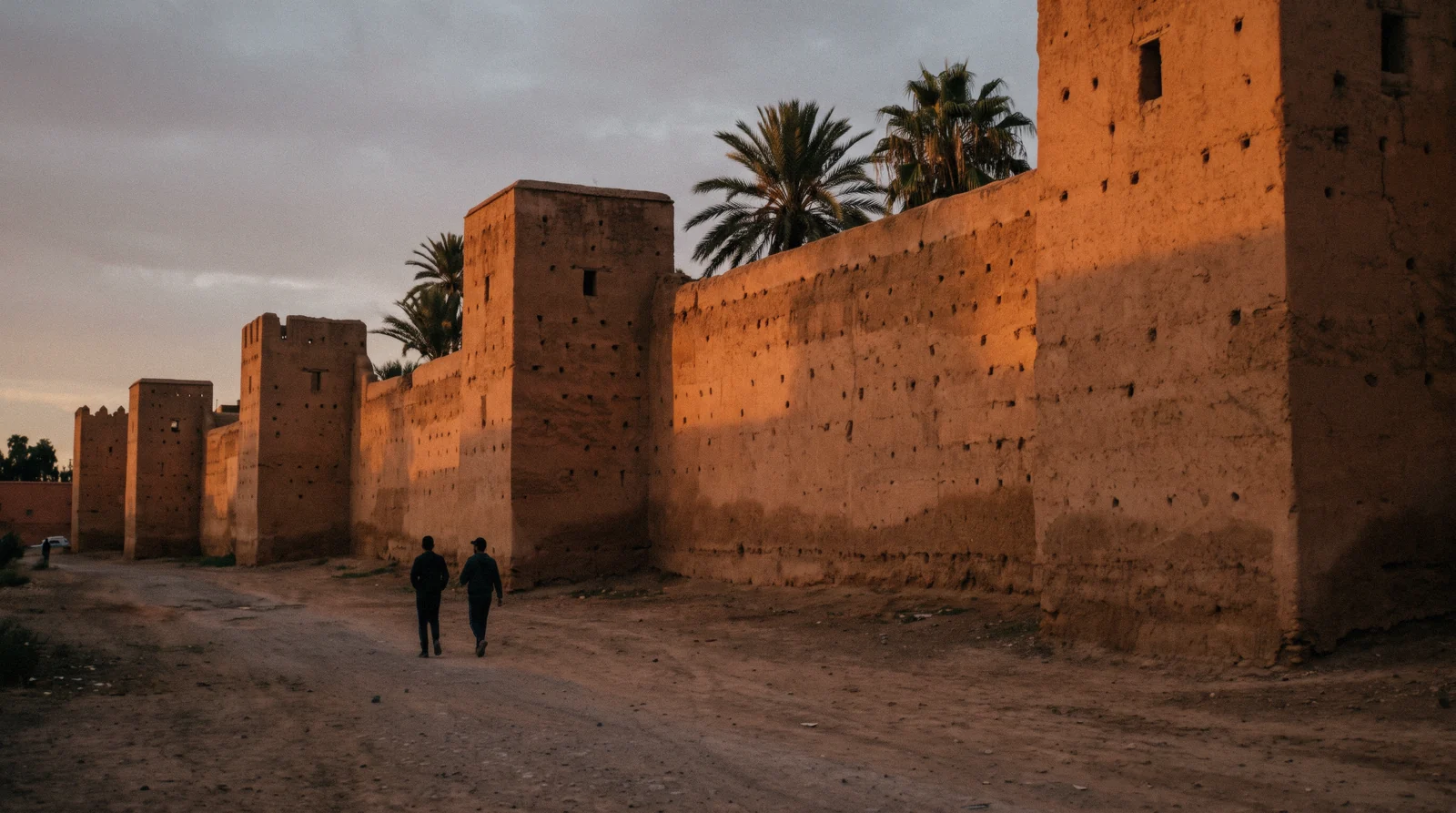
Marrakech for Free: The Half of the City That Charges Nothing
Eight of the 23 places this guide covers charge nothing at all, and two of them carry UNESCO listings in their own right, which makes the free things to do in Marrakech an unusually strong layer rather than a consolation prize. This page sets out what is genuinely free, what free still costs you once performers, guides and mint tea are counted, and where the honest limits of the word free are, including one famous garden nobody official will confirm is free. The paid half sits on the tickets index, and the paid half of this Marrakech guide is the wider picture.
Quick answer What charges nothing, what free still costs, and the one place nobody will confirm
Eight places charge no admission: Jemaa el-Fna, the souks, the Koutoubia esplanade and gardens, the medina lanes, the Kasbah, the Mellah, Gueliz and the Palmeraie. Two of them are UNESCO listings, the square in its own right as intangible heritage and the medina as World Heritage property 331. Nothing on that list is ticketed, timed or bookable.
Key takeaways
- Free does not mean costless. Performers on Jemaa el-Fna solicit payment directly and no authority anywhere publishes a tariff for henna, a photograph or a story, which is the single most reported friction in the city.
- When free runs out, the cheapest real doors are Dar Si Said at $3.20 (30 MAD) and the Ben Youssef Madrasa at $5.33 (50 MAD), both below a coffee in a hotel bar in Gueliz.
- The Menara garden is the honest complication: the Ministry sells a $6.39 (60 MAD) pavilion ticket and publishes nothing at all about the garden around it, so this guide will not print the words free entry there.
- A guided free-layer walk is the alternative to reading a map in a lane: the souks circuit was listed at $17.90, which buys the guide, not an entry.
Every Free Place, And The Paid Door Standing Next To It
The eight free entries in this guide, each set beside the ticketed thing nearest to it, with the international adult fare that door charges. The point of the pairing is that a free day in Marrakech is not a lesser day: in three of these rows the free half is the more memorable one.
| Free place | What it is | The paid door next to it | That door costs |
|---|---|---|---|
| Jemaa el-Fna | UNESCO intangible heritage, ref 00014 | Ben Youssef Madrasa, 13 minutes north | $5.33 (50 MAD) |
| The medina | UNESCO World Heritage, ref 331 | Bahia Palace inside it | $10.65 (100 MAD) |
| Koutoubia esplanade and gardens | Almohad minaret, 77 m, and the first mosque's ruins | Nothing; the interior is closed to non-Muslims | No ticket exists |
| The souks | Public market streets running north from the square | Le Jardin Secret on Rue Mouassine | $10.65 (100 MAD) |
| The Kasbah | Almohad royal quarter, entered by Bab Agnaou | Saadian Tombs inside its walls | $10.65 (100 MAD) |
| The Mellah | The historic Jewish quarter, now Hay Essalam | Dar Si Said, 10 minutes away | $3.20 (30 MAD) |
| Gueliz | The protectorate-era new town, avenues and galleries | Jardin Majorelle on its edge | $18.11 (170 MAD) |
| The Palmeraie | Palm groves 7.2 km north east, no gate | ANIMA garden, the other direction | $14.91 (140 MAD) |
Fares are the international adult rate published by the authority that sets each one, read in Q3 2026: the Ministry of Culture platform for Bahia and the Saadian Tombs, the Ministere des Habous for the madrasa, the Fondation Nationale des Musees for Dar Si Said, and each private venue's own site. Moroccan nationals and residents pay less at every one of them, and enter the four Ministry monuments free on Fridays.
Jemaa El-Fna: The Free Thing Most People Actually Flew For
The square is the only place in Marrakech that UNESCO listed for what happens on it rather than for anything built on it, and it has no gate, no hours and no ticket.
UNESCO's own description calls the square one of the main cultural spaces in Marrakech and a symbol of the city since its foundation in the eleventh century, representing a unique concentration of popular Moroccan cultural traditions performed through musical, religious and artistic expressions. That is a listing for the storytellers, the Gnaoua musicians and the healers, not for the paving. Nobody charges to stand in it.
Go twice, because it is two different places
In the morning the square is a wide, hot, half-empty expanse with orange-juice carts around the edge and traffic pushing through it. From late afternoon the food stalls are wheeled in and assembled, the circles of listeners form around the musicians, and by full dark it is the reason people booked the flight. No official source publishes a time for either transition, which is why this guide describes it rather than printing a schedule.
Allow an hour at dusk, and eat later if you are eating on the square at all.
What free costs on the square
Performers solicit payment directly, and no municipal authority, ministry or tourist office publishes a tariff for a henna design, a photograph with an animal or a story. That absence is the whole problem: with no published price there is no reference point, and the transaction becomes whatever is negotiated after the fact. The two authority-level statements that bear on it are the UK Foreign Office's, verbatim: it is common for people posing as official tourist guides to harass tourists, and always ask permission before taking pictures of people, especially children.
Both are on safety and scams in full. Carry small notes, agree before anything starts, and treat a refusal as an option.
The guided version
The square after dark is also the one part of the free layer where a guide changes the experience rather than duplicating a sign. The night street food walk, listed at $49.98 and rated 4.7 from 3,191 reviews, is the version where the stall choice and the price are settled by someone who eats there. The free version is the same square with the same stalls and a slower learning curve.
UNESCO Intangible Cultural Heritage element 00014, Cultural space of Jemaa el-Fna Square, proclaimed a Masterpiece in 2001 and inscribed on the Representative List in 2008 (ich.unesco.org). FCDO wording from gov.uk travel advice for Morocco, read in Q3 2026.
The Medina: 1,107 Hectares Of World Heritage With No Ticket Office
The second UNESCO listing on this page is the quarter itself, and walking it is the most sustained free thing there is to do in Marrakech.
The medina was inscribed in 1985 on four cultural criteria at once as World Heritage property 331, which is rare, and the inscribed property covers 1,107 hectares bounded by the original ramparts. The ICOMOS evaluation that recommended it describes a medina of 700 hectares, and both figures are in the record: the larger is the inscribed property, the smaller the historic habitat ICOMOS was describing under criterion (v). The evaluation's language is worth quoting because it is also the best short argument for walking it: a maze of narrow streets, houses, souks, fondouks, traditional crafts and trade activities, an ancient habitat that has become vulnerable.
It is lived in, not preserved
The Committee's 1985 decision asked Morocco to avoid any breaching of the ramparts and to protect the medina's facades and gardens, and it named the palm grove and the Menara as the surroundings to protect with them. Forty years on, the quarter is a working city: mopeds in the lanes, handcarts, workshops, school runs. That is the reason it does not feel like a monument, and the reason a wrong turn puts you somewhere residential rather than somewhere closed.
The ramparts and the gates
The walls that define the property are themselves free, and the stretch a first visit usually meets is between Bab Agnaou, the ceremonial gate into the Kasbah, and the earthen sections out towards Bab Debbagh in the north east, which is where the tanneries sit. Late afternoon turns them orange and it is the best free photograph in the city. There is no published walking route and no signage, so treat the wall as the handrail: keeping it on one side is the simplest navigation the medina offers.
What the free walk cannot include
The Koutoubia interior and every working mosque inside the walls are closed to non-Muslim visitors. The clearest statement of the rule any authority publishes is France Diplomatie's, which says that non-Muslims are formally forbidden to enter Muslim places of worship and that only the major tourist sites may be visited. No Moroccan first-party source states it and the UK Foreign Office does not either, so that French ministry wording is what this guide cites.
UNESCO World Heritage property 331, Medina of Marrakesh, inscribed 1985 at the 9th session of the World Heritage Committee on cultural criteria (i), (ii), (iv) and (v); inscribed property area 1,107 hectares. ICOMOS evaluation 331. Read in Q3 2026.
The Koutoubia: Free, Unenterable, And Still Worth The Walk
The most photographed building in Marrakech charges nothing because there is no ticket to sell: what is open is everything outside it.
The minaret stands 77 metres and it is the reference point the whole medina is oriented by. Around it are the esplanade, the gardens behind it and the excavated remains of the first Koutoubia mosque beside it, all open, all free, and none of them ticketed by any authority. There is no ticket office because there is no ticket: the interior is a working mosque, not a monument, and it is closed to non-Muslim visitors at every hour.
When to be there
Before 09:00 the gardens are quiet and the light is on the eastern face; after dark the minaret is lit and the walk between it and Jemaa el-Fna, 470 metres, is the pleasantest five minutes in the city. No opening hours are published for the gardens or the esplanade, because no authority publishes anything about the monument at all, which is unusual for a building this famous and is stated here rather than papered over.
The distinction that explains the ticket layer
If the Koutoubia is closed because it is a working mosque, why is the Ben Youssef Madrasa open at $5.33 (50 MAD)? Because a madrasa is a former Quranic school rather than a place of worship. That single distinction explains why one of the two great Islamic buildings in this city is free and unenterable and the other is ticketed and open, and it is the most useful thing to understand before planning a day around either.
Minaret height 77 m and the Almohad ensemble from UNESCO's own description of property 331; the non-Muslim entry rule from France Diplomatie, Us et coutumes, read in Q3 2026. No official page for the monument itself was reachable.
The Souks: Free To Walk, Priced By Negotiation
The market streets north of the square cost nothing to enter and publish nothing at all, which cuts both ways.
The souks are public streets, not an attraction with a gate: you walk in from Jemaa el-Fna and you are in them. No official body publishes opening hours for the network as a whole, individual shops set their own, and many close around Friday midday prayers, though no authority publishes that either. The practical shape of a free morning is to walk north from the square, let the roofed sections take you, and use the madrasa or Le Jardin Secret as the point you are aiming for so that being lost has a direction.
Nothing here carries a printed price
There is no fixed-price convention in the souks and no published tariff of any kind, so a price is what is agreed. That is not a scam, it is the pricing system, and the discipline that makes it workable is deciding what a thing is worth to you before asking. The trap is a different one and it is documented: the France Diplomatie advisory records fake agencies in Marrakech offering discounted travel or VIP contracts and taking a card imprint to check solvency before making fraudulent transfers.
That is the only Marrakech-specific scam any authority documents, and it happens around shopping, not inside it. The souks page covers the crafts quarter by quarter.
The free version and the guided version
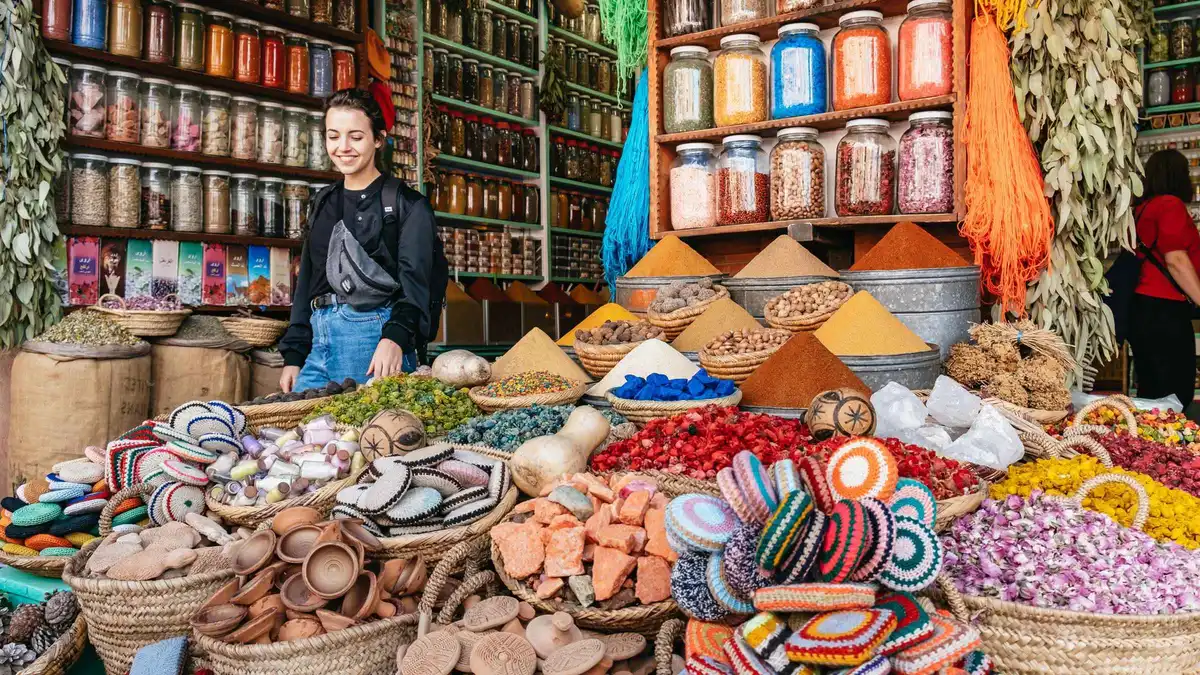
A guided souk walk buys orientation and a badge, not an entry: the colourful souks circuit runs three hours at $17.90 and the guided shopping tour with a local guide at $27.64, rated 4.9 from 719 reviews. Both cover ground that costs nothing to walk alone. Where they earn their fee is the first morning, when the lanes have not yet resolved into a pattern.
No authority publishes opening hours or prices for the souks. The ICOMOS evaluation for property 331 names them under criterion (v). Checked in Q3 2026.
The Menara Garden: The One Place Nobody Official Will Call Free
Every guide on the internet says the Menara gardens are free. No Moroccan authority says so, and the difference matters.
What is published is precise: the Ministry of Culture sells a ticket to the Menara pavilion, the small pleasure house at the end of the basin, at 60 MAD for a foreign adult, 30 MAD for a Moroccan or resident adult, 30 MAD for a foreign child of 7 to 13 and 10 MAD for a Moroccan or resident child, with published hours of 09:00 to 17:00. That is $6.39 (60 MAD) at the international rate, and it is lower than the 100 MAD the same ministry charges at the palaces.
What is not published is anything at all about the olive grove and the basin around it: no entry fee, no hours, and no statement that entry is free. So this guide says what it can: the pavilion has a price, the garden has no published price, and the photograph everyone takes, the pavilion reflected in the basin with the Atlas behind it, is taken from the basin edge rather than from inside. The Menara page carries the full tariff and the gardens hub compares it with the ticketed gardens.
Why this guide will not just say free
Because the rest of the page would be worth less if it did. The eight entries in the table above are free because no authority sells a ticket for them, and each can be checked. Menara is different in kind: a ticket exists for part of it and nothing has been published about the rest.
Printing free entry there would be repeating a claim rather than reporting a fact, and this site keeps the line between the two visible.
Ministry of Culture e-services platform, Pavillon de la Menara: Adulte Etranger 60 Dh, 09:00 to 17:00. Read in Q3 2026. No official publication of a garden fee, or of a statement that the garden is free, was found.
A Free Day, Hour By Hour
One day that spends nothing on entries, built around the heat and around the fact that the free layer is best at the ends of the day.
The shape below assumes a base in or near the medina and no tickets at all. The only money in it is food, water and any petit taxi you choose to take, and it works in every month, though from June to September the middle of it should be spent indoors or under the souk roofs. In July the mean daily high is 36.6 °C.
| Time | Where | What it costs | Why then |
|---|---|---|---|
| 08:00 | Koutoubia gardens and esplanade | Free | Empty, cool, and the light is on the minaret |
| 09:00 | Jemaa el-Fna in its morning form | Free | The square as a working space, before the crowds |
| 09:30 | North into the souks | Free to walk | Shops opening, the roofed lanes still cool |
| 12:00 | The tanneries edge and the ramparts to Bab Debbagh | No published fee | The outer walls before the heat peaks |
| 13:30 | Lunch and shade wherever you have got to | Your own bill | Two hours out of the sun is a plan, not a pause |
| 16:00 | The Kasbah and the Mellah | Free | Quiet quarters, long shadows, few stalls |
| 18:00 | Ramparts near Bab Agnaou | Free | Earthen walls turn orange for about forty minutes |
| 19:30 | Back to the square for the stalls and the circles | Free to watch | This is the UNESCO listing, in operation |
What this day deliberately leaves out
Gueliz and the Palmeraie are both free and both a taxi ride away, so they belong to a second free day rather than this one. If you have three days rather than one, the three-day route shows where the free stretches fit around the ticketed ones.
The Free Quarters: A Second Day That Costs Nothing
Three of the eight free entries are districts rather than sights, and they are what a second or third day in Marrakech is made of.
The Kasbah is the Almohad royal quarter inside its own walls, entered through Bab Agnaou, and it holds the Saadian Tombs, El Badi and the Kasbah mosque within about four hundred metres of one another. Walking it costs nothing and takes forty-five minutes; the three things inside it are ticketed separately, which is why a free morning here still feels complete.
The Mellah, the quarter with no coordinate
The Mellah, the historic Jewish quarter now called Hay Essalam, is a lived-in district rather than a site: the spice market, the synagogue, the cemetery and the goldsmiths' lanes, with no admission and no hours because there is no gate. It is also the one place in this guide with no map pin at all, because its Wikidata item carries no coordinate and no Moroccan source published one. The gap is left visible on the map rather than filled with a plausible point.
Gueliz, and why a free afternoon there is not a waste
Gueliz is the new town laid out under the Protectorate, and the national tourist office describes it and Hivernage as the districts of modern infrastructure, boutiques and airy avenues. What that means for a free day is pavements wide enough to walk on, shade, galleries with no admission, and the only part of Marrakech where you can sit down without ordering anything. It is also where the Jardin Majorelle and the Musee Yves Saint Laurent stand, so the free walk and the two most expensive doors in the city share a street.
The Palmeraie, free ground with private stands
The Palmeraie is 7.2 km north east of the square with nothing to buy a ticket for: the groves are open ground. Every price attached to it belongs to a private operator, and the standard version is a camel hour in the oasis, listed at $21.01 and rated 4.6 from 5,425 reviews. Going independently costs a taxi each way and nothing else, which is worth knowing before a hotel desk quotes a package.
District identities and coordinates from the verified Wikidata items for each quarter; the ONMT description of Gueliz and Hivernage from visitmorocco.com. Checked in Q3 2026.
When Free Runs Out: The Four Cheapest Doors In The City
If the free day leaves you wanting one interior, these are the four that cost less than a taxi across town.
Marrakech has no city pass and four separate ticket authorities, so there is no bundle to buy and no discount to chase. What there is instead is a genuine spread of prices, and the bottom of it is cheap by any European standard.
| Door | International adult | Hours | What you get for it |
|---|---|---|---|
| Dar Si Said | $3.20 (30 MAD) | 10:00 to 18:00, closed Monday | The national weaving and carpet museum in a palace |
| Ben Youssef Madrasa | $5.33 (50 MAD) | 09:00 to 19:00 daily | The most photographed courtyard in Morocco |
| Menara pavilion | $6.39 (60 MAD) | 09:00 to 17:00 | The pavilion interior; the grove around it is unpriced |
| Maison de la Photographie | $8.52 (80 MAD) | 09:30 to 19:00 daily | Three floors of Moroccan photography and a roof terrace |
Two of these are cheaper for a child than a bus fare
The madrasa charges 10 MAD for a child under twelve and the Maison de la Photographie is free for children under fifteen, which makes both of them the best value in the city for a family. The full child-rate picture, including the two-tier Ministry tariff, is on Marrakech with kids.
And one Friday rule that is not for you
Moroccan nationals enter the four Ministry of Culture monuments free every Friday and on the first day of national and religious holidays. International visitors pay the same 100 MAD they pay on a Tuesday, and the monuments stay open, so the practical effect of Friday is a busier building rather than a cheaper one. Friday and holiday openings has the full week.
Guided Walks Over Ground That Costs Nothing
Six listings that cover the free layer. None of them buys an entry, because none of these places has one: what you are paying for is a guide, a route and, in the medina, someone whose badge answers the question the Foreign Office raises. Prices are the platform's own listings, read in Q3 2026.
 from $17.90
Marrakech: Colorful Medina Souks Guided Walking Tour
listed at $17.90
Three-hour guided walk through the dyers', metalworkers' and spice souks with a local guide. Sold as a shared small group or a private walk, pickup optional.
Check Availability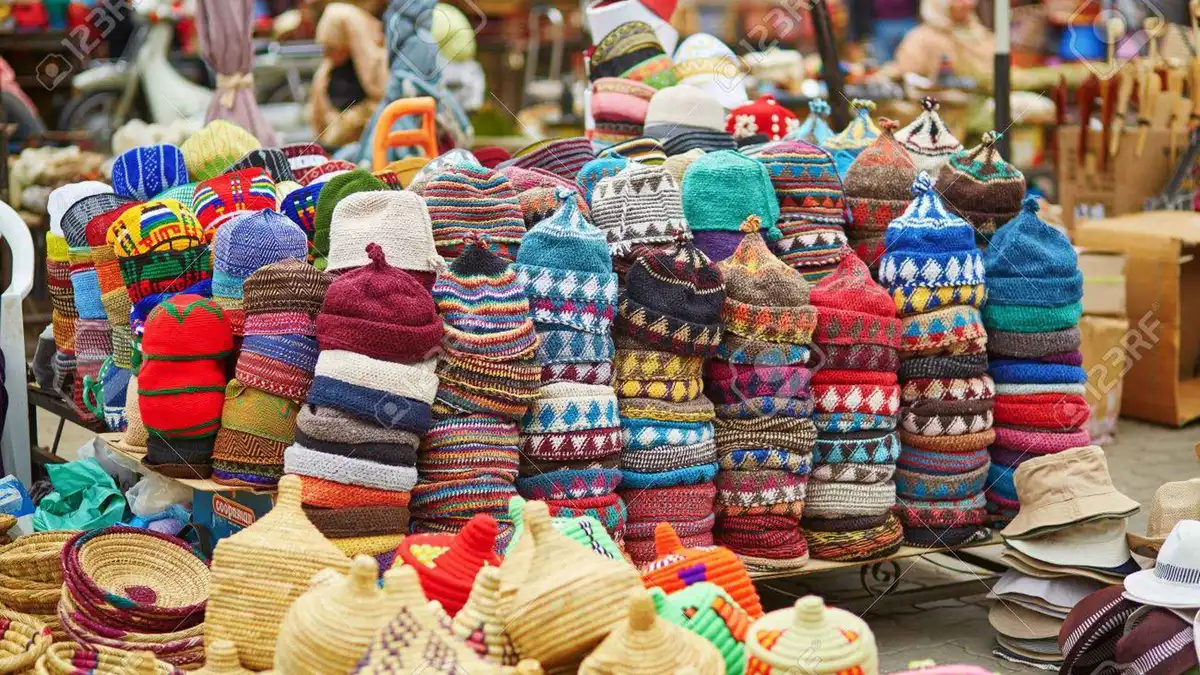 from $27.64
Marrakesh: Guided Souk Shopping Tour with a Local Guide
listed at $27.64
Three-hour shopping walk with a local guide who translates and handles the haggling in the artisan souks. Runs in English or Italian, no pickup.
Check Availability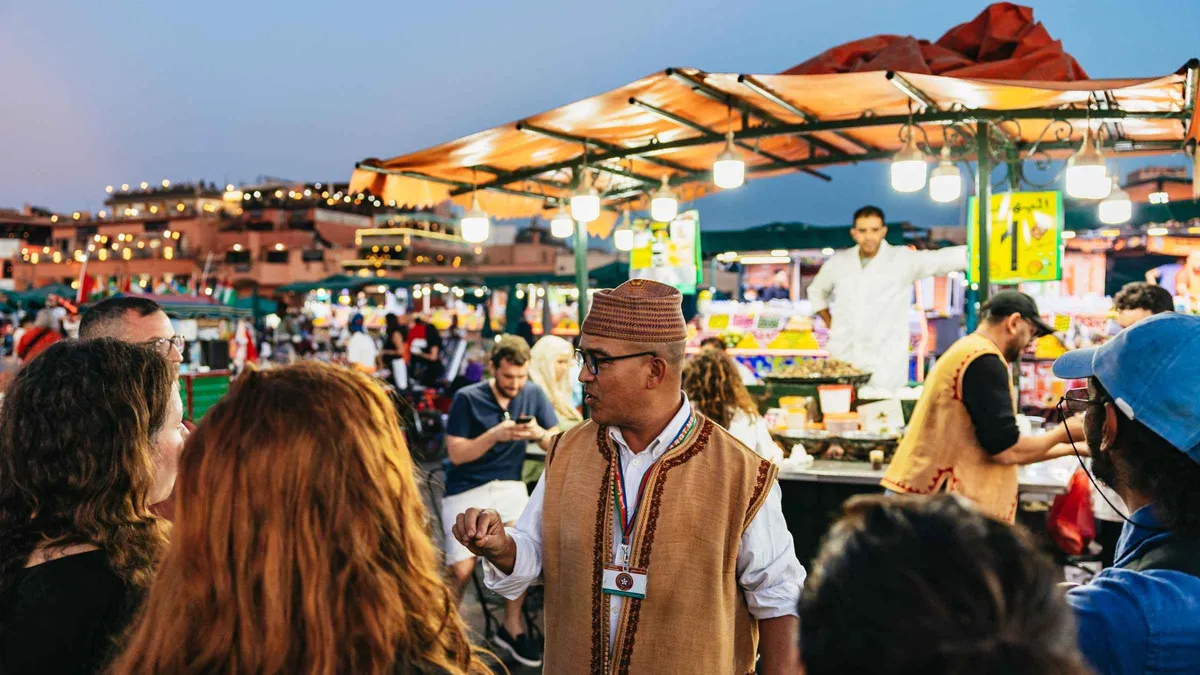 from $49.98
Marrakech: Street Food Tour by Night
listed at $49.98
Two-and-a-half-hour night walk through medina food stalls with tastings and drinks, hotel pickup and drop-off included. Sold as a shared group or a private tour.
Check Availability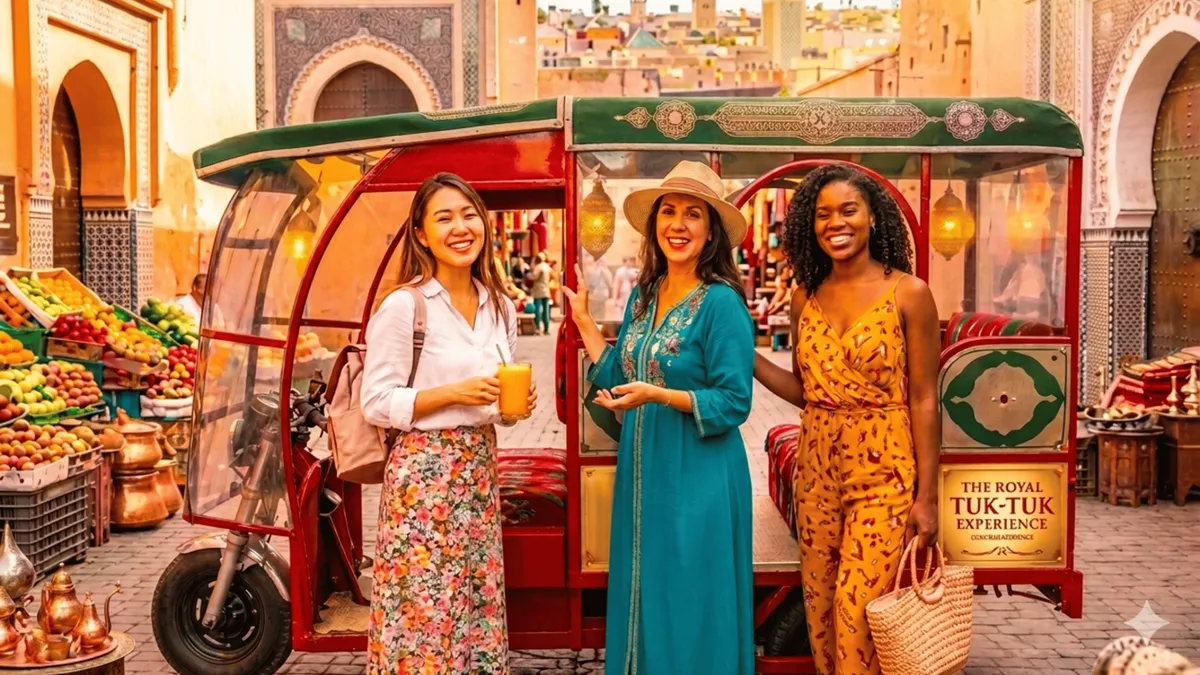 from $16
Tuk Tuk Marrakech Private Tour: Audio guide, Gift & Pastries
listed at $16
One to three-hour private tuk-tuk circuit with an audio guide, pastries and a gift; a driver, not a guide, is provided. Monument tickets are not included and Majorelle tickets have to be bought online first.
Check Availability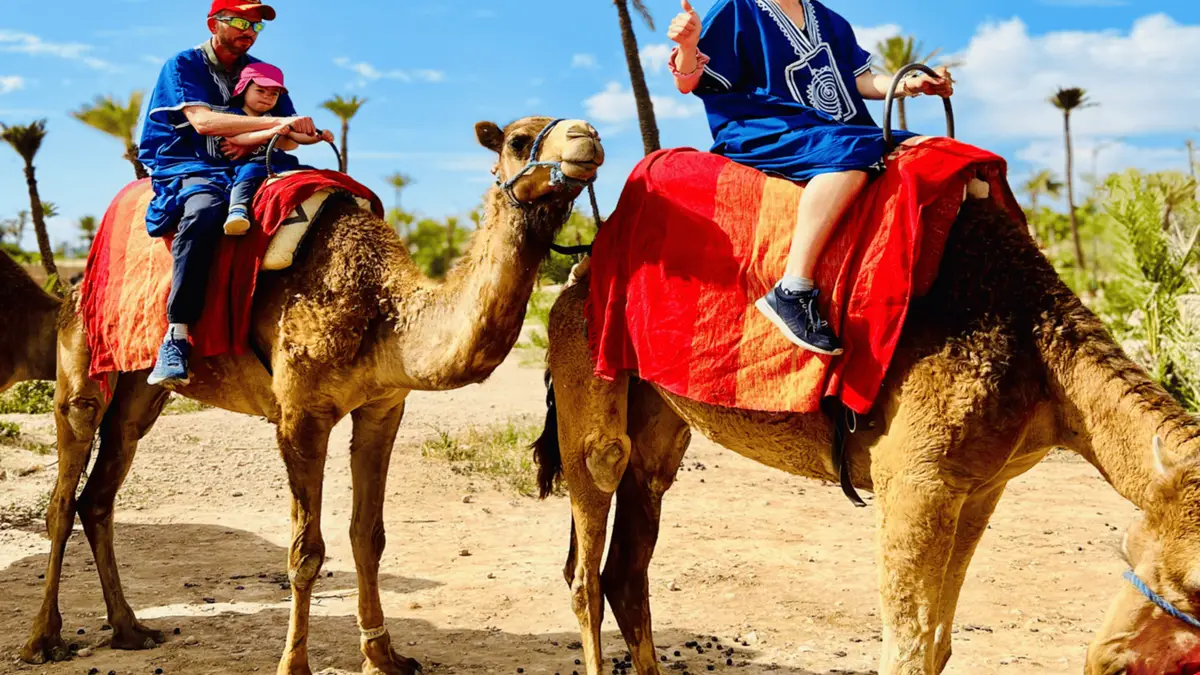 from $21.01
Marrakech: Camel Ride in the Oasis Palmeraie
listed at $21.01
Two-hour camel ride through the Palmeraie palm groves on the edge of town, with hotel pickup and a tea stop. The operator confirms the pickup time the evening before.
Check Availability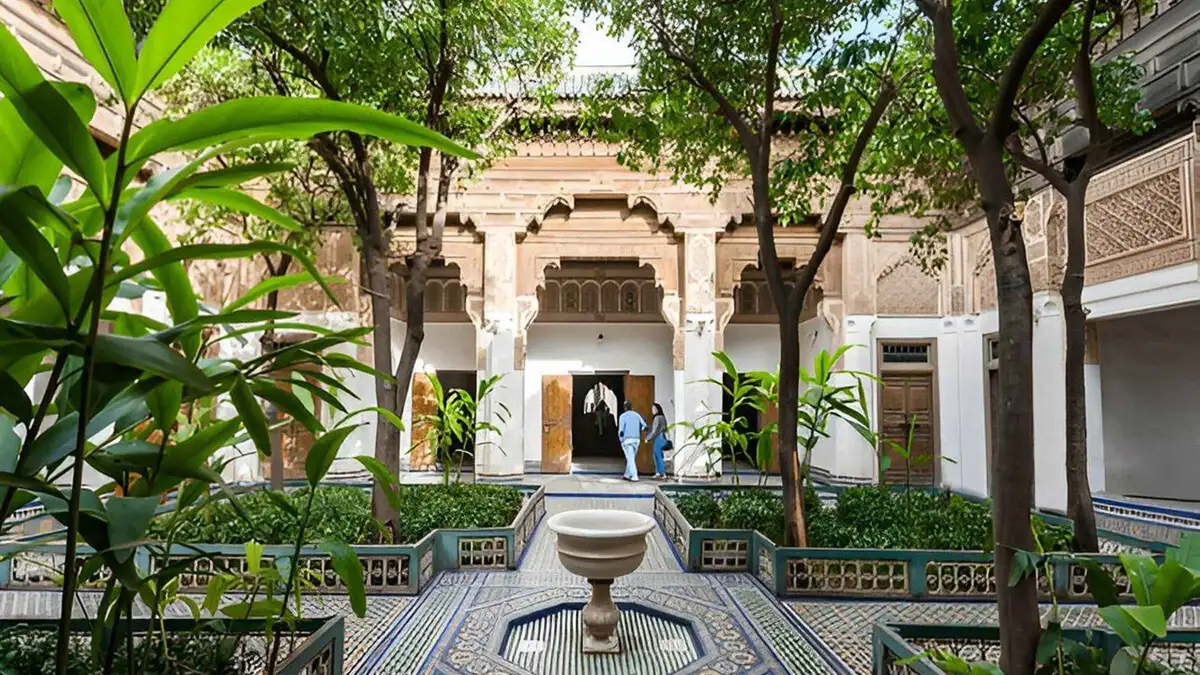 from $17.44
Marrakech: Bahia Palace, Saadian Tombs, & Koutoubia Mosque
listed at $17.44
Three-hour guided walk taking in Bahia Palace, the Saadian Tombs and the Koutoubia from the outside. Monument entrance fees are paid separately in cash: 100 MAD each for Bahia Palace and the Saadian Tombs.
Check AvailabilityPrices, ratings and details are the platform's own, checked in Q3 2026; dollar figures are the listed prices — the platform bills in your account's currency.
Where This Page Hands Over
Three pages that pick up where free stops.
Tickets
The paid half in one table: four authorities, four shops, one two-tier tariff and no city pass, on the tickets index.
Four ticket authorities, none combinedCosts
What a day actually costs once the free layer is priced honestly, including the tourist tax nobody publishes: what Marrakech costs.
Entry money for the full list: $78.80 (740 MAD)Things to do
The same places ranked and numbered to a map, free and paid together: everything this guide covers.
23 entries, 8 of them freeFree Marrakech: The Questions
How much of Marrakech can you see without paying an entry fee?
Eight of the 23 places this guide covers charge nothing, and they include both UNESCO listings: the square as intangible heritage, ref 00014, and the medina as World Heritage property 331. A first-time visitor who never buys a ticket still sees the square, the souks, the Koutoubia esplanade, the ramparts, the Kasbah, the Mellah, Gueliz and the Palmeraie. What is missed is the palace interiors and the two great gardens, which is a real loss but a smaller one than the price list suggests.
Is there a free day at the Marrakech monuments for visitors?
No. The free-entry rule at the four Ministry of Culture monuments applies to Moroccan nationals every Friday and on the first day of national and religious holidays. International visitors pay 100 MAD on those days like any other, so Friday is a busier day rather than a cheaper one. The detail is on Friday and holiday openings.
What does a free morning in Marrakech actually cost in practice?
Nothing in entries and whatever you choose in cash. The costs that appear are food, water and the payments performers on the square ask for, and no authority publishes a tariff for any of the latter. Carry small notes, agree before a henna cone is opened or a photograph is taken, and be ready to decline. The one Marrakech-specific scam an authority documents is a fake travel agency taking card details, not a street payment.
Can you go inside the Koutoubia if you do not pay?
There is nothing to pay and nothing to enter. The interior is a working mosque and is closed to non-Muslim visitors at all times, and the clearest authority statement of the rule is France Diplomatie's, which forbids non-Muslims from entering Muslim places of worship. What is free and open is the esplanade, the gardens and the excavated ruins of the first mosque beside the minaret, covered on the Koutoubia page.
Are the ramparts and the gates free to walk?
Yes, and they are the most underrated free hour in the city. The walls that define the World Heritage property are public, unticketed and unsignposted; the stretch out towards Bab Debbagh in the north east and the ceremonial gate of Bab Agnaou into the Kasbah are the two most rewarding sections. Late afternoon is when the earth turns orange.
Is a guided tour worth it if everything on the route is free?
On the first morning, often yes, because what you are buying is orientation and a badge rather than an entry. The Foreign Office warns that people posing as official guides are common in the medina, so a booked walk such as the souks circuit at $17.90 settles that question before it comes up. On day three, when the lanes have resolved into a pattern, it buys much less.
The Free Layer On Film
Three films that spend their time in the parts of Marrakech that charge nothing: the souk lanes, the square at both ends of the day, and the walking routes between them.
10 THINGS To Do In MARRAKECH That No One Tells YOU
Leans on the walking layer rather than the ticketed one, which is exactly this page's subject.
Video: The Informed Traveler9 hidden gems in Marrakech that most tourists miss
Quieter corners of the medina and the quarters, almost all of them free to reach.
Video: Claire's FootstepsTop 10 Things to Do in MARRAKECH: 48 Hours in Marrakech Travel Guide, Morocco
Useful for seeing how the free stretches and the paid doors fit together across two days.
Video: WanderliciousVideos load from YouTube only when you press play.
Reviewed Q3 2026 (July–September 2026); next review Q4 2026. Prices, hours and terms are set by the venue or operator and confirmed at checkout.
We may earn a commission if you book through one of our links, at no extra cost to you. Full affiliate disclosure