 Marrakech Guidebook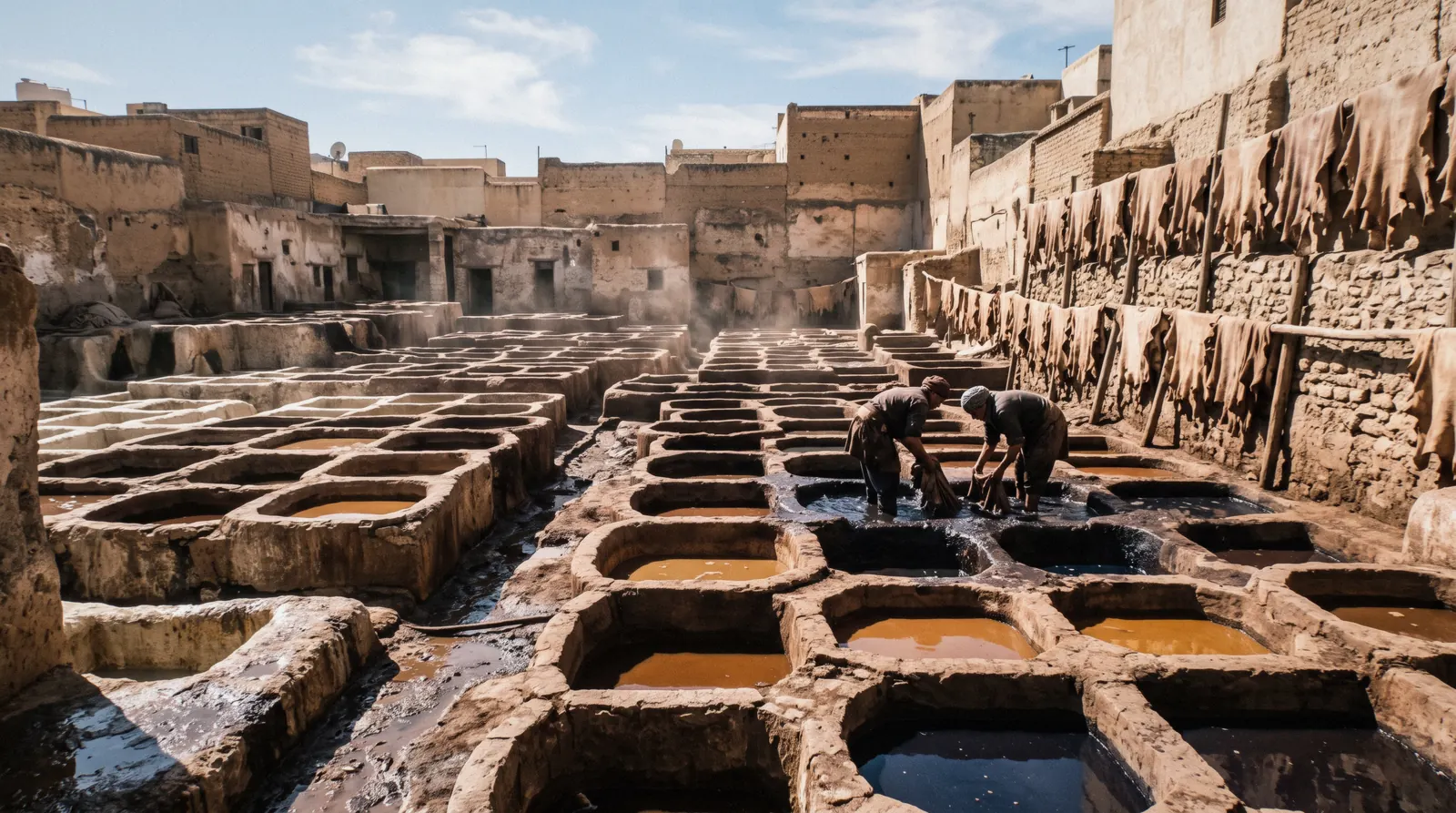
The Marrakech Tanneries at Bab Debbagh: No Ticket, No Tariff, No Guide Fee
The Marrakech tanneries have no door, no price and no closing time, and five separate authorities publish nothing about them. They are private workshops that have worked the same ground beside the Bab Debbagh gate in the north-east corner of the old city for centuries, and they are the single place in Marrakech where a visitor is most likely to be walked somewhere they did not choose and asked for money they cannot check. Five separate authorities were checked for this page and not one publishes an opening hour, an entry price or a guide fee. What can be sourced is the law that decides who may guide you and what happens to somebody who pretends to, so this page prints that law in its own words, sets out what the approach actually looks like, and says plainly which parts of the standard tannery story nobody official will stand behind. The lanes that sell the finished leather are covered on the souks page, the scam layer in full is on safety and scams, and an independent guide to Marrakech puts the quarter in the shape of a trip.
Quick answer What it costs, who may guide you, and what to agree first
Five authorities were checked and not one publishes an opening hour, an entry price or a guide fee for the Bab Debbagh tanneries. They are private working yards, not a ticketed monument, so there is nothing to buy and nobody to buy it from. The money question here is entirely about the man who offers to show you the way, and the law on that is unusually clear.
Key takeaways
- A working guide must carry a professional card and a badge and produce them on demand under article 10 of the guide law, and the penalty for pretending falls on him rather than on you; safety and scams quotes both foreign ministries at length
- GetYourGuide sells no tannery product at all, so the honest booking is a licensed medina walk that passes this quarter: the monuments, souks and medina circuit is listed at $17.47 for four hours
- The hides you watch here are sold fifteen minutes south-west in the leather lanes, which is a better place to spend money than the yards themselves; the souks page sets out what tells a hand-stitched bag from a glued one
Key facts
Opening hours
| All year | not stated–not stated |
|---|---|
| Friday and holidays | not stated–not stated |
Closed not stated. No authority publishes a working day, a rest day or a seasonal pause for the tanning yards
Admission
- Adult
- not stated. There is no admission and no official fee of any kind
- Reduced
- not stated
- Free
- The lanes and the gate are public streets and cost nothing to walk
Planning it
- Time needed
- not stated by anyone; our routing is 30 minutes at the yards inside a 2 hour walk from the main square and back
- Address
- Bab Debbagh, north-east Medina, Marrakech
There is no ticket to compare, so this table compares the three ways people actually arrive at the tanneries: on their own, with a licensed guide on a medina walk, or in the company of somebody who attached himself at the gate. The first row is the only official record of the quarter, the UNESCO property it stands inside; the tour rows carry the operator's own listed price for one adult, read in Q3 2026.
Are you paying for access, which does not exist, or for somebody licensed to walk you there and back?
| How you arrive | What it costs | Who is accountable | Cancel | Book |
|---|---|---|---|---|
| Walking there yourself along the lanesSecond-visit confidence, an early start, and anyone content to look from the lane rather than from a terrace | Free. No admission exists and none has ever been published | Nobody. These are private workshops inside a World Heritage property inscribed in 1985 | Not applicable | Official site |
| Licensed medina circuit, 4 hA first walk in the northern medina, where the approach problem is worst | $17.47 | A licensed guide and a company with an approval, both traceable | Free up to 24 hours before | Check Availability |
| Souks and craft lanes walk, 3 hAnyone whose real interest is the finished leather rather than the vats | $17.90 | The same licensing rules, on the shopping half of the leather trade | Free up to 24 hours before | Check Availability |
| Shopping walk with a local guide, 3 hA significant leather purchase, where a second opinion is worth more than the fee | $27.64 | A named operator, with translation at the counter | Free up to 24 hours before | Check Availability |
No row can be added for the man at the gate, because his figure is not a tariff and there is nothing to compare it with. Article 12 of the guide law leaves even licensed guides' rates indicative only, set by their own federation, so no official Marrakech guiding price exists at any level. If somebody names a number, it is his number.
There is no tannery tour, so these are the walks that pass it
No tannery product is sold on the platform this site works with, which is itself a finding: an operator will not build a product around a private yard with no ticket and no gate. These three are the licensed medina and souk walks that cover the quarter and the leather trade around it. Prices are the operator's own listed figures for one adult, read in Q3 2026.
 from $17.47
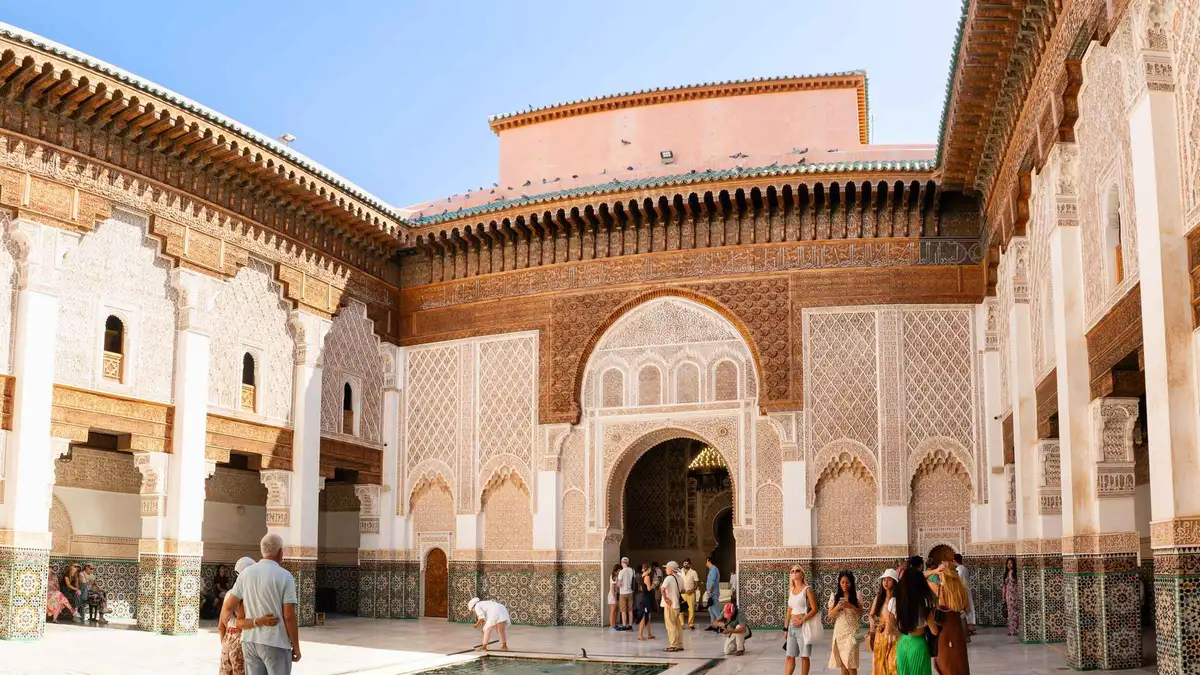
Marrakech: Historical Monuments, Souks & Medina Guided Tour
listed at $17.47
Four-hour licensed-guide circuit of the medina monuments, souks and lanes, with a WhatsApp briefing the day before. Private option includes riad pickup; monument tickets are separate.
Check Availability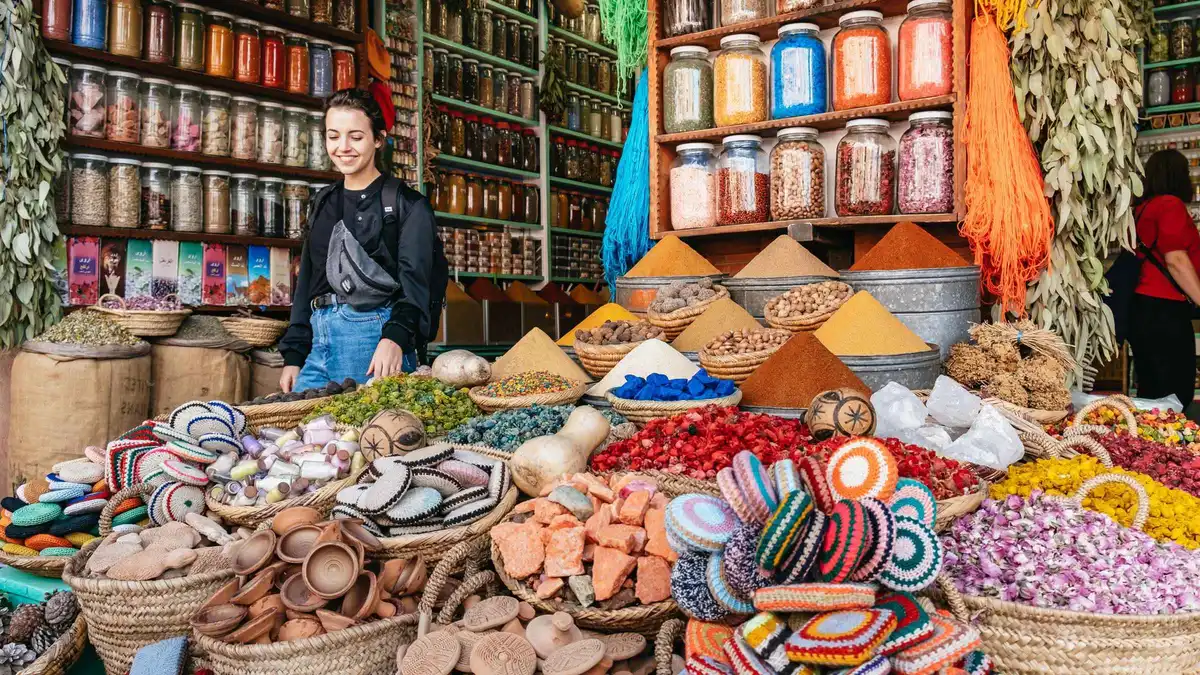 from $17.90
Marrakech: Colorful Medina Souks Guided Walking Tour
listed at $17.90
Three-hour guided walk through the dyers', metalworkers' and spice souks with a local guide. Sold as a shared small group or a private walk, pickup optional.
Check Availability from $27.64
Marrakesh: Guided Souk Shopping Tour with a Local Guide
listed at $27.64
Three-hour shopping walk with a local guide who translates and handles the haggling in the artisan souks. Runs in English or Italian, no pickup.
Check AvailabilityPrices, ratings and details are the platform's own, checked in Q3 2026; dollar figures are the listed prices — the platform bills in your account's currency.
What Is Actually at Bab Debbagh
The tanneries are a trade quarter rather than a site, and the difference decides how the visit goes. Nothing here was built to be looked at.
Bab Debbagh is one of the gates in the eastern wall of the old city, and its name is the tanners' name: the quarter behind it has held the trade for centuries because the work needs running water and distance from where people live. What a visitor sees is a set of open yards packed with stone vats in a rough honeycomb, hides in and out of them, men working barefoot at the rims, and skins pegged out to dry on every wall and roof in sight. The yards are separate businesses, not one operation, which is why nothing about them is centrally published and why the answer to almost every question here is that it depends which one you are looking at.
What is not documented, and this guide will not pretend otherwise
The chemistry that every guidebook prints, the lime pits and the softening agents and the sequence of baths, is not described by any Moroccan authority that could be reached for this page. The Ministry of Tourism and Handicrafts was silent on it, the Maison de l'Artisan's own site would not connect, and neither the commune nor the national tourist office publishes a page about the tanneries at all. So this guide describes what is visible from the lane, states that the process account is trade knowledge rather than a sourced fact, and leaves the confident version to the pages that do not check.
The one thing you can verify with your own eyes is that the work is manual, hot and unmechanised.
The mint, and what it is really for
You will be handed a sprig of mint on the way in, and it is not a ceremony. The yards smell strongly, and holding crushed mint under your nose is the local answer to that, offered as a courtesy and often as the opening move of a transaction. Take it if you want it, and understand that accepting it does not oblige you to anything.
If somebody presses it on you and then names a figure at the end of the visit, that sequence is the point of the mint rather than the smell.
Where the leather goes
The hides finished here supply the leather lanes about fifteen minutes' walk south-west, around Souk Cherratine, where bags, belts and babouches are cut and stitched at the same counter they are sold from. Watching the raw end of the process first is genuinely useful before buying at the finished end, because it is the fastest way to understand why a hand-burnished edge costs what it costs. The souks page sets out what to look at before you talk about money.
Location, gate and heritage context from Wikidata Q58897207 for the gate itself and the UNESCO World Heritage listing for the Medina of Marrakesh, property 331, both read in Q3 2026. No Moroccan authority publishes a description of the yards.
Five Authorities, and Not One Published Figure
The single most useful thing this page can tell you is what was checked. Every body that could plausibly publish an hour, a fee or a rule for the tanneries was tried individually, and the results are printed here rather than summarised.
There is no register of the tanneries, no operator to keep hours, and no ministry that treats them as a monument. That is not an oversight in the research; it is the state of the record, and it explains why every other page about the tanneries prints a different price.
| Authority checked | What it would publish | What it returned |
|---|---|---|
| Ministry of Tourism and Handicrafts | A craft-quarter page, hours, any visiting rule | Site reachable and entirely silent on the tanneries |
| Maison de l'Artisan | The national craft body's own listing | The domain returned no response at all |
| Ministry of Culture | Any heritage designation or tariff | Connection timed out; the tanneries are not on its ticket platform |
| Commune de Marrakech | A municipal decision, a fee, a market rule | No tannery page exists on the commune's site |
| ONMT, the national tourist office | A destination description with practical detail | No tannery page |
So what is a fair price to see them?
There is no fair price, because there is no price. Nobody owns the view from a public lane and nobody is entitled to charge for it. Where money legitimately changes hands is when somebody licensed provides a service: a guide with a card walks you there and explains what you are looking at, or a workshop lets you onto its own terrace and asks for something in return, which is a private arrangement between you and that business.
Neither of those is a tariff, and nothing in either case can be appealed to a published figure, which is why the only defence is agreeing the number in advance and out loud.
The one authority statement that does exist
The UK Foreign Office puts it in plain terms: it is common for people posing as official tourist guides to harass tourists, and if you use a guide in a medina quarter you should make sure they have an official badge and permission from the local authority. That sentence is the entire authority-level record on the tannery approach, and it is worth more than any price anyone can quote you, because it points at the one document that settles the encounter.
All five attempts made in Q3 2026. The FCDO wording quoted below is from UK travel advice for Morocco, the only authority-level statement that bears on the guide question here.
The Approach, and the Law That Ends It
This is the classic Marrakech encounter and it has a legal answer that is much stronger than the travel forums suggest. Guiding here is a licensed profession with a card, a badge and a criminal penalty for impersonation.
The sequence is consistent enough to write down. Somewhere north of the souks, a friendly voice tells you the way ahead is closed, that there is a Berber market on today, or that the tanneries are just up here and he is going that way anyway. You arrive, you are handed mint, you are walked onto a terrace over the vats, a short explanation happens, and then a figure is named, usually with a second man present and usually a good deal larger than the one you would have offered.
Nothing about that is violent and nothing about it is unusual. What makes it work is that you do not know what the correct number is, and there is no correct number to know.
| What you are told | What is actually the case | What to do |
|---|---|---|
| The way ahead is closed, or there is a market on today | The lanes are public streets with no closures published by anyone | Keep walking; the phrase exists to redirect you |
| He is an official guide for the tanneries | Article 5 requires an approval from the administration to practise at all | Ask for the professional card and the badge, then decide |
| The entry to the tannery is a fixed amount | No entry exists, and no authority has ever published a figure | Agree any payment out loud before you go in, or decline before you do |
| The mint is a gift, so the visit is free | Accepting mint creates no obligation and settles no price | Take it or refuse it; either way, the number is still unagreed |
| Refusing would be an insult | Nothing in the law penalises the tourist who declines | Decline plainly and keep moving; that is the end of it |
The badge is a legal document, not a courtesy
Article 1 of the guide law defines a tourist guide as a person who, for payment, accompanies tourists, sees to their safety and gives them the information they need. Article 5 states that nobody may practise the profession without an approval issued by the competent administration. Article 10 requires a working guide to carry a professional card and a badge issued by that administration and to produce them at any moment on the request of sworn officials.
Asking to see them is therefore a normal request, answered in two seconds by anybody entitled to be paid for the walk.
The penalty falls on him, not on you
Article 21 sends the offence of usurping the title of guide to article 381 of the Penal Code, which sets three months to two years in prison and a fine of 120 to 5,000 dirhams. A licensed guide who lends or rents out his own card faces six months to a year and a fine of 10,000 to 20,000 dirhams, and a guiding company operating without approval faces 100,000 to 200,000 dirhams. There is nothing in the statute that penalises the visitor who went along with an unlicensed walk.
Knowing that changes the tone of the encounter: you are not in the wrong for saying no, and the story about a law from 1956 that circulates on the forums appears in no official text at all.
The one scam a government does document in Marrakech
It is worth knowing that the encounter at the tanneries is not the thing foreign ministries actually warn about here. France Diplomatie records exactly one Marrakech-specific fraud: fake agencies offering discounted travel or VIP contracts, often framed as compensation for a service that fell short, taking an initial payment or a card imprint to check the customer's solvency and then making fraudulent transfers from the account. Both ministries also describe bag-snatching from motorbikes in medina quarters, which is the risk that actually costs visitors money. Safety and scams prints both governments in full.
Loi 05-12 regulating the profession of tourist guide, published in Bulletin Officiel 6088, articles 1, 5, 10, 12 and 21, with Penal Code article 381; France Diplomatie's conseils aux voyageurs for Morocco for the Marrakech-specific scam. Both read in Q3 2026.
How Much Time To Give the Tanneries
Nobody publishes a visit length for a working yard, so these three routings are ours, built from the walking distances through the northern medina. All three are on foot, because vehicles do not reach Bab Debbagh from inside the walls.
The yards themselves take ten minutes to look at and the walk takes an hour of your day. That ratio is the whole planning problem here, and it is why the tanneries work as one leg of a northern medina morning rather than as a destination of their own.
| Routing | What you get | What it skips | Door to door |
|---|---|---|---|
| The walk out and back on your own | The lanes, the gate, the yards from the street, and the approach in full | A terrace view, which is the part somebody charges for | About 2 hours from Jemaa el-Fna and back |
| The tanneries inside a medina morning | The yards, then Ben Youssef Madrasa at $5.33 (50 MAD) and the leather lanes | Nothing in this quarter; it is the full loop | About 4 hours, one gate fee in cash |
| The licensed guided version | The four-hour medina circuit at $17.47, with the approach handled for you | The freedom to stand still, since the group keeps a pace | 4 hours, monument entry paid separately |
The decision, in one line
If it is your first day in the medina, take the guided version and let somebody licensed absorb the approach; if you have already walked the souks twice and are comfortable saying no, go early on your own and look from the lane. Do not build a separate trip out here for the vats alone. The one thing worth planning around is footwear and clothes you do not mind smelling of the yards for the rest of the day.
At Bab Debbagh: What To Do, and What Not To
Each line is a decision argued somewhere above, in the form you can act on the morning you walk out there. The short version of what to avoid in Marrakech is on this list twice: an unverified guide, and a figure nobody has agreed out loud.
Do
- Ask any guide who attaches himself for the professional card and the badge that article 10 obliges him to carry
- Agree any payment out loud, and the currency, before you step onto a terrace or into a yard
- Go early, when the yards are working and the lanes are still thin
- Wear shoes and clothes you are content to have smell of the vats until you change
Don't
- Do not accept that the way ahead is closed or that a market is on today; those two sentences exist to redirect you
- Do not treat the mint sprig as a settled price, because nothing has been agreed by taking it
- Do not quote a figure you read online back to anybody: no authority has published one, so it carries no weight
- Do not photograph the men working without asking, which UK travel advice states plainly for people anywhere in Morocco
Five Things Most Visitors Do Not Know About the Tanneries
Five findings from the record, each of which changes something practical about the walk. Every one carries the source it came from.
- There is no Wikidata item for the working tanneries at all. The nearest item, Q58897207, is the Bab Debbagh gate itself, described as a Moroccan cultural heritage site; the yards behind it exist in no register we could find [Wikidata wbgetentities, checked in Q3 2026]. - Five authorities publish nothing about them. The tourism ministry, the national craft body, the culture ministry, the commune and the national tourist office were each tried in turn, and none carries an hour, a fee or a rule [fetch log, in Q3 2026]. - Even licensed guides have no official tariff. Article 12 of loi 05-12 makes guides' rates indicative only, set by the national federation of guides, so no Marrakech guiding price exists at any official level [Bulletin Officiel 6088]. - The penalty for a fake guide is criminal, and it is his. Article 21 refers the offence to Penal Code article 381: three months to two years and a fine of 120 to 5,000 dirhams, with 100,000 to 200,000 dirhams for a company operating without approval [consolidated Penal Code and loi 05-12]. - The tanneries stand inside a World Heritage property but are not a listed monument. The Medina of Marrakesh was inscribed in 1985 as property 331 on four criteria, and the yards are ordinary working premises inside that boundary rather than an item within it [UNESCO World Heritage list 331, read in Q3 2026].
Getting to Bab Debbagh, and Getting Back
The gate sits in the north-east corner of the walled city, further from the square than most visitors expect, and every route to it is on foot.
From Jemaa el-Fna it is about 1.6 km through the lanes, which takes 25 to 30 minutes on foot: north through the covered souks, past Place Ben Youssef, then east into lanes that become residential and quiet. From the Ben Youssef Madrasa it is about 15 minutes east, and from the Maison de la Photographie about 12. The route matters because the last five minutes are where the approach happens: once the shops stop and the lanes empty, an offer of help is much more likely.
By taxi, and why it only half works
A petit taxi can bring you to the gate from outside the walls, since Bab Debbagh is on the ring road that circles the ramparts, but it cannot take you back into the medina lanes. The meter is compulsory under a dahir of 12 November 1963, restated by ministry circulars in 2022 and 2024, and no Marrakech tariff document is published anywhere, so the meter itself is the protection rather than any figure. Ride-hailing is not an option: Morocco has no legal framework for it, as getting around Marrakech sets out.
What to do about the smell
It is genuinely strong, particularly in the summer months when highs average 36.6°C in July, and it carries on clothes. Go before 10:00, keep the visit to 30 minutes, and plan the next stop to be outdoors rather than a restaurant table. If somebody in the group is likely to find it unbearable, the honest advice is to look at the yards from the lane for two minutes rather than to pay for a terrace nobody wants to stand on.
The tanneries on the map, and the walk back into the medina
Bab Debbagh in the north-east corner, with the monuments and the leather lanes that make the walk out there worth the hour. The gate's point is its verified Wikidata coordinate; every other pin is that venue's own. Walking times are our estimates from the mapped distances and run long, because the lanes bend.
Coordinates from Wikidata for the gate and from each venue's own site for the rest, read in Q3 2026. There is no official coordinate for the tanneries as a working site, because no authority records them as one.
Where to go next from Bab Debbagh
Three stops on the walk back into the middle of the old city, in the order the lanes take you. Walking minutes are our estimates from the mapped distances.
The leather lanes at Souk Cherratine
The finished end of what you just watched: bags, belts and babouches cut and stitched at the counter they are sold from. Nothing there carries a price tag and nothing about the trade is regulated, so the souks page sets out what tells hand-burnished edges from glued ones before you start talking about money.
15 min walk south-westMaison de la Photographie
The obvious recovery stop after the yards: a private photographic collection in a restored house, open daily 9:30 to 19:00 at $8.52 (80 MAD), free under fifteen, with a roof terrace over the northern medina. The Maison de la Photographie page has the tariff and the terrace.
12 min walk westBen Youssef Madrasa
The former Quranic school on Place Ben Youssef, open 9:00 to 19:00 daily at $5.33 (50 MAD) and the best-value interior in the city. It sits under the Ministry of Habous rather than the Ministry of Culture, which is why it is not on the state ticket platform; the madrasa page explains that split.
15 min walk westMarrakech tanneries questions
How much does it cost to visit the Marrakech tanneries?
Nothing, because there is no admission and no authority has ever published a fee. The tanneries are private working yards on public lanes, so nobody sells access to them. Money only enters the picture if you pay a guide to walk you there or a workshop to let you onto its own terrace, and both of those are private arrangements with no published figure behind them. Agree any number out loud before anything begins.
What are the opening hours at the tanneries?
None are published. The tourism ministry, the national craft body, the culture ministry, the commune and the national tourist office were each checked and not one carries an hour for the yards. They are businesses that work when their owners work, and the practical reading is that the early morning is when there is most to see and the fewest people waiting at the gate to help you find it.
Do I need a guide to see the tanneries at Bab Debbagh?
No, and the ones who offer at the gate are usually not licensed. A real guide holds an approval from the administration under article 5 of the guide law and must carry a card and a badge under article 10, producible on demand. If you want the walk explained by somebody accountable, book it: the four-hour medina circuit at $17.47 covers this quarter with a licensed guide and a traceable company.
Is it safe to walk to Bab Debbagh on my own?
The published risks in medina quarters are theft rather than violence. Both the UK and French foreign ministries describe pickpocketing and drive-by motorbike theft of bags and phones, and the French page records one Marrakech-specific fraud, which involves fake travel agencies rather than anything at the tanneries. Walk with the bag on the wall side, keep the phone away while moving, and read safety and scams before you set out.
Why do they give you mint at the tanneries?
Because the yards smell strongly and crushed mint held under the nose is the local answer to that. It is a courtesy and it is frequently also the first move of a transaction, since somebody who has given you something is better placed to name a figure at the end. Accepting the mint obliges you to nothing and settles no price. If a number is going to be paid, agree it before you walk in, not after.
Are the Marrakech tanneries worth the walk?
For half an hour inside a northern medina morning, yes: it is the one place in the city where a medieval trade is still being done in the open, and it makes everything in the leather lanes legible afterwards. As a separate trip across the old city for the vats alone, no. Go early, keep it short, and pair it with the madrasa and the leather souks on the way back.
Where the tanneries fit in a day in Marrakech
Put them at the far end of a northern medina morning and walk back towards the middle of the city rather than out to them and straight home. The sequence that works is the yards first thing while the light is low and the work is under way, then west to Place Ben Youssef for the madrasa at $5.33 (50 MAD) and the Koubba at $10.65 (100 MAD), then a terrace at the Maison de la Photographie for $8.52 (80 MAD), then south into the leather lanes with your eye trained by what you saw at the start.
That whole loop is roughly four hours on foot and lands you back on Jemaa el-Fna in the late afternoon, which is exactly when the square starts to be worth standing in. Save the buying for the end: you will negotiate better for a bag once you have watched where the hide came from, and the souks page sets out how a price actually gets set in lanes where nothing is labelled.
The Tanneries on Film, Before You Walk Out There
Three films that show the yards, the lanes and the scale of the walk, which together answer the question a photograph never does: whether you actually want to stand in it.
Exploring Central Marrakesh: A Walking Tour of Tanneries Av. Bab El Debbagh
An unbroken walk along the tannery avenue at normal pace, which is the best sense of the approach you will get before arriving.
Video: Hustlin Sober360 video: Tannery Bab Debbagh, Marrakesh, Morocco
A 360 view from inside a yard, useful for judging how close the vats really are and how much room there is to stand.
Video: Tripomatic Trip Planner & 360 VideosWalking Tour: Medina, Marrakesh (visiting the leather tanneries)
The full route through the lanes to the tanneries and back, filmed the way most visitors actually do it.
Video: Anastasia PapageorgopoulouVideos load from YouTube only when you press play.
Reviewed Q3 2026 (July–September 2026); next review Q4 2026. Prices, hours and terms are set by the venue or operator and confirmed at checkout.
We may earn a commission if you book through one of our links, at no extra cost to you. Full affiliate disclosure