 Marrakech Guidebook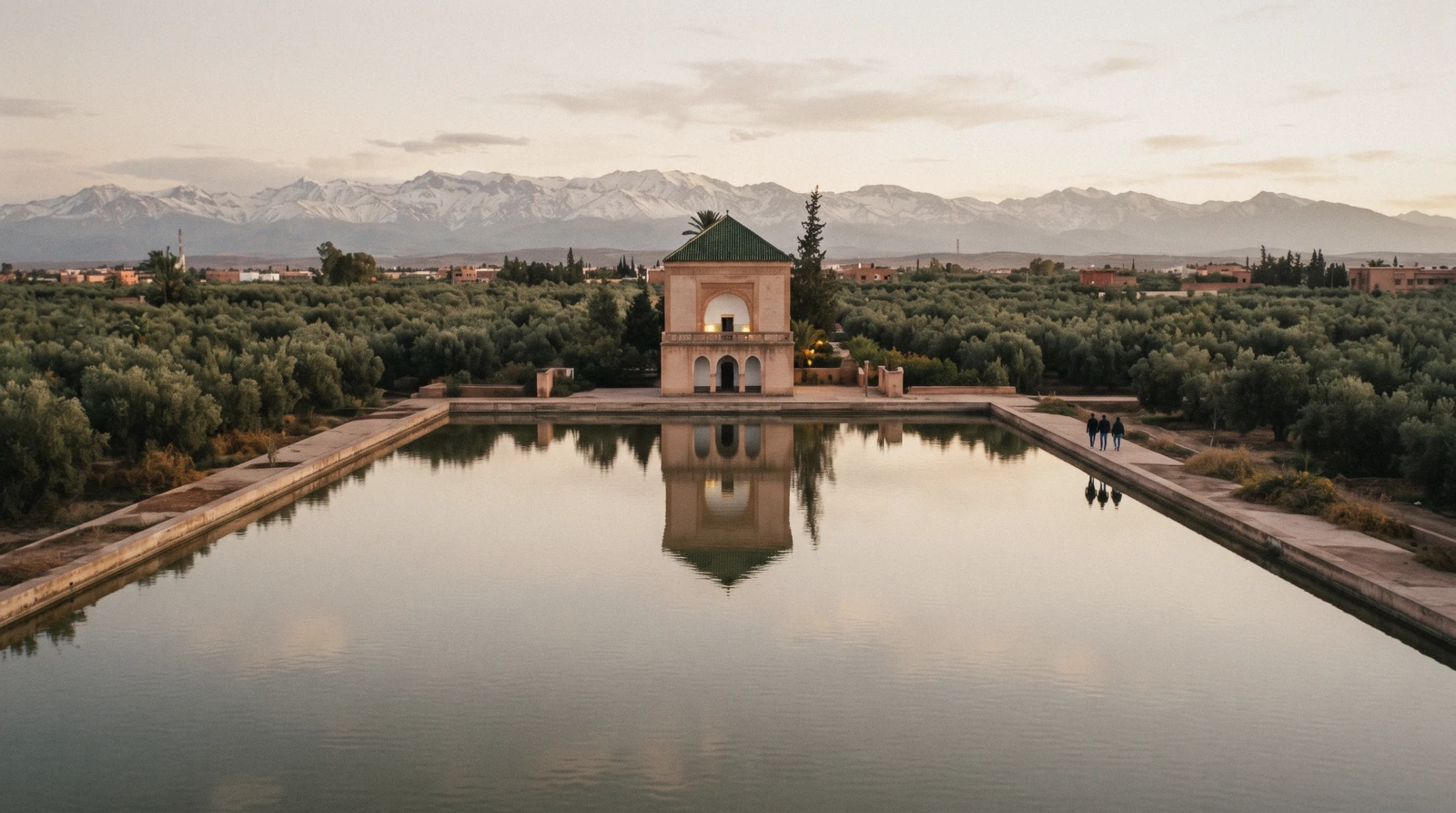
Menara Gardens
The Menara Gardens are the olive grove and the great irrigation basin west of the medina, with a small green-roofed pavilion standing at the water's edge and the Atlas rising behind it on a clear day. This page separates what an authority actually publishes about the Menara Gardens from what the internet repeats about them, which turns out to be two very different things. The other five green sites in the city are compared on the gardens hub, and the routes out here are on getting around. the Marrakech guide index is where the tickets, the districts and the itineraries meet.
Quick answer What is ticketed, what is not published, hours and how to get there
The Ministry of Culture sells one thing at the Menara: entry to the pavilion, at $6.39 (60 MAD) for a foreign adult, 09:00 to 17:00. That is lower than the $10.65 (100 MAD) the same Ministry charges at the Bahia Palace and the Saadian Tombs, and it is the only Menara price any authority publishes.
Key takeaways
- No Moroccan official body publishes an entry fee for the garden itself, and none publishes a statement that the garden is free. Every page telling you it is free is repeating an unsourced claim, so carry small change
- Reduced pavilion fares are $3.20 (30 MAD) for a Moroccan or resident adult and for a foreign child of 7 to 13, and $1.07 (10 MAD) for a Moroccan or resident child
- No GetYourGuide product sells the Menara. The nearest thing is a tailor-made private guide you can point at it, or a taxi; the pavilion ticket is bought straight from the Ministry
- UNESCO names the Menara in its own description of the Medina of Marrakesh inscription, which is the reason the basin and the olive grove still exist inside a growing city
Key facts
Opening hours
| Pavilion, per the Ministry ticketing platform | 09:00–17:00 |
|---|
Closed Not stated. The Ministry platform publishes no closing day for the pavilion, and no authority publishes any hours at all for the garden and the basin
Admission
- Adult
- $6.39 (60 MAD) foreign adult, pavilion only
- Reduced
- $3.20 (30 MAD) Moroccan or resident adult; $3.20 (30 MAD) foreign child 7 to 13; $1.07 (10 MAD) Moroccan or resident child 7 to 13
- Free
- Moroccan nationals on Fridays and on the first days of national and religious holidays. No published fare exists for the garden itself, and no official statement that it is free
Planning it
- Time needed
- Not stated by any authority; our routing: 45 minutes for the basin and the pavilion, longer if you walk the olive grove
- Book ahead
- Optional — walk-up usually fine
- Address
- Avenue de la Menara, Marrakech
The Ministry of Culture's Khadamat Culture platform is the only official shop here and it sells the pavilion alone, at the fares read on the platform in Q3 2026. Nothing on any booking platform sells the Menara as a product, so the second row below is the only realistic paid alternative: a private guide whose route you choose. Prices for the tour move with the date and the length you pick.
Are you paying to go inside the pavilion, or just going to look at the basin?
| Option | Price | Includes | Cancel | Book |
|---|---|---|---|---|
| Pavilion ticket, Ministry of CultureAnyone who wants to go inside and up to the room above the water. Buy on the platform or at the gate | $6.39 (60 MAD) foreign adult; $3.20 (30 MAD) foreign child 7-13 | Entry to the pavilion, 09:00 to 17:00 | Not stated | Official site |
| Tailor-made private guide, half or full dayVisitors who want the Menara explained alongside the medina, and who are content to pay gate fees separately | From $66.35, entry fees extra | A licensed private guide and pickup; you name the stops | Free up to 24 hours before | Check Availability |
The pavilion tariff is the Ministry's own published grid: 60 MAD foreign adult, 30 MAD Moroccan or resident adult, 30 MAD foreign child aged 7 to 13, 10 MAD Moroccan or resident child. Moroccan nationals enter free on Fridays and on the first days of national and religious holidays; visitors do not. There is no combined ticket with any other Marrakech monument, because four separate authorities sell them, as the tickets hub sets out.
Getting out to the Menara, and what is actually bookable
No operator on GetYourGuide sells a Menara ticket or a Menara tour, which is unusual for a site this famous and is worth saying plainly rather than filling the page with substitutes. The three cards below are what exists: a private guide who will include it, a tuk-tuk circuit that passes it, and the airport transfer that matters because the gardens sit fifteen minutes from the runway. Prices as listed in Q3 2026.
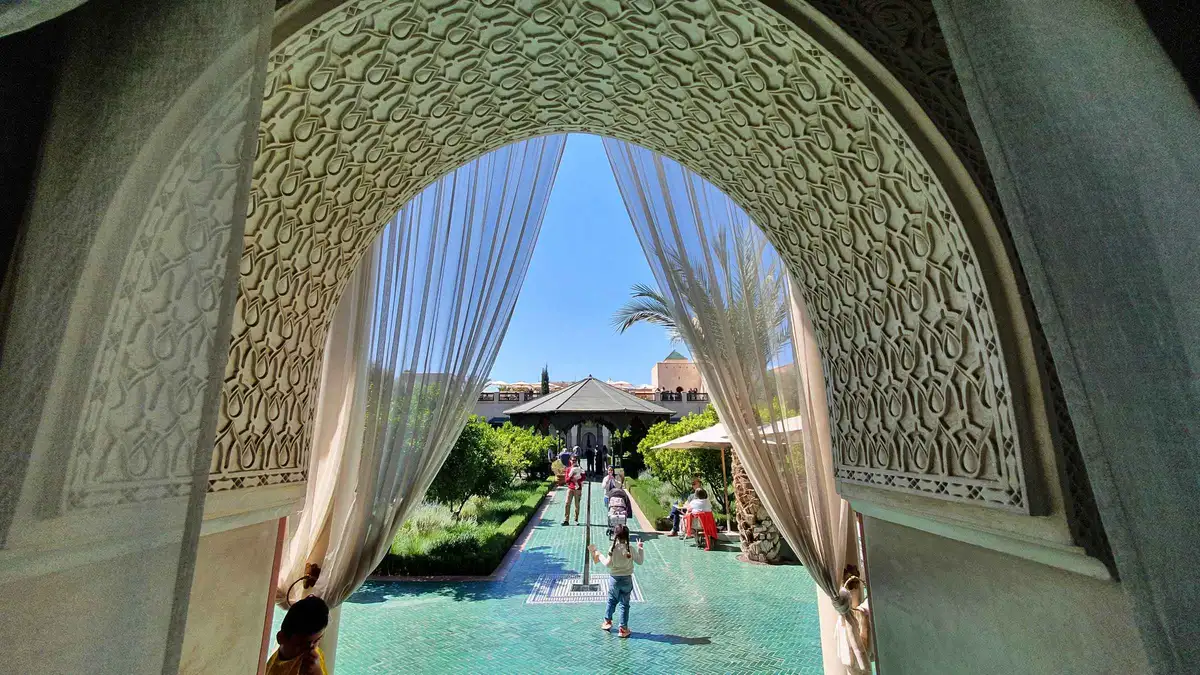 from $66.35
Marrakech: Tailor-Made City Tour With Your Own Private Guide
listed at $66.35
Half or full-day private tour built around what you ask to see, with pickup included. Up to two sights on the half-day and four on the full day; entrance fees are not included.
Check Availability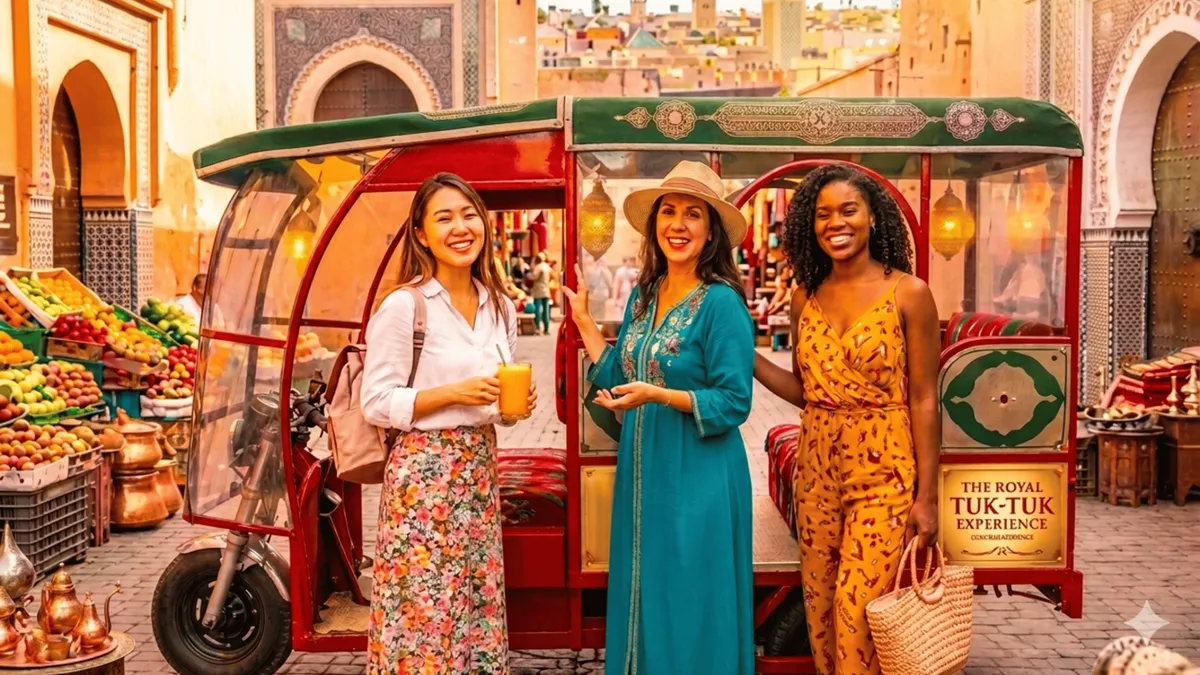 from $16
Tuk Tuk Marrakech Private Tour: Audio guide, Gift & Pastries
listed at $16
One to three-hour private tuk-tuk circuit with an audio guide, pastries and a gift; a driver, not a guide, is provided. Monument tickets are not included and Majorelle tickets have to be bought online first.
Check Availability from $8.29
Marrakech: Private Transfer to/from RAK Menara Airport
listed at $8.29
Private transfer between Menara airport and your Marrakech address, about 20 minutes. Vehicles cannot enter parts of the medina, so the drop-off can leave a 5-10 minute walk with luggage.
Check AvailabilityPrices, ratings and details are the platform's own, checked in Q3 2026; dollar figures are the listed prices — the platform bills in your account's currency.
What The Menara Is: A Reservoir, Not A Park
The thing most first-time visitors misread is the function. This is agricultural infrastructure with a summer house on the end of it, and understanding that changes what you look at.
The basin, the grove and the water system
The centre of the site is a large rectangular basin, an irrigation reservoir fed from the mountains, surrounded by an olive grove. The water is there to be used, not admired: it fed the plantations that supplied the city. The pavilion at one end, with its green pyramidal roof, is a later garden building that gives the basin its postcard.
That is why the Menara looks nothing like the Jardin Majorelle or Le Jardin Secret. Those are designed gardens with planting schemes. This is a working landscape with a view attached, and the view is the reason to come: the pavilion doubled in the water, with the Atlas behind it when the air is clear, usually in winter and early spring.
Why it survived the city growing around it
The Menara is named in UNESCO's own texts on the Medina of Marrakesh inscription. The World Heritage Committee's decision asked Morocco to protect the surroundings of Marrakech, and named the palm grove, the Menara and the gardens of Bab Djedid, by strictly enforcing the management plan adopted for them. UNESCO's statement of outstanding universal value for the property describes the natural setting as notably the gardens of Aguedal, the Menara and the palm grove, whose plantation it attributes to the Almoravids.
So the protection is real and it is documented, but note what it is: a heritage instruction about the surroundings of the inscribed medina, not a national decree we could obtain, and not a visitor-facing management regime. The Palmeraie sits under exactly the same sentence and the same silence.
Are The Menara Gardens Free? What Nobody Publishes
This is the most asked question about the site and the most confidently answered one online. Here is what we could and could not source.
The Ministry of Culture sells the pavilion. Its platform page carries the four fares, the hours of 09:00 to 17:00, the free-entry rule for Moroccan nationals and the coordinates. It says nothing whatsoever about the garden, the basin or the grove.
We went looking for the garden's own status on the commune's site, on the regional tourism council's official destination guide and on the Ministry's platform. No Moroccan official body publishes an entry fee for the Menara garden. No Moroccan official body publishes a statement that the garden is free either. The claim that the gardens are free is universally repeated and, as far as any official source goes, unsupported.
What that means in practice is simple and slightly annoying: turn up with small change in dirhams. If there is nothing to pay you have lost nothing; if a gate or a parking attendant asks for something, you are not standing there arguing with an authority that has published no tariff to argue against. The same principle covers the caleche at the rank and the parking attendants across the city, and the safety and scams page explains why an unpublished price is the recurring theme of money in Marrakech rather than an exception.
- Published: the pavilion fares of 60, 30, 30 and 10 MAD and the hours 09:00 to 17:00 (Ministry of Culture platform)
- Published: Moroccan nationals free at the pavilion on Fridays and the first days of national and religious holidays
- NOT published: any entry fee for the garden and basin
- NOT published: any statement that the garden and basin are free
- NOT published: opening or closing hours for the garden, by anyone
The Pavilion Ticket, And Why It Costs Less Than The Palaces
Sixty dirhams for a foreign adult looks like a rounding error next to the rest of the Ministry's grid, and the difference is worth understanding before you decide whether to go inside.
The same Ministry of Culture charges a foreign adult $10.65 (100 MAD) at the Bahia Palace, the El Badi Palace, the Saadian Tombs and the Almoravid Koubba. At the Menara pavilion it charges $6.39 (60 MAD). The child fare follows the same discount, $3.20 (30 MAD) here against $5.33 (50 MAD) at the four medina monuments.
What you get for it is a small building, a staircase and a room looking straight down the length of the water. It is a fifteen-minute visit and the honest reason to buy it is the view from inside, which is the composition every photograph of the Menara uses and which you cannot quite reach from the bank.
| Ministry of Culture site | Foreign adult | Foreign child 7-13 | Moroccan or resident adult |
|---|---|---|---|
| Menara pavilion | $6.39 (60 MAD) | $3.20 (30 MAD) | $3.20 (30 MAD) |
| Bahia Palace | $10.65 (100 MAD) | $5.33 (50 MAD) | $3.20 (30 MAD) |
| El Badi Palace | $10.65 (100 MAD) | $5.33 (50 MAD) | $3.20 (30 MAD) |
| Saadian Tombs | $10.65 (100 MAD) | $5.33 (50 MAD) | $3.20 (30 MAD) |
| Almoravid Koubba | $10.65 (100 MAD) | $5.33 (50 MAD) | $3.20 (30 MAD) |
The grid above is read off the Ministry's own ticketing platform in Q3 2026 and it carries the fact that decides a Friday: Moroccan nationals enter these sites free on Fridays and on the first day of national and religious holidays, and visitors do not. That asymmetry is set out in full on the Friday and holiday openings page.
How To Get To The Menara, And What Each Route Costs
The gardens are about three kilometres west of Jemaa el-Fna on Avenue de la Menara, and roughly the same distance from the airport terminal. Every route has a published problem.
The petit taxi is the default. The meter is compulsory under the Dahir of 12 November 1963, restated by Ministry of the Interior circulars, and each city's rates are fixed by a local order of the wali. Marrakech has never published that order online: not the commune, not the wilaya, not the ministry. So the fare is a real number set by a real authority that no visitor can look up, and the only protection is insisting the meter runs. Do not use the figures blogs quote, and read getting around before your first ride.
The caleche is the other classic approach, and the Menara circuit is one of the routes the ranks offer. The trade is regulated under a permanent municipal order dating from 1935, horses carry a branded number, a bracelet and a microchip, and the fleet faces three mandatory inspections a year with SPANA and SOREC. No tariff is published for that either; every price you will be quoted comes from the driver. The main rank is at Place Foucauld beside Jemaa el-Fna.
The city bus is the cheap route and the least certain one. Supratours, a subsidiary of the national rail operator ONCF, took over the Marrakech network on 14 December 2025, replacing ALSA after 26 years, and no post-handover fare table has been published. The last officially published urban fare is 4 MAD. Every ALSA timetable still circulating online is stale.
The one route with a real number is the airport, and it is relevant here because the Menara sits between the city and the runway. A private transfer lists at $8.29, and the airport to city page sets out the two conflicting official taxi figures that make that number worth having in advance.
| Route | What is published | What is not | Our reading |
|---|---|---|---|
| Petit taxi from the medina | The meter is compulsory by law | The Marrakech tariff order, anywhere online | Insist on the meter; agree nothing in advance |
| Caleche from Place Foucauld | The 1935 control order, the welfare inspections | Any fare at all | A sightseeing choice, not a transport one |
| City bus | 4 MAD, from the pre-handover period | Any Supratours fare or timetable since the December 2025 handover | Cheap if it runs; do not build a schedule on it |
| Private car with driver | Operator prices on the platform | Nothing relevant | Worth it when the Menara is one stop of several |
| On foot from Jemaa el-Fna | Nothing | Nothing | About 3 km along busy avenues; not a pleasant walk in summer |
When To Go: Light, Heat And The Atlas View
There is no shade to speak of on the bank of the basin, and the climate figures below decide the hour you should be standing there.
The thirty-year ERA5 series for Marrakech, computed from 1995 to 2024, gives July a mean daily high of 36.6C and August 36.2C, with January at 18.1C and a mean daily low of 3.8C. In July and August the middle of the day at an unshaded reservoir is not a sightseeing proposition; go in the first hour after 09:00 or in the last hour before the light goes.
The Atlas view is a winter and early spring thing. The snow line behind the pavilion needs clear air, and the wettest month in the series is March at 37.3 mm across 5.8 rain days, which is also when the mountains look their best from the bank. July is the driest month at 2.7 mm, and also the one where the haze is worst.
Late afternoon is when Marrakech families come out here, which is the other reason to pick it: the Menara is one of the few places on a visitor's list where the crowd is local. The best time to visit page has the full month-by-month series.
- Best light on the pavilion and the reflection: the last hour before sunset
- Stillest water: early, before the wind gets up
- Best chance of the Atlas behind the roof: clear winter and early spring days
- Worst hour: midday from June to September, when there is no shade on the bank
Five Things Most Visitors Do Not Know About The Menara
Each of these comes from an official platform or a UNESCO document, and each one changes what you do when you get there.
- The Ministry sells the pavilion, not the garden. Its platform page covers one building and is silent on the basin, the grove and the gates [e-services.minculture.gov.ma, pavilion page, read in Q3 2026]. - Nobody official says the garden is free. No Moroccan authority publishes a garden fee, and none publishes a statement that there is no fee; the universal claim online has no source behind it [commune, regional destination guide and Ministry platform, all checked in Q3 2026]. - The pavilion is the Ministry's cheapest Marrakech ticket, at 60 MAD against 100 MAD at Bahia, El Badi, the Saadian Tombs and the Almoravid Koubba [Ministry ticketing platform tariff pages]. - UNESCO named the Menara in the inscription decision for the medina, asking Morocco to protect the surroundings of the city, in particular the palm grove, the Menara and the gardens of Bab Djedid [World Heritage Committee report SC-85/CONF.008/9]. - Moroccan nationals enter free on Fridays and on the first days of national and religious holidays, and visitors do not, which is why a Friday morning here looks busier than the ticket sales suggest [Ministry ticketing platform].
At The Menara: What To Do, And What Not To
Each line is argued above and each is something you decide before you get in the taxi.
Do
- Carry small dirham notes, because no published tariff exists for anything except the pavilion
- Buy the pavilion ticket if you want the view down the water from inside the building
- Go in the first or last hour of daylight, when the bank is bearable and the reflection works
- Insist the taxi meter runs, on the way out and on the way back
- Pair it with the airport run if you have a late flight and a free afternoon
Don't
- Don't plan a midday summer visit: the ERA5 series puts July at a 36.6C mean daily high and there is no shade on the bank
- Don't expect a designed garden here; for planting go to Le Jardin Secret or Majorelle
- Don't rely on a bus timetable found online, because every one of them predates the December 2025 operator handover
- Don't accept a caleche price as an official rate, because no caleche tariff is published anywhere
- Don't assume the pavilion is open when the garden is: the only published hours, 09:00 to 17:00, are the pavilion's
Menara Gardens map: the basin, the pavilion and the way out here
The pavilion coordinate comes from the Ministry of Culture's own ticket page; the second marker is Wikidata's coordinate for the garden as a whole, which sits a few hundred metres away and is why map apps disagree about where the Menara is.
Coordinates: the Ministry of Culture ticketing platform for the pavilion; Wikidata Q1920259 for the garden; Wikidata for the Koutoubia, the square and Hivernage.
Next stop from the Menara
Distances are straight-line readings from the coordinates above; allow more in traffic, which on Avenue Mohammed VI is most of the day.
Hivernage
The hotel and nightlife quarter between the Menara and the walls, and the district most people are actually staying in when they take a taxi out here. Hivernage has the pavement width the medina does not.
About 2 km eastKoutoubia mosque
The minaret you navigate the whole city by, with rose gardens behind it that cost nothing to walk in. Nobody sells a ticket to any of it. The Koutoubia page explains what non-Muslim visitors can and cannot enter.
About 3 km eastThe gardens hub
The Menara is the cheapest thing on the list and the one with the least published about it. The gardens hub puts all six side by side with their fares, their hours and who sets them.
The other five green sitesMenara Gardens questions
Are the Menara Gardens free?
No authority publishes an entry fee for the garden, and no authority publishes a statement that it is free either. The Ministry of Culture sells the pavilion at $6.39 (60 MAD) for a foreign adult and says nothing about the grounds. Treat the widely repeated claim as unsourced, carry small change, and see what a day in Marrakech costs.
What are the Menara pavilion opening hours?
09:00 to 17:00, as published on the Ministry of Culture ticketing platform, with no closing day stated. No hours at all are published for the garden and the basin, by anyone. If you are coming for the light rather than the building, the best time to visit page has the seasonal detail.
How much is a ticket for the Menara pavilion?
$6.39 (60 MAD) for a foreign adult, $3.20 (30 MAD) for a foreign child aged 7 to 13, $3.20 (30 MAD) for a Moroccan or resident adult and $1.07 (10 MAD) for a Moroccan or resident child. Buy it on the Ministry platform or at the gate. It is the Ministry's cheapest Marrakech ticket; the tickets hub shows the rest of the grid.
Are the Menara Gardens worth visiting?
For the pavilion doubled in the basin with the Atlas behind it, yes, and it is one of the few places on a visitor's list where the late-afternoon crowd is local. For planting, no: this is a reservoir in an olive grove, and the designed gardens are Le Jardin Secret inside the walls and ANIMA out on the Ourika road.
How do I get to the Menara from Jemaa el-Fna?
About three kilometres west, so a petit taxi with the meter running, a caleche from the Place Foucauld rank as a sightseeing choice, or a city bus whose fares have not been republished since the operator changed in December 2025. Walking it along the avenues is possible and unpleasant in summer. Getting around covers all four.
Can you see the Atlas Mountains from the Menara?
On a clear day, yes: the snow line sits behind the pavilion roof and it is the composition every photograph of the site uses. Winter and early spring give the best air; the summer haze usually hides it. A private guide will time the stop for the light if you ask.
Is there anything to do at the Menara with children?
It is a large flat open space to walk in, which is worth something after a morning in the souk lanes, and the pavilion ticket for a foreign child aged 7 to 13 is $3.20 (30 MAD). There is no playground, no shade on the bank and no published facilities. Marrakech with kids sets out where the shade and the seats actually are.
Where the Menara fits in a Marrakech day
The Menara is a late-afternoon stop or a departure-day one, not a morning. Give the morning to the ticketed monuments inside the walls, where the doors shut earlier than you expect, and come out here when the light drops. If you are flying that evening, the gardens sit between the city and the terminal, so a private transfer with a stop written in makes more sense than a return taxi.
The two-day itinerary uses it exactly that way, the gardens hub puts it against the other five green sites, and things to do in Marrakech ranks it against everything else in the city.
The Menara On Film: The Basin, The Pavilion And The Grove
Three walk-throughs that show the scale of the site, which photographs never do: the basin is much bigger and the pavilion much smaller than the postcard suggests.
A Walk Through MENARA GARDENS, MARRAKECH - Ancient Oasis
A full walk from the entrance to the basin, useful for judging the distances on the ground.
Video: iTraveLXVisiting the Menara Gardens in Marrakesh | Morocco | DJI Pocket 2 | 4K
Steady 4K footage of the pavilion and the water, filmed in good light.
Video: Wandering togetherMenara Gardens Tour | Marrakech's Most Popular Gardens | Travel Morocco
A tour of the grove and the bank, showing how local the late crowd is.
Video: Ahmed DawnVideos load from YouTube only when you press play.
Reviewed Q3 2026 (July–September 2026); next review Q4 2026. Prices, hours and terms are set by the venue or operator and confirmed at checkout.
We may earn a commission if you book through one of our links, at no extra cost to you. Full affiliate disclosure